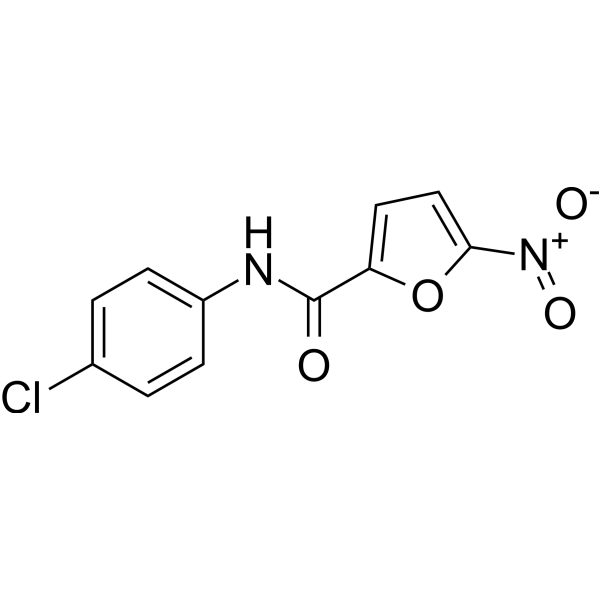
Physicochemical Properties
| Molecular Formula | C11H7N2O4CL |
| Molecular Weight | 266.637 |
| Exact Mass | 266.009 |
| CAS # | 109844-92-0 |
| PubChem CID | 844044 |
| Appearance | Light yellow to yellow solid powder |
| LogP | 3.689 |
| Hydrogen Bond Donor Count | 1 |
| Hydrogen Bond Acceptor Count | 4 |
| Rotatable Bond Count | 2 |
| Heavy Atom Count | 18 |
| Complexity | 326 |
| Defined Atom Stereocenter Count | 0 |
| InChi Key | JDBZJNUHQINERI-UHFFFAOYSA-N |
| InChi Code | InChI=1S/C11H7ClN2O4/c12-7-1-3-8(4-2-7)13-11(15)9-5-6-10(18-9)14(16)17/h1-6H,(H,13,15) |
| Chemical Name | N-(4-chlorophenyl)-5-nitrofuran-2-carboxamide |
| HS Tariff Code | 2934.99.9001 |
| Storage |
Powder-20°C 3 years 4°C 2 years In solvent -80°C 6 months -20°C 1 month |
| Shipping Condition | Room temperature (This product is stable at ambient temperature for a few days during ordinary shipping and time spent in Customs) |
Biological Activity
| ln Vitro | While untransformed lung cells are not inhibited by LCS3 (5 nM–10 µM; 96 hours), lung cancer cell lines are [1]. Sensitive lung adenocarcinoma cells (LUAD) are activated via the NRF2 pathway and ROS production by LCS3 (3 µM) at 3, 6, and 12 hours [1]. LCS3 (3 µM; 96 hours) selectively kills cell lines of lung adenocarcinoma (LUAD), partly through apoptosis induction [1]. |
| Cell Assay |
Cell Viability Assay[1] Cell Types: Non-small cell lung cancer (NSCLC) cells and non-transformed lung cells Tested Concentrations: 5 nM-10 µM Incubation Duration: 96 hrs (hours) Experimental Results: Inhibited growth of 24/25 NSCLC cell lines at low micromolar concentrations (IC50 <5μM), two non-transformed lung cell lines were relatively insensitive (IC50>10μM). Cell viability assay[1] Cell Types: H23 and H1650 Cell Tested Concentrations: 3 µM Incubation Duration: 3, 6 and 12 hrs (hours) Experimental Results: Respond to LCS3 by accumulating ROS and activating the NRF2 transcriptional program. Apoptosis analysis[1] Cell Types: Lung adenocarcinoma (LUAD) Cell Tested Concentrations: 3 µM Incubation Duration: 96 hrs (hours) Experimental Results: Increased cleavage of caspase 3, caspase 7 and/or PARP1 in all LCS3-sensitive LUAD cell lines. Western Blot Analysis[1] Cell Types: H23 and H1650 Cell Tested Concentrations: 3 µM Incubation Duration: 24 hrs (hours) Experimental Results: Protein levels of NRF2 and selected NRF2 downstream target products increased in both cell lines. |
| References |
[1]. Characterization of a small molecule inhibitor of disulfide reductases that induces oxidative stress and lethality in lung cancer cells. Cell Rep. 2022 Feb 8;38(6):110343. |
Solubility Data
| Solubility (In Vitro) | DMSO : ~125 mg/mL (~468.80 mM) |
| Solubility (In Vivo) |
Solubility in Formulation 1: ≥ 2.5 mg/mL (9.38 mM) (saturation unknown) in 10% DMSO + 40% PEG300 +5% Tween-80 + 45% Saline (add these co-solvents sequentially from left to right, and one by one), clear solution. For example, if 1 mL of working solution is to be prepared, you can add 100 μL of 25.0 mg/mL clear DMSO stock solution to 400 μL PEG300 and mix evenly; then add 50 μL Tween-80 + to the above solution and mix evenly; then add 450 μL normal saline to adjust the volume to 1 mL. Preparation of saline: Dissolve 0.9 g of sodium chloride in 100 mL ddH₂ O to obtain a clear solution. (Please use freshly prepared in vivo formulations for optimal results.) |
| Preparing Stock Solutions | 1 mg | 5 mg | 10 mg | |
| 1 mM | 3.7504 mL | 18.7519 mL | 37.5038 mL | |
| 5 mM | 0.7501 mL | 3.7504 mL | 7.5008 mL | |
| 10 mM | 0.3750 mL | 1.8752 mL | 3.7504 mL |