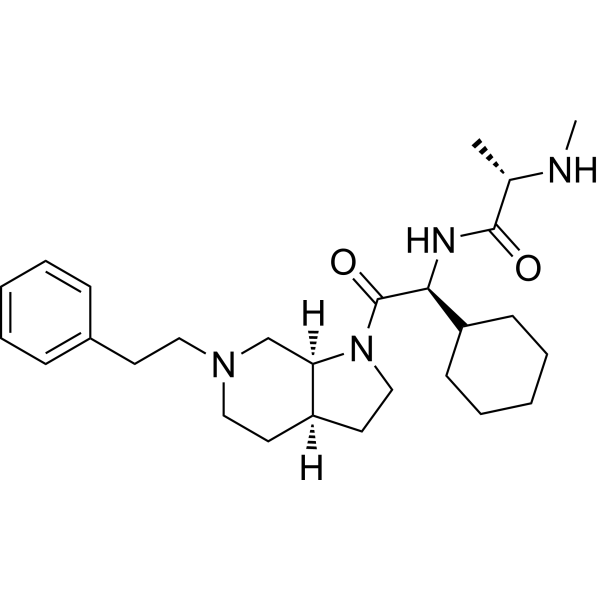
Physicochemical Properties
| Molecular Formula | C27H42N4O2 |
| Molecular Weight | 454.65 |
| Exact Mass | 454.331 |
| CAS # | 867324-12-7 |
| PubChem CID | 11503417 |
| Appearance | Typically exists as solid at room temperature |
| LogP | 3.482 |
| Hydrogen Bond Donor Count | 2 |
| Hydrogen Bond Acceptor Count | 4 |
| Rotatable Bond Count | 8 |
| Heavy Atom Count | 33 |
| Complexity | 644 |
| Defined Atom Stereocenter Count | 4 |
| SMILES | C(N[C@@H](C1CCCCC1)C(N1[C@@]2([H])[C@@]([H])(CC1)CCN(CCC1=CC=CC=C1)C2)=O)(=O)[C@@H](NC)C |
| InChi Key | HCSMRSHIIKPNAK-LSAVBLLPSA-N |
| InChi Code | InChI=1S/C27H42N4O2/c1-20(28-2)26(32)29-25(23-11-7-4-8-12-23)27(33)31-18-15-22-14-17-30(19-24(22)31)16-13-21-9-5-3-6-10-21/h3,5-6,9-10,20,22-25,28H,4,7-8,11-19H2,1-2H3,(H,29,32)/t20-,22+,24+,25-/m0/s1 |
| Chemical Name | (2S)-N-[(1S)-2-[(3aR,7aS)-6-(2-phenylethyl)-3,3a,4,5,7,7a-hexahydro-2H-pyrrolo[2,3-c]pyridin-1-yl]-1-cyclohexyl-2-oxoethyl]-2-(methylamino)propanamide |
| Synonyms | LBW-242; LBW 242; LBW242 |
| HS Tariff Code | 2934.99.9001 |
| Storage |
Powder-20°C 3 years 4°C 2 years In solvent -80°C 6 months -20°C 1 month |
| Shipping Condition | Room temperature (This product is stable at ambient temperature for a few days during ordinary shipping and time spent in Customs) |
Biological Activity
| ln Vitro | Based on Smac's capacity to neutralize the BIR3 domain of X-linked IAP (XIAP) using its NH2-terminal seven amino acids, LBW242 is a 3-mer and Smac mimic. The FLT3 mutant strain MV4;11 is partially inhibited in its development by LBW242 at 1 μM [1]. In a purely caspase-dependent way, LBW242 causes cell death, which is accompanied by annexin positivity, PARP cleavage, and an accumulation of cells in the sub-G1 phase [1]. A panel of PKC412-sensitive or PKC412-resistant Ba/F3 lines expressing mutant FLT3 are inhibited by LBW242 (0-0.1 μM; 3 days). The range of IC50 values is 0.5–>1 μM [1]. |
| ln Vivo | Tumor burden is decreased by LBW242 (50 mg/kg; oral; once daily for 10 days) [1]. |
| Cell Assay |
Cell viability assay [1] Cell Types: FLT3-ITD-Ba/F3 cells and mutant FLT3 expressing cells, A627T-FLT3-Ba/F3, F691IFLT3-Ba/F3 and N676D-FLT3-Ba/F3 cells Tested Concentrations: 0.001, 0.01, 0.1 μM Incubation Duration: 3 days Experimental Results: Inhibition of a group of PKC412-sensitive or PKC412-resistant Ba/F3 lines expressing mutant FLT3 with IC50 values ranging from 0.5 to >1 μM. |
| Animal Protocol |
Animal/Disease Models: NCR nude mice were inoculated with FLT3-ITD-Ba/F3 cells [1]. Doses: 50 mg/kg. Route of Administration: po (oral gavage); one time/day for 10 days. Experimental Results: Effectively diminished tumor load. |
| References |
[1]. Potentiation of antileukemic therapies by Smac mimetic, LBW242: effects on mutant FLT3-expressing cells. Mol Cancer Ther. 2007 Jul;6(7):1951-61. [2]. A small molecule SMAC mimic LBW242 potentiates TRAIL- and anticancer drug-mediated cell death of ovarian cancer cells. PLoS One. 2012;7(4):e35073. |
Solubility Data
| Solubility (In Vitro) | May dissolve in DMSO (in most cases), if not, try other solvents such as H2O, Ethanol, or DMF with a minute amount of products to avoid loss of samples |
| Solubility (In Vivo) |
Note: Listed below are some common formulations that may be used to formulate products with low water solubility (e.g. < 1 mg/mL), you may test these formulations using a minute amount of products to avoid loss of samples. Injection Formulations (e.g. IP/IV/IM/SC) Injection Formulation 1: DMSO : Tween 80: Saline = 10 : 5 : 85 (i.e. 100 μL DMSO stock solution → 50 μL Tween 80 → 850 μL Saline) *Preparation of saline: Dissolve 0.9 g of sodium chloride in 100 mL ddH ₂ O to obtain a clear solution. Injection Formulation 2: DMSO : PEG300 :Tween 80 : Saline = 10 : 40 : 5 : 45 (i.e. 100 μL DMSO → 400 μLPEG300 → 50 μL Tween 80 → 450 μL Saline) Injection Formulation 3: DMSO : Corn oil = 10 : 90 (i.e. 100 μL DMSO → 900 μL Corn oil) Example: Take the Injection Formulation 3 (DMSO : Corn oil = 10 : 90) as an example, if 1 mL of 2.5 mg/mL working solution is to be prepared, you can take 100 μL 25 mg/mL DMSO stock solution and add to 900 μL corn oil, mix well to obtain a clear or suspension solution (2.5 mg/mL, ready for use in animals). Injection Formulation 4: DMSO : 20% SBE-β-CD in saline = 10 : 90 [i.e. 100 μL DMSO → 900 μL (20% SBE-β-CD in saline)] *Preparation of 20% SBE-β-CD in Saline (4°C,1 week): Dissolve 2 g SBE-β-CD in 10 mL saline to obtain a clear solution. Injection Formulation 5: 2-Hydroxypropyl-β-cyclodextrin : Saline = 50 : 50 (i.e. 500 μL 2-Hydroxypropyl-β-cyclodextrin → 500 μL Saline) Injection Formulation 6: DMSO : PEG300 : castor oil : Saline = 5 : 10 : 20 : 65 (i.e. 50 μL DMSO → 100 μLPEG300 → 200 μL castor oil → 650 μL Saline) Injection Formulation 7: Ethanol : Cremophor : Saline = 10: 10 : 80 (i.e. 100 μL Ethanol → 100 μL Cremophor → 800 μL Saline) Injection Formulation 8: Dissolve in Cremophor/Ethanol (50 : 50), then diluted by Saline Injection Formulation 9: EtOH : Corn oil = 10 : 90 (i.e. 100 μL EtOH → 900 μL Corn oil) Injection Formulation 10: EtOH : PEG300:Tween 80 : Saline = 10 : 40 : 5 : 45 (i.e. 100 μL EtOH → 400 μLPEG300 → 50 μL Tween 80 → 450 μL Saline) Oral Formulations Oral Formulation 1: Suspend in 0.5% CMC Na (carboxymethylcellulose sodium) Oral Formulation 2: Suspend in 0.5% Carboxymethyl cellulose Example: Take the Oral Formulation 1 (Suspend in 0.5% CMC Na) as an example, if 100 mL of 2.5 mg/mL working solution is to be prepared, you can first prepare 0.5% CMC Na solution by measuring 0.5 g CMC Na and dissolve it in 100 mL ddH2O to obtain a clear solution; then add 250 mg of the product to 100 mL 0.5% CMC Na solution, to make the suspension solution (2.5 mg/mL, ready for use in animals). Oral Formulation 3: Dissolved in PEG400 Oral Formulation 4: Suspend in 0.2% Carboxymethyl cellulose Oral Formulation 5: Dissolve in 0.25% Tween 80 and 0.5% Carboxymethyl cellulose Oral Formulation 6: Mixing with food powders Note: Please be aware that the above formulations are for reference only. InvivoChem strongly recommends customers to read literature methods/protocols carefully before determining which formulation you should use for in vivo studies, as different compounds have different solubility properties and have to be formulated differently. (Please use freshly prepared in vivo formulations for optimal results.) |
| Preparing Stock Solutions | 1 mg | 5 mg | 10 mg | |
| 1 mM | 2.1995 mL | 10.9975 mL | 21.9949 mL | |
| 5 mM | 0.4399 mL | 2.1995 mL | 4.3990 mL | |
| 10 mM | 0.2199 mL | 1.0997 mL | 2.1995 mL |