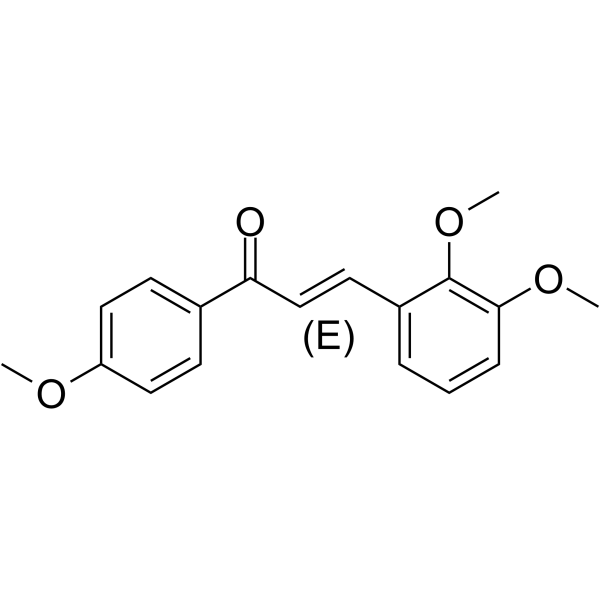
Physicochemical Properties
| Molecular Formula | C18H18O4 |
| Molecular Weight | 298.333125591278 |
| Exact Mass | 298.12 |
| CAS # | 24533-47-9 |
| PubChem CID | 5346378 |
| Appearance | White to off-white solid powder |
| LogP | 3.6 |
| Hydrogen Bond Donor Count | 0 |
| Hydrogen Bond Acceptor Count | 4 |
| Rotatable Bond Count | 6 |
| Heavy Atom Count | 22 |
| Complexity | 371 |
| Defined Atom Stereocenter Count | 0 |
| SMILES | C(C1=CC=C(OC)C=C1)(=O)/C=C/C1=CC=CC(OC)=C1OC |
| InChi Key | IECVLMVZGCYCSZ-FMIVXFBMSA-N |
| InChi Code | InChI=1S/C18H18O4/c1-20-15-10-7-13(8-11-15)16(19)12-9-14-5-4-6-17(21-2)18(14)22-3/h4-12H,1-3H3/b12-9+ |
| Chemical Name | (E)-3-(2,3-dimethoxyphenyl)-1-(4-methoxyphenyl)prop-2-en-1-one |
| HS Tariff Code | 2934.99.9001 |
| Storage |
Powder-20°C 3 years 4°C 2 years In solvent -80°C 6 months -20°C 1 month |
| Shipping Condition | Room temperature (This product is stable at ambient temperature for a few days during ordinary shipping and time spent in Customs) |
Biological Activity
| ln Vitro | In RAW264.7 cells, EtOH + LPS-induced apoptosis and mitochondrial damage are inhibited by L6H21 (10 μM, 2 hours) [1]. Attenuating EtOH + LPS-induced ROS generation and TLR4–NF-κB activation, as well as reducing NLRP3 inflammasome activation, are the effects of L6H21 (10 μM, 2 hours) [1]. |
| ln Vivo | Hepatic steatosis, liver damage, and EtOH + LPS-induced hepatic fat formation are all successfully inhibited by L6H21 (10 mg/kg, oral gavage, daily) [1]. L6H21 (0-40 mg/kg, orally, daily for 4 weeks) has been demonstrated to provide neuroprotective benefits in a prediabetes model and to attenuate metabolic derangements, restore cognition, and decrease brain pathology in HFD-fed rats in a dose- and time-dependent manner[2]. |
| Cell Assay |
Apoptosis analysis [1] Cell Types: RAW264.7 cells (mouse macrophage cell line) Tested Concentrations: 10 μM Incubation Duration: 2 hrs (hours) Experimental Results: The number of apoptotic cells was Dramatically diminished; complete inhibition of EtOH + LPS-induced Bax/Bcl -2 increase; Dramatically diminished the increase in cleaved caspase-3 protein induced by EtOH + LPS. Western Blot Analysis[1] Cell Types: RAW264.7 cells (mouse macrophage cell line) Tested Concentrations: 10 μM Incubation Duration: 2 hrs (hours) Experimental Results: EtOH + LPS-induced TLR4–NF-κB signaling is attenuated; complete inhibition of EtOH and LPS-induced increase in nuclear levels of TLR4 and NF-κB p65. Attenuate the expression of NLRP3 inflammasome induced by EtOH + LPS; inhibit the increase in NLRP3 and IL-1β protein expression; reduce the expression of p20 (an active form of caspase-1). Cell viability assay[1] Cell Types: RAW264.7 cells (mouse macrophage cell line) Tested Concentrations: 10 and 20 μM Incubation Duration: 2 hrs (hours) Experimental Results: L6H21 pretreatment prevents loss of cell viab |
| Animal Protocol |
Animal/Disease Models: Male C57BL6 mice (8-10 weeks old, n = 36, 8 mice per group, 25-30 g, containing EtOH and LPS) [1] Doses: 10 mg/kg Route of Administration: po (oral gavage), Daily, EtOH feeding results before Route of Administration: hepatic triglyceride (TG) concentration diminished, serum alanine aminotransferase (ALT) and aspartate aminotransferase (AST) levels Dramatically diminished; EtOH + LPS induction was Dramatically diminished Inflammation of liver tissue. Animal/Disease Models: Male Wistar rats (6-7 weeks old, 250 g, normal diet (ND) (n=8) or high-fat diet (HFD) (n=104) for 16 weeks) [2] Usage and Doses: 0, 10, 20 and 40 mg/kg Dosing: Orally one time/day for 1, 2 or 4 weeks Experimental Results: Brain mitochondrial dysfunction improved in HFD-fed rats at the 2-week dosing time point; Improves brain mitochondrial function in a dependent manner. Reduces prediabetic hippocampal cell apoptosis for 4 weeks. The reduction in dendritic spine volume and density persisted for 4 weeks. Preservation of microglial morphology in a |
| References |
[1]. Chalcone Derivative L6H21 Reduces EtOH + LPS-Induced Liver Injury Through Inhibition of NLRP3 Inflammasome Activation. Alcohol Clin Exp Res. 2019 Aug;43(8):1662-1671. [2]. L6H21 protects against cognitive impairment and brain pathologies via toll-like receptor 4-myeloid differentiation factor 2 signalling in prediabetic rats. Br J Pharmacol. 2022 Mar;179(6):1220-1236. [3]. MD-2 as the target of a novel small molecule, L6H21, in the attenuation of LPS-induced inflammatory response and sepsis. Br J Pharmacol. 2015 Sep;172(17):4391-405. |
Solubility Data
| Solubility (In Vitro) | May dissolve in DMSO (in most cases), if not, try other solvents such as H2O, Ethanol, or DMF with a minute amount of products to avoid loss of samples |
| Solubility (In Vivo) |
Note: Listed below are some common formulations that may be used to formulate products with low water solubility (e.g. < 1 mg/mL), you may test these formulations using a minute amount of products to avoid loss of samples. Injection Formulations (e.g. IP/IV/IM/SC) Injection Formulation 1: DMSO : Tween 80: Saline = 10 : 5 : 85 (i.e. 100 μL DMSO stock solution → 50 μL Tween 80 → 850 μL Saline) *Preparation of saline: Dissolve 0.9 g of sodium chloride in 100 mL ddH ₂ O to obtain a clear solution. Injection Formulation 2: DMSO : PEG300 :Tween 80 : Saline = 10 : 40 : 5 : 45 (i.e. 100 μL DMSO → 400 μLPEG300 → 50 μL Tween 80 → 450 μL Saline) Injection Formulation 3: DMSO : Corn oil = 10 : 90 (i.e. 100 μL DMSO → 900 μL Corn oil) Example: Take the Injection Formulation 3 (DMSO : Corn oil = 10 : 90) as an example, if 1 mL of 2.5 mg/mL working solution is to be prepared, you can take 100 μL 25 mg/mL DMSO stock solution and add to 900 μL corn oil, mix well to obtain a clear or suspension solution (2.5 mg/mL, ready for use in animals). Injection Formulation 4: DMSO : 20% SBE-β-CD in saline = 10 : 90 [i.e. 100 μL DMSO → 900 μL (20% SBE-β-CD in saline)] *Preparation of 20% SBE-β-CD in Saline (4°C,1 week): Dissolve 2 g SBE-β-CD in 10 mL saline to obtain a clear solution. Injection Formulation 5: 2-Hydroxypropyl-β-cyclodextrin : Saline = 50 : 50 (i.e. 500 μL 2-Hydroxypropyl-β-cyclodextrin → 500 μL Saline) Injection Formulation 6: DMSO : PEG300 : castor oil : Saline = 5 : 10 : 20 : 65 (i.e. 50 μL DMSO → 100 μLPEG300 → 200 μL castor oil → 650 μL Saline) Injection Formulation 7: Ethanol : Cremophor : Saline = 10: 10 : 80 (i.e. 100 μL Ethanol → 100 μL Cremophor → 800 μL Saline) Injection Formulation 8: Dissolve in Cremophor/Ethanol (50 : 50), then diluted by Saline Injection Formulation 9: EtOH : Corn oil = 10 : 90 (i.e. 100 μL EtOH → 900 μL Corn oil) Injection Formulation 10: EtOH : PEG300:Tween 80 : Saline = 10 : 40 : 5 : 45 (i.e. 100 μL EtOH → 400 μLPEG300 → 50 μL Tween 80 → 450 μL Saline) Oral Formulations Oral Formulation 1: Suspend in 0.5% CMC Na (carboxymethylcellulose sodium) Oral Formulation 2: Suspend in 0.5% Carboxymethyl cellulose Example: Take the Oral Formulation 1 (Suspend in 0.5% CMC Na) as an example, if 100 mL of 2.5 mg/mL working solution is to be prepared, you can first prepare 0.5% CMC Na solution by measuring 0.5 g CMC Na and dissolve it in 100 mL ddH2O to obtain a clear solution; then add 250 mg of the product to 100 mL 0.5% CMC Na solution, to make the suspension solution (2.5 mg/mL, ready for use in animals). Oral Formulation 3: Dissolved in PEG400 Oral Formulation 4: Suspend in 0.2% Carboxymethyl cellulose Oral Formulation 5: Dissolve in 0.25% Tween 80 and 0.5% Carboxymethyl cellulose Oral Formulation 6: Mixing with food powders Note: Please be aware that the above formulations are for reference only. InvivoChem strongly recommends customers to read literature methods/protocols carefully before determining which formulation you should use for in vivo studies, as different compounds have different solubility properties and have to be formulated differently. (Please use freshly prepared in vivo formulations for optimal results.) |
| Preparing Stock Solutions | 1 mg | 5 mg | 10 mg | |
| 1 mM | 3.3520 mL | 16.7600 mL | 33.5199 mL | |
| 5 mM | 0.6704 mL | 3.3520 mL | 6.7040 mL | |
| 10 mM | 0.3352 mL | 1.6760 mL | 3.3520 mL |