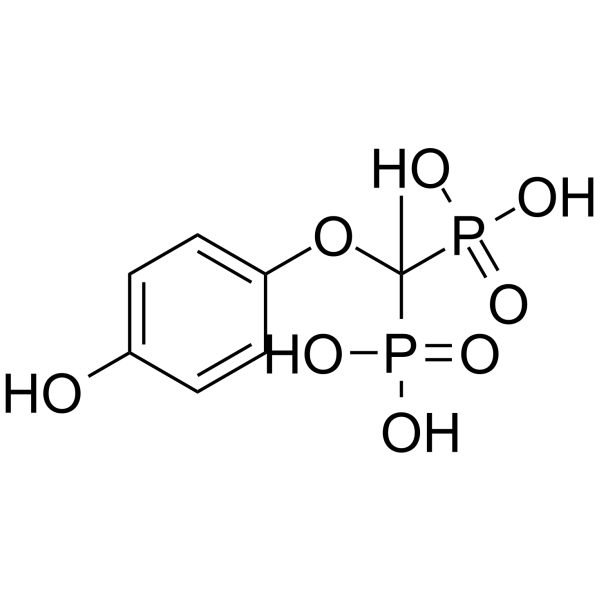
Physicochemical Properties
| Molecular Formula | C8H12O8P2 |
| Molecular Weight | 298.12 |
| Exact Mass | 298.001 |
| CAS # | 142523-38-4 |
| Related CAS # | L-690330 hydrate |
| PubChem CID | 132449 |
| Appearance | White to off-white solid powder |
| Density | 1.787g/cm3 |
| Boiling Point | 696.9ºC at 760mmHg |
| Flash Point | 375.3ºC |
| Vapour Pressure | 2.18E-20mmHg at 25°C |
| Index of Refraction | 1.629 |
| LogP | 0.8 |
| Hydrogen Bond Donor Count | 5 |
| Hydrogen Bond Acceptor Count | 8 |
| Rotatable Bond Count | 4 |
| Heavy Atom Count | 18 |
| Complexity | 355 |
| Defined Atom Stereocenter Count | 0 |
| InChi Key | JKOCAAWWDVHWKB-UHFFFAOYSA-N |
| InChi Code | InChI=1S/C8H12O8P2/c1-8(17(10,11)12,18(13,14)15)16-7-4-2-6(9)3-5-7/h2-5,9H,1H3,(H2,10,11,12)(H2,13,14,15) |
| Chemical Name | [1-(4-hydroxyphenoxy)-1-phosphonoethyl]phosphonic acid |
| Synonyms | L-690330; L 690330; L690330 |
| HS Tariff Code | 2934.99.9001 |
| Storage |
Powder-20°C 3 years 4°C 2 years In solvent -80°C 6 months -20°C 1 month Note: Please store this product in a sealed and protected environment, avoid exposure to moisture. |
| Shipping Condition | Room temperature (This product is stable at ambient temperature for a few days during ordinary shipping and time spent in Customs) |
Biological Activity
| ln Vitro | L-690330 (50 μM; 1 hour) enhances p-AMPK and LC3-I/II expression in HEK293 cells and stimulates P-AMPK and autophagy in cells [2]. |
| ln Vivo | L-690330 (intracerebroventricular injection; 0.1 μMol) They only lessen the amount of time in the light during the dark/light testing, but otherwise they had no influence on motor activity and coordination during beam walking [3]. |
| Cell Assay |
Western Blot analysis [2] Cell Types: HEK293 cells Tested Concentrations: 50 μM Incubation Duration: 1 hour Experimental Results: Increased LC3-I/II and p-AMPK protein levels. |
| Animal Protocol |
Animal/Disease Models: Eightweeks old male ICR mice [3] Doses: 0.1 μmol Route of Administration: Intracerebroventricular injection Experimental Results: ICV injection will not affect the health of mice. |
| References |
[1]. In vitro and in vivo inhibition of inositol monophosphatase by the bisphosphonate L-690,330. J Neurochem. 1993 Feb;60(2):652-8. [2]. Essential regulation of cell bioenergetics by constitutive InsP3 receptor Ca2+ transfer to mitochondria.Cell. 2010 Jul 23;142(2):270-83. [3]. The inositol monophosphatase inhibitor L-690,330 affects pilocarpine-behavior and the forced swim test.Psychopharmacology (Berl). 2013 Jun;227(3):503-8. |
| Additional Infomation | [1-(4-hydroxyphenoxy)-1-phosphonoethyl]phosphonic acid is a 1,1-bis(phosphonic acid). |
Solubility Data
| Solubility (In Vitro) |
H2O : ~33.33 mg/mL (~111.80 mM) DMSO : ~25 mg/mL (~83.86 mM) |
| Solubility (In Vivo) |
Solubility in Formulation 1: ≥ 2.5 mg/mL (8.39 mM) (saturation unknown) in 10% DMSO + 40% PEG300 + 5% Tween80 + 45% Saline (add these co-solvents sequentially from left to right, and one by one), clear solution. For example, if 1 mL of working solution is to be prepared, you can add 100 μL of 25.0 mg/mL clear DMSO stock solution to 400 μL PEG300 and mix evenly; then add 50 μL Tween-80 to the above solution and mix evenly; then add 450 μL normal saline to adjust the volume to 1 mL. Preparation of saline: Dissolve 0.9 g of sodium chloride in 100 mL ddH₂ O to obtain a clear solution. Solubility in Formulation 2: ≥ 2.5 mg/mL (8.39 mM) (saturation unknown) in 10% DMSO + 90% (20% SBE-β-CD in Saline) (add these co-solvents sequentially from left to right, and one by one), clear solution. For example, if 1 mL of working solution is to be prepared, you can add 100 μL of 25.0 mg/mL clear DMSO stock solution to 900 μL of 20% SBE-β-CD physiological saline solution and mix evenly. Preparation of 20% SBE-β-CD in Saline (4°C,1 week): Dissolve 2 g SBE-β-CD in 10 mL saline to obtain a clear solution. Solubility in Formulation 3: ≥ 2.5 mg/mL (8.39 mM) (saturation unknown) in 10% DMSO + 90% Corn Oil (add these co-solvents sequentially from left to right, and one by one), clear solution. For example, if 1 mL of working solution is to be prepared, you can add 100 μL of 25.0 mg/mL clear DMSO stock solution to 900 μL of corn oil and mix evenly. Solubility in Formulation 4: 100 mg/mL (335.44 mM) in PBS (add these co-solvents sequentially from left to right, and one by one), clear solution; with ultrasonication. (Please use freshly prepared in vivo formulations for optimal results.) |
| Preparing Stock Solutions | 1 mg | 5 mg | 10 mg | |
| 1 mM | 3.3544 mL | 16.7718 mL | 33.5435 mL | |
| 5 mM | 0.6709 mL | 3.3544 mL | 6.7087 mL | |
| 10 mM | 0.3354 mL | 1.6772 mL | 3.3544 mL |