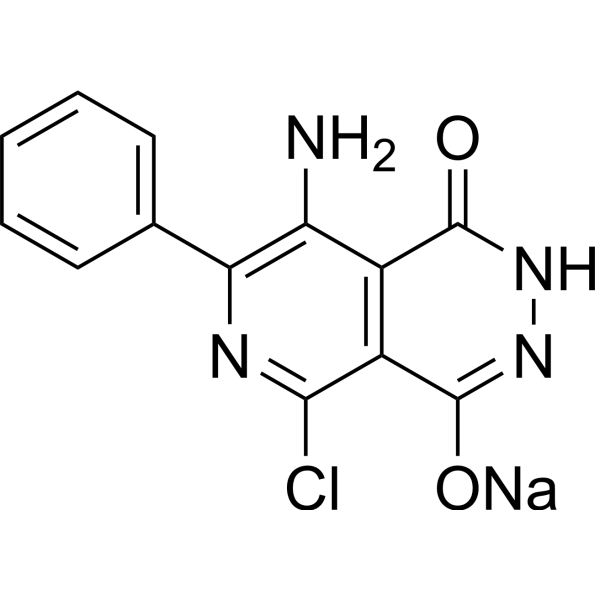
Physicochemical Properties
| Molecular Formula | C13H8CLN4NAO2 |
| Molecular Weight | 310.67 |
| Exact Mass | 310.023 |
| CAS # | 143556-24-5 |
| PubChem CID | 78243715 |
| Appearance | White to yellow solid powder |
| Hydrogen Bond Donor Count | 2 |
| Hydrogen Bond Acceptor Count | 5 |
| Rotatable Bond Count | 1 |
| Heavy Atom Count | 21 |
| Complexity | 430 |
| Defined Atom Stereocenter Count | 0 |
| InChi Key | IGEUYSJHQQCEFP-UHFFFAOYSA-M |
| InChi Code | InChI=1S/C13H9ClN4O2.Na/c14-11-8-7(12(19)17-18-13(8)20)9(15)10(16-11)6-4-2-1-3-5-6;/h1-5H,15H2,(H,17,19)(H,18,20);/q;+1/p-1 |
| Chemical Name | sodium;8-amino-5-chloro-1-oxo-7-phenyl-2H-pyrido[3,4-d]pyridazin-4-olate |
| Synonyms | L-012 sodium; L012 sodium; L012 sodium salt |
| HS Tariff Code | 2934.99.9001 |
| Storage |
Powder-20°C 3 years 4°C 2 years In solvent -80°C 6 months -20°C 1 month Note: Please store this product in a sealed and protected environment (e.g. under nitrogen), avoid exposure to moisture. |
| Shipping Condition | Room temperature (This product is stable at ambient temperature for a few days during ordinary shipping and time spent in Customs) |
Biological Activity
| ln Vitro | L012 Sodium salt is a chemical analogue of Luminol that, when compared to MCLA and Lucigenin, other CL highlights, greatly enhances luminescence production. |
| ln Vivo | It is possible to track the growth and control of biosensors by utilizing the robust ROS/RNS-dependent luminescence signals that are mediated in vivo by the sodium salt L-012 [2], which is widely distributed in mice. |
| References |
[1]. On the use of L-012, a luminol-based chemiluminescent probe, for detecting superoxide and identifying inhibitors of NADPH oxidase: a reevaluation. Free Radic Biol Med. 2013;65:1310-1314. [2]. In vivo imaging of reactive oxygen and nitrogen species in inflammation using the luminescent probe L-012. Free Radic Biol Med. 2009;47(6):760-766. |
Solubility Data
| Solubility (In Vitro) |
DMSO : ~50 mg/mL (~160.94 mM) H2O : ~3.33 mg/mL (~10.72 mM) |
| Solubility (In Vivo) |
Solubility in Formulation 1: ≥ 1.25 mg/mL (4.02 mM) (saturation unknown) in 10% DMSO + 40% PEG300 + 5% Tween80 + 45% Saline (add these co-solvents sequentially from left to right, and one by one), clear solution. For example, if 1 mL of working solution is to be prepared, you can add 100 μL of 12.5 mg/mL clear DMSO stock solution to 400 μL PEG300 and mix evenly; then add 50 μL Tween-80 to the above solution and mix evenly; then add 450 μL normal saline to adjust the volume to 1 mL. Preparation of saline: Dissolve 0.9 g of sodium chloride in 100 mL ddH₂ O to obtain a clear solution. Solubility in Formulation 2: ≥ 1.25 mg/mL (4.02 mM) (saturation unknown) in 10% DMSO + 90% (20% SBE-β-CD in Saline) (add these co-solvents sequentially from left to right, and one by one), clear solution. For example, if 1 mL of working solution is to be prepared, you can add 100 μL of 12.5 mg/mL clear DMSO stock solution to 900 μL of 20% SBE-β-CD physiological saline solution and mix evenly. Preparation of 20% SBE-β-CD in Saline (4°C,1 week): Dissolve 2 g SBE-β-CD in 10 mL saline to obtain a clear solution. (Please use freshly prepared in vivo formulations for optimal results.) |
| Preparing Stock Solutions | 1 mg | 5 mg | 10 mg | |
| 1 mM | 3.2188 mL | 16.0942 mL | 32.1885 mL | |
| 5 mM | 0.6438 mL | 3.2188 mL | 6.4377 mL | |
| 10 mM | 0.3219 mL | 1.6094 mL | 3.2188 mL |