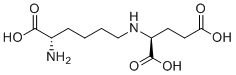
L-Saccharopine is a breakdown product of Lysine which is an essential amino acid. Saccharopine is also part of the α-aminoadipate pathway of fungal lysine biosynthesis.
Physicochemical Properties
| Molecular Formula | C11H20N2O6 |
| Molecular Weight | 276.2863 |
| Exact Mass | 276.132 |
| CAS # | 997-68-2 |
| Related CAS # | Saccharopine hydrochloride |
| PubChem CID | 160556 |
| Appearance | White to off-white solid powder |
| Density | 1.333g/cm3 |
| Boiling Point | 537.2ºC at 760mmHg |
| Melting Point | 247 - 250 °C |
| Flash Point | 278.7ºC |
| Index of Refraction | 1.537 |
| LogP | 0.567 |
| Hydrogen Bond Donor Count | 5 |
| Hydrogen Bond Acceptor Count | 8 |
| Rotatable Bond Count | 11 |
| Heavy Atom Count | 19 |
| Complexity | 320 |
| Defined Atom Stereocenter Count | 2 |
| SMILES | C(CCN[C@@H](CCC(=O)O)C(=O)O)C[C@@H](C(=O)O)N |
| InChi Key | ZDGJAHTZVHVLOT-YUMQZZPRSA-N |
| InChi Code | InChI=1S/C11H20N2O6/c12-7(10(16)17)3-1-2-6-13-8(11(18)19)4-5-9(14)15/h7-8,13H,1-6,12H2,(H,14,15)(H,16,17)(H,18,19)/t7-,8-/m0/s1 |
| Chemical Name | ((S)-5-amino-5-carboxypentyl)-L-glutamic acid |
| Synonyms | L-Saccharopine accharopin Saccharopine |
| HS Tariff Code | 2934.99.9001 |
| Storage |
Powder-20°C 3 years 4°C 2 years In solvent -80°C 6 months -20°C 1 month |
| Shipping Condition | Room temperature (This product is stable at ambient temperature for a few days during ordinary shipping and time spent in Customs) |
Biological Activity
| ln Vitro | Glycoside dehydrogenase (SDH) mutations in α-aminoadipic semialdehyde synthase (AASS)-1 in C cause glycoside buildup, which results in mitochondrial damage and loss of function. elegans [1]. |
| ln Vivo | In Aass mutant mice, glucose buildup results in mitochondrial damage and gradual postnatal growth retardation [1]. |
| References |
[1]. The lysine catabolite saccharopine impairs development by disrupting mitochondrial homeostasis. J Cell Biol. 2019 Feb 4;218(2):580-597. [2]. Saccharopine, a lysine degradation intermediate, is a mitochondrial toxin. J Cell Biol. 2019 Feb 4;218(2):391-392. [3]. Lysine degradation through the saccharopine pathway in mammals: involvement of both bifunctional and monofunctional lysine-degrading enzymes in mouse. Biochem J. 1999 Dec 1;344 Pt 2(Pt 2):555-63. |
| Additional Infomation |
L-saccharopine is the N(6)-(1,3-dicarboxypropan-1-yl) derivative of L-lysine. It has a role as a human metabolite, a Saccharomyces cerevisiae metabolite and a mouse metabolite. It is an amino acid opine and a L-lysine derivative. It is a conjugate acid of a L-saccharopinate(1-). Saccharopine is a metabolite found in or produced by Escherichia coli (strain K12, MG1655). L-Saccharopine has been reported in Psophocarpus tetragonolobus, Arabidopsis thaliana, and other organisms with data available. Saccharopine is an intermediate in the degradation of lysine, formed by condensation of lysine and alpha-ketoglutarate. The saccharopine pathway is the main route for lysine degradation in mammal and its first two reactions are catalyzed by enzymatic activities known as lysine-oxoglutarate reductase (LOR) and saccharopine dehydrogenase (SDH), which reside on a single bifunctional polypeptide (EC EC 1.5.1.8, LOR/SDH). The reactions involved by saccharopine dehydrogenases have a very strict substrate specificity for L-lysine, 2-oxoglutarate and NADPH. LOR/SDH has been detected in a number of mammalian tissues, mainly in the liver and kidney, contributing not only to the general nitrogen balance in the organism but also to the controlled conversion of lysine into ketone bodies. A tetrameric form has also been observed in human liver and placenta. LOR activity has also been detected in brain mitochondria during embryonic development, and this opens the question of whether the degradation of lysine has any functional significance during brain development and puts a new focus on the nutritional requirements for lysine in gestation and infancy. Finally, LOR and/or SDH deficiencies seem to be involved in a human autosomic genetic disorder known as familial hyperlysinemia, which is characterized by serious defects in the functioning of the nervous system, and characterized by deficiency in lysine-ketoglutarate reductase, saccharopine dehydrogenase, and saccharopine oxidoreductase activities. Saccharopinuria (high amounts of saccharopine in the urine) and saccharopinemia (an excess of saccharopine in the blood) are conditions present in some inherited disorders of lysine degradation. (A3471, A3472, A3473, A3474). Saccharopine is a metabolite found in or produced by Saccharomyces cerevisiae. |
Solubility Data
| Solubility (In Vitro) | May dissolve in DMSO (in most cases), if not, try other solvents such as H2O, Ethanol, or DMF with a minute amount of products to avoid loss of samples |
| Solubility (In Vivo) |
Note: Listed below are some common formulations that may be used to formulate products with low water solubility (e.g. < 1 mg/mL), you may test these formulations using a minute amount of products to avoid loss of samples. Injection Formulations (e.g. IP/IV/IM/SC) Injection Formulation 1: DMSO : Tween 80: Saline = 10 : 5 : 85 (i.e. 100 μL DMSO stock solution → 50 μL Tween 80 → 850 μL Saline) *Preparation of saline: Dissolve 0.9 g of sodium chloride in 100 mL ddH ₂ O to obtain a clear solution. Injection Formulation 2: DMSO : PEG300 :Tween 80 : Saline = 10 : 40 : 5 : 45 (i.e. 100 μL DMSO → 400 μLPEG300 → 50 μL Tween 80 → 450 μL Saline) Injection Formulation 3: DMSO : Corn oil = 10 : 90 (i.e. 100 μL DMSO → 900 μL Corn oil) Example: Take the Injection Formulation 3 (DMSO : Corn oil = 10 : 90) as an example, if 1 mL of 2.5 mg/mL working solution is to be prepared, you can take 100 μL 25 mg/mL DMSO stock solution and add to 900 μL corn oil, mix well to obtain a clear or suspension solution (2.5 mg/mL, ready for use in animals). Injection Formulation 4: DMSO : 20% SBE-β-CD in saline = 10 : 90 [i.e. 100 μL DMSO → 900 μL (20% SBE-β-CD in saline)] *Preparation of 20% SBE-β-CD in Saline (4°C,1 week): Dissolve 2 g SBE-β-CD in 10 mL saline to obtain a clear solution. Injection Formulation 5: 2-Hydroxypropyl-β-cyclodextrin : Saline = 50 : 50 (i.e. 500 μL 2-Hydroxypropyl-β-cyclodextrin → 500 μL Saline) Injection Formulation 6: DMSO : PEG300 : castor oil : Saline = 5 : 10 : 20 : 65 (i.e. 50 μL DMSO → 100 μLPEG300 → 200 μL castor oil → 650 μL Saline) Injection Formulation 7: Ethanol : Cremophor : Saline = 10: 10 : 80 (i.e. 100 μL Ethanol → 100 μL Cremophor → 800 μL Saline) Injection Formulation 8: Dissolve in Cremophor/Ethanol (50 : 50), then diluted by Saline Injection Formulation 9: EtOH : Corn oil = 10 : 90 (i.e. 100 μL EtOH → 900 μL Corn oil) Injection Formulation 10: EtOH : PEG300:Tween 80 : Saline = 10 : 40 : 5 : 45 (i.e. 100 μL EtOH → 400 μLPEG300 → 50 μL Tween 80 → 450 μL Saline) Oral Formulations Oral Formulation 1: Suspend in 0.5% CMC Na (carboxymethylcellulose sodium) Oral Formulation 2: Suspend in 0.5% Carboxymethyl cellulose Example: Take the Oral Formulation 1 (Suspend in 0.5% CMC Na) as an example, if 100 mL of 2.5 mg/mL working solution is to be prepared, you can first prepare 0.5% CMC Na solution by measuring 0.5 g CMC Na and dissolve it in 100 mL ddH2O to obtain a clear solution; then add 250 mg of the product to 100 mL 0.5% CMC Na solution, to make the suspension solution (2.5 mg/mL, ready for use in animals). Oral Formulation 3: Dissolved in PEG400 Oral Formulation 4: Suspend in 0.2% Carboxymethyl cellulose Oral Formulation 5: Dissolve in 0.25% Tween 80 and 0.5% Carboxymethyl cellulose Oral Formulation 6: Mixing with food powders Note: Please be aware that the above formulations are for reference only. InvivoChem strongly recommends customers to read literature methods/protocols carefully before determining which formulation you should use for in vivo studies, as different compounds have different solubility properties and have to be formulated differently. (Please use freshly prepared in vivo formulations for optimal results.) |
| Preparing Stock Solutions | 1 mg | 5 mg | 10 mg | |
| 1 mM | 3.6194 mL | 18.0969 mL | 36.1939 mL | |
| 5 mM | 0.7239 mL | 3.6194 mL | 7.2388 mL | |
| 10 mM | 0.3619 mL | 1.8097 mL | 3.6194 mL |