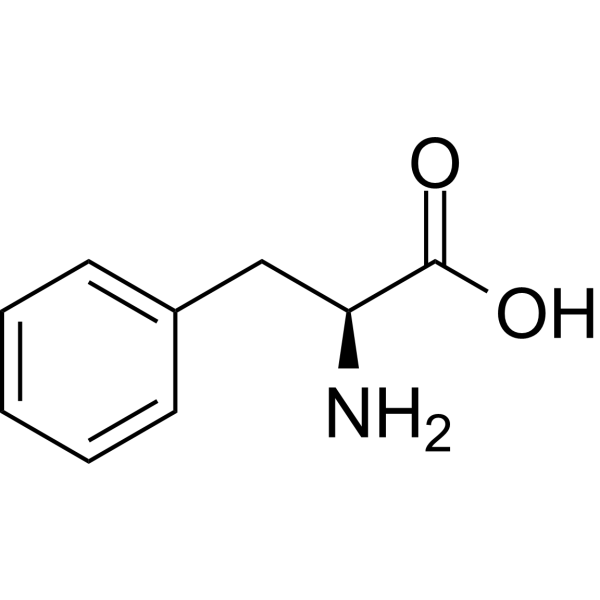
Physicochemical Properties
| Molecular Formula | C9H11NO2 |
| Molecular Weight | 165.1891 |
| Exact Mass | 165.078 |
| CAS # | 63-91-2 |
| Related CAS # | L-Phenylalanine benzyl ester hydrochloride;2462-32-0;L-Phenylalanine-d7;69113-60-6;L-Phenylalanine-d8;17942-32-4;L-Phenylalanine-13C9,15N;878339-23-2;L-Phenylalanine-d5;56253-90-8;L-Phenylalanine-d2;221346-31-2;DL-Phenylalanine-d5;284664-89-7;L-Phenylalanine-3-13C;136056-02-5;L-Phenylalanine-13C9;439685-11-7;L-Phenylalanine-d;54793-54-3;L-Phenylalanine-15N,d8;L-Phenylalanine-13C;81201-86-7;L-Phenylalanine-15N;29700-34-3;DL-Phenylalanine-d5 hydrochloride;L-Phenylalanine-13C6;180268-82-0;L-Phenylalanine-13C9,15N,d8;1994331-22-4 |
| PubChem CID | 6140 |
| Appearance | White to off-white solid powder |
| Density | 1.2±0.1 g/cm3 |
| Boiling Point | 307.5±30.0 °C at 760 mmHg |
| Melting Point | 270-275ºC (dec.)(lit.) |
| Flash Point | 139.8±24.6 °C |
| Vapour Pressure | 0.0±0.7 mmHg at 25°C |
| Index of Refraction | 1.576 |
| LogP | 1.11 |
| Hydrogen Bond Donor Count | 2 |
| Hydrogen Bond Acceptor Count | 3 |
| Rotatable Bond Count | 3 |
| Heavy Atom Count | 12 |
| Complexity | 153 |
| Defined Atom Stereocenter Count | 1 |
| SMILES | C1=CC=C(C=C1)C[C@@H](C(=O)O)N |
| InChi Key | COLNVLDHVKWLRT-QMMMGPOBSA-N |
| InChi Code | InChI=1S/C9H11NO2/c10-8(9(11)12)6-7-4-2-1-3-5-7/h1-5,8H,6,10H2,(H,11,12)/t8-/m0/s1 |
| Chemical Name | (2S)-2-amino-3-phenylpropanoic acid |
| HS Tariff Code | 2934.99.9001 |
| Storage |
Powder-20°C 3 years 4°C 2 years In solvent -80°C 6 months -20°C 1 month |
| Shipping Condition | Room temperature (This product is stable at ambient temperature for a few days during ordinary shipping and time spent in Customs) |
Biological Activity
| ln Vitro | Important players in the biosynthesis of L-phenylalanine include DAHP synthase (DS) and chorismate mutase/prephenylate dehydratase (CM/PD). While CM/PD is susceptible to feedback inhibition by L-phenylalanine, DS is susceptible to feedback inhibition by tyrosine [1]. With an IC50 of 980 μM, L-phenylalanine can reduce the activity of non-NMDA receptors in cultured neurons [5]. |
| ln Vivo | The patch-clamp method was used to examine the impact of L-phenylalanine on NMDA-activated currents (INMDA) in cultured rat hippocampus neurons. With an IC50 of 1.71 mM, L-phenylalanine selectively and reversibly reduces IMDA in a concentration-dependent manner. By competing with glycine binding sites, L-phenylalanine selectively suppresses NMDAR currents in hippocampus neurons [3]. |
| ADME/Pharmacokinetics |
Absorption, Distribution and Excretion Absorbed from the small intestine by a sodium dependent active transport process. ... It diffuses across placental membrane reaching higher fetal than maternal levels. In rhesus monkey when serum maternal levels are 1-2 mg/100 mL near full term there is an approx 1.5:1 diffusion rate, but when maternal levels ... high (25 mg/100 mL) fetal serum ... reach 45 mg/100 mL to detriment of fetus. /Phenylalanine/ Although the free amino acids dissolved in the body fluids are only a very small proportion of the body's total mass of amino acids, they are very important for the nutritional and metabolic control of the body's proteins. ... Although the plasma compartment is most easily sampled, the concentration of most amino acids is higher in tissue intracellular pools. Typically, large neutral amino acids, such as leucine and phenylalanine, are essentially in equilibrium with the plasma. Others, notably glutamine, glutamic acid, and glycine, are 10- to 50-fold more concentrated in the intracellular pool. Dietary variations or pathological conditions can result in substantial changes in the concentrations of the individual free amino acids in both the plasma and tissue pools. Table: Comparison of the Pool Sizes of Free and Protein-Bound Amino Acids in Rat Muscle [Table#3668] Metabolism / Metabolites Hepatic. L-phenylalanine that is not metabolized in the liver is distributed via the systemic circulation to the various tissues of the body, where it undergoes metabolic reactions similar to those that take place in the liver. Pathways of amino acid metabolism- L-phenylalanine; product of oxidative deamination or transamination: phenylpyruvic acid. Product of decarboxylation: phenylethylamine. Phenylalanine to tyrosine. L-Phenylalanine yields in man: N-acetyl-L-phenylalanine; benzoic acid; probably in man, 2,5-dihydroxy-L-phenylalanine. /From table/ L-Phenylalanine yields in man: phenethylamine; phenylpyruvic acid; L-tyrosine. /From table/ L-Phenylalanine yields L-m-tyrosine in rat. /From table/ For more Metabolism/Metabolites (Complete) data for (L)-Phenylalanine (12 total), please visit the HSDB record page. Hepatic. L-phenylalanine that is not metabolized in the liver is distributed via the systemic circulation to the various tissues of the body, where it undergoes metabolic reactions similar to those that take place in the liver. |
| Toxicity/Toxicokinetics |
Toxicity Summary Extremely high serum levels of phenylalanine are found in patients with the inborn error of metabolism (IEM) called Phenylketonuria (PKU). At pathological concentrations typical of PKU, phenylalanine self-assembles into fibrils with amyloid-like morphology and well-ordered electron diffraction. These fibrils and their resulting amyloid deposits that localize to the brain appear to be partially responsible for the neural tissue damage seen in PKU patients (A8160). It has also been suggested that very high plasma phenylalanine concentrations can increase phenylalanine entry into brain and thereby restrict the entry of other large neutral amino acids. The lack of large neutral amino acids may lead to disturbed cerebral protein synthesis, which is particularly important for young children (A8162). The mechanism of L-phenylalanine's putative antidepressant activity may be accounted for by its precursor role in the synthesis of the neurotransmitters norepinephrine and dopamine. Elevated brain norepinephrine and dopamine levels are thought to be associated with antidepressant effects. The mechanism of L-phenylalanine's possible antivitiligo activity is not well understood. It is thought that L-phenylalanine may stimulate the production of melanin in the affected skin. Interactions Ochratoxin A (0.8 mg) injected ip together with 0.8 mg of phenylalanine, 97% of animals survived, and 100% survived when 1 mg of phenylalanine was injected. Non-Human Toxicity Values LD50 Rat ip 5287 mg/kg |
| References |
[1]. Long-term changes in glutamatergic synaptic transmission in phenylketonuria. Brain. 2005 Feb;128(Pt 2):300-7. [2]. L-phenylalanine selectively depresses currents at glutamatergic excitatory synapses. J Neurosci Res. 2003 Apr 1;72(1):116-24. [3]. Specific inhibition of N-methyl-D-aspartate receptor function in rat hippocampal neurons by L-phenylalanine at concentrations observed during phenylketonuria. Mol Psychiatry. 2002;7(4):359-67. [4]. Structure-activity relationships of alpha-amino acid ligands for the alpha2delta subunit of voltage-gated calcium channels. Bioorg Med Chem Lett. 2006 Mar 1;16(5):1138-41. [5]. Enhancement of l-phenylalanine production in Escherichia coli by heterologous expression of Vitreoscilla hemoglobin. Biotechnol Appl Biochem. 2018 May;65(3):476-483. |
| Additional Infomation |
Therapeutic Uses An essential aromatic amino acid that is a precursor of MELANIN; DOPAMINE; noradrenalin (NOREPINEPHRINE), and THYROXINE. /EXPTL TREATMENT/ There is no totally effective treatment for vitiligo (localised hypopigmentation). Oral or topical photochemotherapy with psoralens is generally considered to be the best available treatment, but experimental therapy includes UVA phototherapy with phenylalanine. Use of phenylalanine in oral doses of up to 100 mg/kg with UVA/sunlight led to beneficial results in more than 90% of 200 patients with vitiligo. Greatest benefit was noted in early disease, but prolonged use still induced repigmentation in long-standing cases. Repigmentation occurred mainly in areas rich in follicles. Such therapy is contra-indicated in phenylketonuria and in pregnancy. Similarly a further open study reported responses in 94 of 149 patients receiving 50 to 100 mg/kg daily of phenylalanine plus twice weekly UVA treatment. However, only 22% of responders had repigmentation in more than 60% of the affected area. Higher doses did not seem to be more effective than 50 mg/kg daily. Another group reported on 6 years of experience of treatment of vitiligo using 50 or 100 mg/kg daily of phenylalanine, with application of 10% phenylalanine gel and daily sun exposure. Although not ideal, they considered the treatment useful, especially for its ability to rapidly repigment the face. The same group performed an open study, adding topical 0.025% clobetasol propionate, and ultraviolet exposure during autumn and winter; 65.5% of patients achieved 100% repigmentation on the face. /Experimental Therapy/ L-Phenylalanine (Phe), is a potent releaser of the satiety hormone, cholecystokinin (CCK) and previous studies, conducted primarily in men, show that ingestion of Phe reduces energy intake. The objective of the current study was to test the effects of Phe on energy intake in overweight and obese women. Subjects (n =3 2) received three treatments (high-dose (10 g Phe), low-dose (5 g Phe and 5 g glucose) or control (10 g glucose)) 20 min before an ad libitum lunch and dinner meal in a within-subjects', counterbalanced, double-blind study. No effect of Phe was found; however, interactions with dietary restraint status were detected in post-hoc analyses. /Experimental Therapy/ L-phenylalanine in combination with 0.025% clobetasol propionate and sunlight during sunny months or UVA lamps in winter, appears to improve evolutive vitiligo without side effects, and therefore is especially recommended on the face or for children. For more Therapeutic Uses (Complete) data for (L)-Phenylalanine (7 total), please visit the HSDB record page. Drug Warnings Overweight and obese women (n = 32) received three treatments (high-dose (10 g Phe), low-dose (5 g Phe and 5 g glucose) or control (10 g glucose)) 20 min before an ad libitum lunch and dinner meal. High-dose Phe increased ratings of nausea. Pharmacodynamics Used by the brain to produce Norepinephrine, a chemical that transmits signals between nerve cells and the brain; keeps you awake and alert; reduces hunger pains; functions as an antidepressant and helps improve memory. |
Solubility Data
| Solubility (In Vitro) | H2O : ~6.67 mg/mL (~40.38 mM) |
| Solubility (In Vivo) |
Solubility in Formulation 1: 9.09 mg/mL (55.03 mM) in PBS (add these co-solvents sequentially from left to right, and one by one), clear solution; with sonication (<60°C). (Please use freshly prepared in vivo formulations for optimal results.) |
| Preparing Stock Solutions | 1 mg | 5 mg | 10 mg | |
| 1 mM | 6.0536 mL | 30.2682 mL | 60.5364 mL | |
| 5 mM | 1.2107 mL | 6.0536 mL | 12.1073 mL | |
| 10 mM | 0.6054 mL | 3.0268 mL | 6.0536 mL |