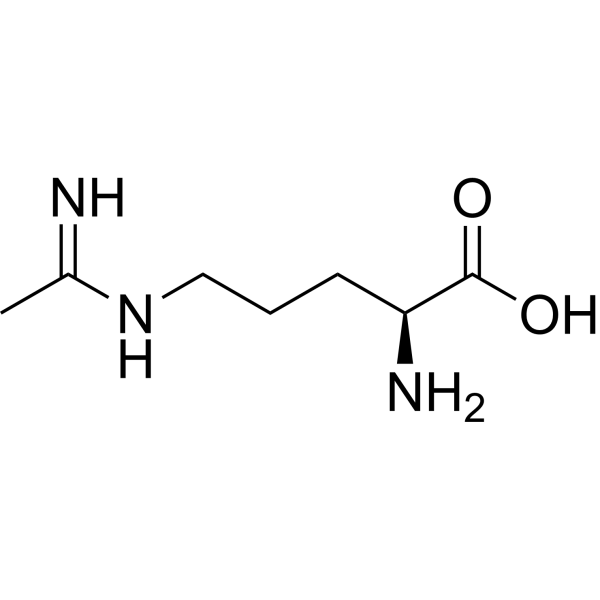
Physicochemical Properties
| Molecular Formula | C7H15N3O2 |
| Molecular Weight | 173.21 |
| Exact Mass | 173.1164 |
| Elemental Analysis | C, 48.54; H, 8.73; N, 24.26; O, 18.47 |
| CAS # | 36889-13-1 |
| Related CAS # | L-NIO dihydrochloride;159190-44-0 |
| PubChem CID | 107984 |
| Appearance | Typically exists as solid at room temperature |
| Density | 1.26 g/cm3 |
| Boiling Point | 358.9ºC at 760 mmHg |
| Melting Point | 225-226ºC |
| Flash Point | 170.9ºC |
| LogP | 2.56 |
| Hydrogen Bond Donor Count | 3 |
| Hydrogen Bond Acceptor Count | 4 |
| Rotatable Bond Count | 5 |
| Heavy Atom Count | 12 |
| Complexity | 180 |
| Defined Atom Stereocenter Count | 1 |
| SMILES | N=C(NCCCC(C(O)=O)N)C |
| InChi Key | UYZFAUAYFLEHRC-LURJTMIESA-N |
| InChi Code | InChI=1S/C7H15N3O2/c1-5(8)10-4-2-3-6(9)7(11)12/h6H,2-4,9H2,1H3,(H2,8,10)(H,11,12)/t6-/m0/s1 |
| Chemical Name | (2S)-2-amino-5-(1-aminoethylideneamino)pentanoic acid |
| Synonyms | N5-(1-Iminoethyl)-L-ornithine; L-NIO; 36889-13-1; N5-(1-Iminoethyl)-L-ornithine; N(G)-Iminoethylornithine; n5-iminoethyl-l-ornithine; (2S)-2-amino-5-(1-aminoethylideneamino)pentanoic acid; L-NIO HCl; L-NIO DIHYDROCHLORIDE; N(G)-Iminoethylornithine; L-NIO HCl |
| HS Tariff Code | 2934.99.9001 |
| Storage |
Powder-20°C 3 years 4°C 2 years In solvent -80°C 6 months -20°C 1 month |
| Shipping Condition | Room temperature (This product is stable at ambient temperature for a few days during ordinary shipping and time spent in Customs) |
Biological Activity
| Targets | NOS/nitric oxide synthase (Ki = 1.7 μM ~3.9 μM) |
| ln Vitro | Nitric oxide synthase (NOS), which is dependent on NADPH, is effectively and non-selectively inhibited by L-NIO. The Ki values for inducible (iNOS), endothelial cells (eNOS), and neurons (nNOS) are 3.9, 3.9, and 1.7 μM, respectively. 1]. |
| ln Vivo | In the adult rat brain, localized cerebral ischemia was caused by L-NIO (2.0 μmol, 3 days after ischemia) [2]. |
| Enzyme Assay | Nitric oxide synthase (NOS) catalyzes the NADPH- and O2-dependent conversion of L-arginine to nitric oxide (NO) and citrulline; three isoforms, the neuronal (nNOS), endothelial, and inducible, have been identified. Because overproduction of NO is known to contribute to several pathophysiological conditions, NOS inhibitors are of interest as potential therapeutic agents. Inhibitors that are potent, mechanism-based, and relatively selective for the NOS isoform causing pathology are of particular interest. In the present studies we report that vinyl-L-NIO (N5-(1-imino-3-butenyl)-L-ornithine; L-VNIO) binds to and inhibits nNOS in competition with L-arginine (Ki = 100 nM); binding is accompanied by a type I optical difference spectrum consistent with binding near the heme cofactor without interaction as a sixth axial heme ligand. Such binding is fully reversible. However, in the presence of NADPH and O2, L-VNIO irreversibly inactivates nNOS (kinact = 0.078 min-1; KI = 90 nM); inactivation is Ca2+/calmodulin-dependent. The cytochrome c reduction activity of the enzyme is not affected by such treatment, but the L-arginine-independent NADPH oxidase activity of nNOS is lost in parallel with the overall activity. Spectral analyses establish that the nNOS heme cofactor is lost or modified by L-VNIO-mediated mechanism-based inactivation of the enzyme. The inducible isoform of NOS is not inactivated by L-VNIO, and the endothelial isoform requires 20-fold higher concentrations to attain approximately 75% of the rate of inactivation seen with nNOS. Among the NOS inactivating L-arginine derivatives, L-VNIO is the most potent and nNOS-selective reported to date[1]. |
| Animal Protocol |
Animal/Disease Models: Adult male Sprague Dawley rat (250-350 g) [2] Doses: 0.04-2.0 μmol/(3.0-5.0 μL) per rat Route of Administration: Injection into the striatum 3 days after ischemia Experimental Results: The infarct volume produced by 2.0 μmol L-NIO is Dramatically different from that of sham-operated animals. The current study establishes a novel in vivo rat model of focal striatal ischemia using the vasoconstrictive agent N5-(1-iminoethyl)-L-ornithine (L-NIO). Adult male Sprague Dawley rats received a unilateral intrastriatal infusion of L-NIO in combination with jugular vein occlusion.[2] |
| References |
[1]. N5-(1-Imino-3-butenyl)-L-ornithine. A neuronal isoform selective mechanism-based inactivator of nitric oxide synthase. J Biol Chem. 1998 Apr 10;273(15):8882-9. [2]. L-NIO as a novel mechanism for inducing focal cerebral ischemia in the adult rat brain. J Neurosci Methods. 2015 Apr 30;245:44-57. |
| Additional Infomation | L-NIO is a L-alpha-amino acid. |
Solubility Data
| Solubility (In Vitro) | May dissolve in DMSO (in most cases), if not, try other solvents such as H2O, Ethanol, or DMF with a minute amount of products to avoid loss of samples |
| Solubility (In Vivo) |
Note: Listed below are some common formulations that may be used to formulate products with low water solubility (e.g. < 1 mg/mL), you may test these formulations using a minute amount of products to avoid loss of samples. Injection Formulations (e.g. IP/IV/IM/SC) Injection Formulation 1: DMSO : Tween 80: Saline = 10 : 5 : 85 (i.e. 100 μL DMSO stock solution → 50 μL Tween 80 → 850 μL Saline) *Preparation of saline: Dissolve 0.9 g of sodium chloride in 100 mL ddH ₂ O to obtain a clear solution. Injection Formulation 2: DMSO : PEG300 :Tween 80 : Saline = 10 : 40 : 5 : 45 (i.e. 100 μL DMSO → 400 μLPEG300 → 50 μL Tween 80 → 450 μL Saline) Injection Formulation 3: DMSO : Corn oil = 10 : 90 (i.e. 100 μL DMSO → 900 μL Corn oil) Example: Take the Injection Formulation 3 (DMSO : Corn oil = 10 : 90) as an example, if 1 mL of 2.5 mg/mL working solution is to be prepared, you can take 100 μL 25 mg/mL DMSO stock solution and add to 900 μL corn oil, mix well to obtain a clear or suspension solution (2.5 mg/mL, ready for use in animals). Injection Formulation 4: DMSO : 20% SBE-β-CD in saline = 10 : 90 [i.e. 100 μL DMSO → 900 μL (20% SBE-β-CD in saline)] *Preparation of 20% SBE-β-CD in Saline (4°C,1 week): Dissolve 2 g SBE-β-CD in 10 mL saline to obtain a clear solution. Injection Formulation 5: 2-Hydroxypropyl-β-cyclodextrin : Saline = 50 : 50 (i.e. 500 μL 2-Hydroxypropyl-β-cyclodextrin → 500 μL Saline) Injection Formulation 6: DMSO : PEG300 : castor oil : Saline = 5 : 10 : 20 : 65 (i.e. 50 μL DMSO → 100 μLPEG300 → 200 μL castor oil → 650 μL Saline) Injection Formulation 7: Ethanol : Cremophor : Saline = 10: 10 : 80 (i.e. 100 μL Ethanol → 100 μL Cremophor → 800 μL Saline) Injection Formulation 8: Dissolve in Cremophor/Ethanol (50 : 50), then diluted by Saline Injection Formulation 9: EtOH : Corn oil = 10 : 90 (i.e. 100 μL EtOH → 900 μL Corn oil) Injection Formulation 10: EtOH : PEG300:Tween 80 : Saline = 10 : 40 : 5 : 45 (i.e. 100 μL EtOH → 400 μLPEG300 → 50 μL Tween 80 → 450 μL Saline) Oral Formulations Oral Formulation 1: Suspend in 0.5% CMC Na (carboxymethylcellulose sodium) Oral Formulation 2: Suspend in 0.5% Carboxymethyl cellulose Example: Take the Oral Formulation 1 (Suspend in 0.5% CMC Na) as an example, if 100 mL of 2.5 mg/mL working solution is to be prepared, you can first prepare 0.5% CMC Na solution by measuring 0.5 g CMC Na and dissolve it in 100 mL ddH2O to obtain a clear solution; then add 250 mg of the product to 100 mL 0.5% CMC Na solution, to make the suspension solution (2.5 mg/mL, ready for use in animals). Oral Formulation 3: Dissolved in PEG400 Oral Formulation 4: Suspend in 0.2% Carboxymethyl cellulose Oral Formulation 5: Dissolve in 0.25% Tween 80 and 0.5% Carboxymethyl cellulose Oral Formulation 6: Mixing with food powders Note: Please be aware that the above formulations are for reference only. InvivoChem strongly recommends customers to read literature methods/protocols carefully before determining which formulation you should use for in vivo studies, as different compounds have different solubility properties and have to be formulated differently. (Please use freshly prepared in vivo formulations for optimal results.) |
| Preparing Stock Solutions | 1 mg | 5 mg | 10 mg | |
| 1 mM | 5.7733 mL | 28.8667 mL | 57.7334 mL | |
| 5 mM | 1.1547 mL | 5.7733 mL | 11.5467 mL | |
| 10 mM | 0.5773 mL | 2.8867 mL | 5.7733 mL |