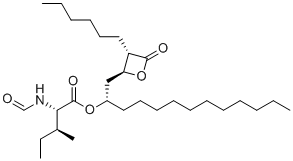
L-Isoleucine orlistat is an impurity of orlistat, which is a general lipase inhibitor and anti-Obesity drug.
Physicochemical Properties
| Molecular Formula | C29H53NO5 |
| Molecular Weight | 495.74 |
| Exact Mass | 495.392 |
| Elemental Analysis | C, 70.26; H, 10.78; N, 2.83; O, 16.14 |
| CAS # | 1072902-75-0 |
| PubChem CID | 25140641 |
| Appearance | Typically exists as solid at room temperature |
| LogP | 7.722 |
| Hydrogen Bond Donor Count | 1 |
| Hydrogen Bond Acceptor Count | 5 |
| Rotatable Bond Count | 23 |
| Heavy Atom Count | 35 |
| Complexity | 581 |
| Defined Atom Stereocenter Count | 5 |
| SMILES | CCCCCCCCCCCC(CC1C(C(=O)O1)CCCCCC)OC(=O)C(C(C)CC)NC=O |
| InChi Key | CBHKWVNFZKJLIS-IRGGMKSGSA-N |
| InChi Code | InChI=1S/C29H53NO5/c1-5-8-10-12-13-14-15-16-17-19-24(34-29(33)27(30-22-31)23(4)7-3)21-26-25(28(32)35-26)20-18-11-9-6-2/h22-27H,5-21H2,1-4H3,(H,30,31)/t23-,24-,25-,26-,27-/m0/s1 |
| Chemical Name | [(2S)-1-[(2S,3S)-3-hexyl-4-oxooxetan-2-yl]tridecan-2-yl] (2S,3S)-2-formamido-3-methylpentanoate |
| Synonyms | Orlistat related compound E; L-Isoleucine orlistat; Isoleucine orlistat, L-; L-Isoleucine Orlistat; 1072902-75-0; UNII-9P192EY8ZT; 9P192EY8ZT; OMDM-188; L-Isoleucine, N-formyl-, (1S)-1-(((2S,3S)-3-hexyl-4-oxo-2-oxetanyl)methyl)dodecyl ester; N-Formyl-S-isoleucin-(S)-1-(((2S, 3S)-3-hexyl-4-oxo-2-oxetanyl)methyl)dodecyl ester; Isoleucine orlistat, L- |
| HS Tariff Code | 2934.99.9001 |
| Storage |
Powder-20°C 3 years 4°C 2 years In solvent -80°C 6 months -20°C 1 month |
| Shipping Condition | Room temperature (This product is stable at ambient temperature for a few days during ordinary shipping and time spent in Customs) |
Biological Activity
| Targets | Lipase; fatty acid synthase (FASN) |
| References | [1]. Inhibiting endocannabinoid biosynthesis: a novel approach to the treatment of constipation. Br J Pharmacol. 2015 Jun;172(12):3099-111 |
| Additional Infomation |
Background and purpose: Endocannabinoids are a family of lipid mediators involved in the regulation of gastrointestinal (GI) motility. The expression, localization and function of their biosynthetic enzymes in the GI tract are not well understood. Here, we examined the expression, localization and function of the enzyme diacylglycerol lipase-α (DAGLα), which is involved in biosynthesis of the endocannabinoid 2-arachidonoylglycerol (2-AG).
Experimental approach: Cannabinoid CB1 receptor-deficient, wild-type control and C3H/HeJ mice, a genetically constipated strain, were used. The distribution of DAGLα in the enteric nervous system was examined by immunohistochemistry. Effects of the DAGL inhibitors, orlistat and OMDM-188 on pharmacologically induced GI hypomotility were assessed by measuring intestinal contractility in vitro and whole gut transit or faecal output in vivo. Endocannabinoid levels were measured by mass spectrometry. Key results: DAGLα was expressed throughout the GI tract. In the intestine, unlike DAGLβ, DAGLα immunoreactivity was prominently expressed in the enteric nervous system. In the myenteric plexus, it was colocalized with the vesicular acetylcholine transporter in cholinergic nerves. In normal mice, inhibiting DAGL reversed both pharmacologically reduced intestinal contractility and pharmacologically prolonged whole gut transit. Moreover, inhibiting DAGL normalized faecal output in constipated C3H/HeJ mice. In colons incubated with scopolamine, 2-AG was elevated while inhibiting DAGL normalized 2-AG levels. Conclusions and implications: DAGLα was expressed in the enteric nervous system of mice and its inhibition reversed slowed GI motility, intestinal contractility and constipation through 2-AG and CB1 receptor-mediated mechanisms. Our data suggest that DAGLα inhibitors may be promising candidates for the treatment of constipation. [1] |
Solubility Data
| Solubility (In Vitro) | May dissolve in DMSO (in most cases), if not, try other solvents such as H2O, Ethanol, or DMF with a minute amount of products to avoid loss of samples |
| Solubility (In Vivo) |
Note: Listed below are some common formulations that may be used to formulate products with low water solubility (e.g. < 1 mg/mL), you may test these formulations using a minute amount of products to avoid loss of samples. Injection Formulations (e.g. IP/IV/IM/SC) Injection Formulation 1: DMSO : Tween 80: Saline = 10 : 5 : 85 (i.e. 100 μL DMSO stock solution → 50 μL Tween 80 → 850 μL Saline) *Preparation of saline: Dissolve 0.9 g of sodium chloride in 100 mL ddH ₂ O to obtain a clear solution. Injection Formulation 2: DMSO : PEG300 :Tween 80 : Saline = 10 : 40 : 5 : 45 (i.e. 100 μL DMSO → 400 μLPEG300 → 50 μL Tween 80 → 450 μL Saline) Injection Formulation 3: DMSO : Corn oil = 10 : 90 (i.e. 100 μL DMSO → 900 μL Corn oil) Example: Take the Injection Formulation 3 (DMSO : Corn oil = 10 : 90) as an example, if 1 mL of 2.5 mg/mL working solution is to be prepared, you can take 100 μL 25 mg/mL DMSO stock solution and add to 900 μL corn oil, mix well to obtain a clear or suspension solution (2.5 mg/mL, ready for use in animals). Injection Formulation 4: DMSO : 20% SBE-β-CD in saline = 10 : 90 [i.e. 100 μL DMSO → 900 μL (20% SBE-β-CD in saline)] *Preparation of 20% SBE-β-CD in Saline (4°C,1 week): Dissolve 2 g SBE-β-CD in 10 mL saline to obtain a clear solution. Injection Formulation 5: 2-Hydroxypropyl-β-cyclodextrin : Saline = 50 : 50 (i.e. 500 μL 2-Hydroxypropyl-β-cyclodextrin → 500 μL Saline) Injection Formulation 6: DMSO : PEG300 : castor oil : Saline = 5 : 10 : 20 : 65 (i.e. 50 μL DMSO → 100 μLPEG300 → 200 μL castor oil → 650 μL Saline) Injection Formulation 7: Ethanol : Cremophor : Saline = 10: 10 : 80 (i.e. 100 μL Ethanol → 100 μL Cremophor → 800 μL Saline) Injection Formulation 8: Dissolve in Cremophor/Ethanol (50 : 50), then diluted by Saline Injection Formulation 9: EtOH : Corn oil = 10 : 90 (i.e. 100 μL EtOH → 900 μL Corn oil) Injection Formulation 10: EtOH : PEG300:Tween 80 : Saline = 10 : 40 : 5 : 45 (i.e. 100 μL EtOH → 400 μLPEG300 → 50 μL Tween 80 → 450 μL Saline) Oral Formulations Oral Formulation 1: Suspend in 0.5% CMC Na (carboxymethylcellulose sodium) Oral Formulation 2: Suspend in 0.5% Carboxymethyl cellulose Example: Take the Oral Formulation 1 (Suspend in 0.5% CMC Na) as an example, if 100 mL of 2.5 mg/mL working solution is to be prepared, you can first prepare 0.5% CMC Na solution by measuring 0.5 g CMC Na and dissolve it in 100 mL ddH2O to obtain a clear solution; then add 250 mg of the product to 100 mL 0.5% CMC Na solution, to make the suspension solution (2.5 mg/mL, ready for use in animals). Oral Formulation 3: Dissolved in PEG400 Oral Formulation 4: Suspend in 0.2% Carboxymethyl cellulose Oral Formulation 5: Dissolve in 0.25% Tween 80 and 0.5% Carboxymethyl cellulose Oral Formulation 6: Mixing with food powders Note: Please be aware that the above formulations are for reference only. InvivoChem strongly recommends customers to read literature methods/protocols carefully before determining which formulation you should use for in vivo studies, as different compounds have different solubility properties and have to be formulated differently. (Please use freshly prepared in vivo formulations for optimal results.) |
| Preparing Stock Solutions | 1 mg | 5 mg | 10 mg | |
| 1 mM | 2.0172 mL | 10.0859 mL | 20.1719 mL | |
| 5 mM | 0.4034 mL | 2.0172 mL | 4.0344 mL | |
| 10 mM | 0.2017 mL | 1.0086 mL | 2.0172 mL |