Physicochemical Properties
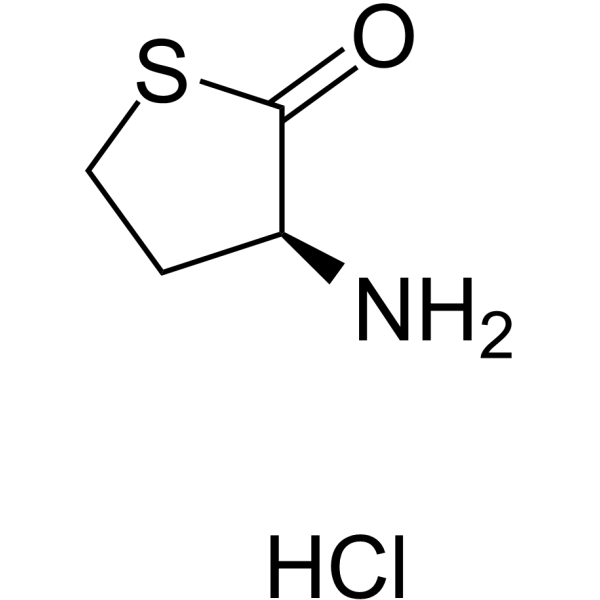
| Molecular Formula | C4H7NOS.HCL |
| Molecular Weight | 153.63042 |
| Exact Mass | 153.001 |
| CAS # | 31828-68-9 |
| Related CAS # | DL-Homocysteine thiolactone hydrochloride;6038-19-3 |
| PubChem CID | 10313226 |
| Appearance | White to off-white solid powder |
| Boiling Point | 253.8ºC at 760mmHg |
| Melting Point | 185-191ºC |
| Flash Point | 107.3ºC |
| LogP | 1.479 |
| Hydrogen Bond Donor Count | 2 |
| Hydrogen Bond Acceptor Count | 3 |
| Rotatable Bond Count | 0 |
| Heavy Atom Count | 8 |
| Complexity | 93.7 |
| Defined Atom Stereocenter Count | 1 |
| SMILES | N[C@@H](CCS1)C1=O.Cl |
| InChi Key | ZSEGSUBKDDEALH-DFWYDOINSA-N |
| InChi Code | InChI=1S/C4H7NOS.ClH/c5-3-1-2-7-4(3)6;/h3H,1-2,5H2;1H/t3-;/m0./s1 |
| Chemical Name | (3S)-3-aminothiolan-2-one;hydrochloride |
| HS Tariff Code | 2934.99.9001 |
| Storage |
Powder-20°C 3 years 4°C 2 years In solvent -80°C 6 months -20°C 1 month Note: Please store this product in a sealed and protected environment, avoid exposure to moisture. |
| Shipping Condition | Room temperature (This product is stable at ambient temperature for a few days during ordinary shipping and time spent in Customs) |
Biological Activity
| ln Vitro |
Methionyl-tRNA synthetase converts homocysteine to homocysteine thiolactone in all cell types, including bacteria and humans. In humans, high homocysteine levels are a separate risk factor for cardiovascular disease. Due to its metabolic conversion to homocysteine thiolactone, a reactive thioester, homocysteine may be toxic to human cells. All human cell types, including endothelial cells, undergo this switch [1]. Increased phosphatidylserine exposure on the membrane surface, increased hypoploid DNA content in apoptotic cells, and internucleosomal DNA fragmentation in HL-60 cells are all signs of apoptosis that are brought on by homocysteine thiolactone [2]. DNA fragmentation and caspase-3 activation are two indicators of homocysteine thiolactone's cytotoxicity and promotion of cell death. IL-8 release is strongly activated by HcyT [3]. - HL-60 cells: L-Homocysteine thiolactone hydrochloride induces apoptotic DNA damage mediated by increased intracellular hydrogen peroxide and caspase 3 activation[2] - HUVEC cells: L-Homocysteine thiolactone hydrochloride exerts stronger proapoptotic and proinflammatory effects than homocysteine[3] |
| ln Vivo |
In addition to being poisonous and known to cause seizures in rats, homocysteine thiolactone has also been connected to Alzheimer's [4]. The coexistence of convulsive and nonconvulsive epilepsy is caused by homocysteine thiolactone. Seizures vary in intensity depending on the dosage [5]. - Mice: L-Homocysteine thiolactone hydrochloride shows neurotoxicity, and paraoxonase 1 exerts a protective role in its metabolism[4] - Adult rats: L-Homocysteine thiolactone hydrochloride induces two types of seizures, confirmed by behavioral observations and electroencephalographic recordings[5] |
| Cell Assay |
- HL-60 cell apoptosis assay: Cells are treated with L-Homocysteine thiolactone hydrochloride, apoptotic DNA damage is detected, and intracellular hydrogen peroxide levels and caspase 3 activation are measured to verify the mediation pathway[2] - HUVEC cell assay: Cells are exposed to L-Homocysteine thiolactone hydrochloride and homocysteine separately, with proapoptotic (cell survival rate, apoptotic marker expression) and proinflammatory (inflammatory cytokine release) effects compared[3] |
| Animal Protocol |
- Mouse experiment: L-Homocysteine thiolactone hydrochloride is administered to mice, and neurotoxicity-related indicators are detected to evaluate the protective effect of paraoxonase 1[4] - Rat seizure experiment: L-Homocysteine thiolactone hydrochloride is administered to adult rats, followed by behavioral monitoring and electroencephalographic recording to observe seizure types[5] |
| ADME/Pharmacokinetics |
- L-Homocysteine thiolactone hydrochloride is metabolized in mice, with paraoxonase 1 involved in its metabolic pathway[4] - In humans, L-Homocysteine thiolactone hydrochloride is derived from metabolic processes and can induce protein homocysteinylation[1] |
| Toxicity/Toxicokinetics |
- In vitro toxicity: L-Homocysteine thiolactone hydrochloride induces apoptosis in HL-60 and HUVEC cells[2][3] - In vivo toxicity: L-Homocysteine thiolactone hydrochloride causes neurotoxicity in mice and seizures in rats[4][5] |
| References |
[1]. Jakubowski H, et al. Homocysteine thiolactone: metabolic origin and protein homocysteinylation in humans. J Nutr. 2000 Feb;130(2S Suppl):377S-381S. [2]. Huang RF, et al. Homocysteine thiolactone induces apoptotic DNA damage mediated by increased intracellularhydrogen peroxide and caspase 3 activation in HL-60 cells. Life Sci. 2001 May 11;68(25):2799-811. [3]. Kerkeni M, et al. Comparative study on in vitro effects of homocysteine thiolactone and homocysteine on HUVECcells: evidence for a stronger proapoptotic and proinflammative homocysteine thiolactone. Mol Cell Biochem. 2006 Oct;291(1-2):119-26. [4]. Borowczyk K, et al. Metabolism and neurotoxicity of homocysteine thiolactone in mice: evidence for a protective role of paraoxonase 1. J Alzheimers Dis. 2012;30(2):225-31. [5]. Stanojlovi? O, et al. Two types of seizures in homocysteine thiolactone-treated adult rats, behavioral and electroencephalographic study. Cell Mol Neurobiol. 2009 May;29(3):329-39 |
| Additional Infomation |
- L-Homocysteine thiolactone hydrochloride is a metabolite with the ability to modify proteins through homocysteinylation in humans[1] |
Solubility Data
| Solubility (In Vitro) | H2O : ≥ 23 mg/mL (~149.71 mM) |
| Solubility (In Vivo) |
Solubility in Formulation 1: 100 mg/mL (650.91 mM) in PBS (add these co-solvents sequentially from left to right, and one by one), clear solution; with sonication. (Please use freshly prepared in vivo formulations for optimal results.) |
| Preparing Stock Solutions | 1 mg | 5 mg | 10 mg | |
| 1 mM | 6.5091 mL | 32.5457 mL | 65.0915 mL | |
| 5 mM | 1.3018 mL | 6.5091 mL | 13.0183 mL | |
| 10 mM | 0.6509 mL | 3.2546 mL | 6.5091 mL |