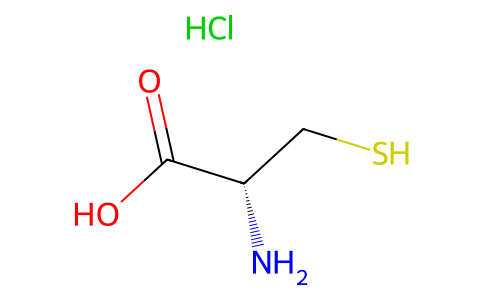
Physicochemical Properties
| Molecular Formula | C3H8CLNO2S |
| Molecular Weight | 157.6191 |
| Exact Mass | 156.996 |
| CAS # | 52-89-1 |
| PubChem CID | 60960 |
| Appearance | White to off-white solid powder |
| Boiling Point | 293.9ºC at 760 mmHg |
| Melting Point | 140-142ºC |
| Flash Point | 131.5ºC |
| LogP | 0.83 |
| Hydrogen Bond Donor Count | 4 |
| Hydrogen Bond Acceptor Count | 4 |
| Rotatable Bond Count | 2 |
| Heavy Atom Count | 8 |
| Complexity | 75.3 |
| Defined Atom Stereocenter Count | 1 |
| SMILES | C([C@@H](C(=O)O)N)S.Cl |
| InChi Key | IFQSXNOEEPCSLW-DKWTVANSSA-N |
| InChi Code | InChI=1S/C3H7NO2S.ClH/c4-2(1-7)3(5)6;/h2,7H,1,4H2,(H,5,6);1H/t2-;/m0./s1 |
| Chemical Name | (2R)-2-amino-3-sulfanylpropanoic acid;hydrochloride |
| HS Tariff Code | 2934.99.9001 |
| Storage |
Powder-20°C 3 years 4°C 2 years In solvent -80°C 6 months -20°C 1 month |
| Shipping Condition | Room temperature (This product is stable at ambient temperature for a few days during ordinary shipping and time spent in Customs) |
Biological Activity
| ADME/Pharmacokinetics |
Metabolism / Metabolites L-Cysteine is the central compound in sulfur metabolism in the human body. In proteins the formation of disulfide bonds between the thiol groups of cysteine plays an important role for tertiary structure and enzymatic activity; cysteine is however always incorporated in the polypeptide chain as cysteine. L-Cysteine is degraded to pyruvate in two steps: one is removal of sulfur and the other is a transamination. Cysteine can be metabolized to form taurine and carbon dioxide through the cysteinsulfinate pathway, where the initial step is oxidation of cysteine to cysteine sulfinate. This step is catalyzed by cysteine dioxygenase. Cysteine sulfinate may then be decarboxylated to form taurine or it may be metabolized via the putative intermediate beta-sulfinylpyruvate to pyruvate and sulfite and then to carbon dioxide and sulfate. Amino acid catabolism is essential for adjusting pool sizes of free amino acids and takes part in energy production as well as nutrient remobilization. The carbon skeletons are generally converted to precursors or intermediates of the tricarboxylic acid cycle. In the case of cysteine, the reduced sulfur derived from the thiol group also has to be oxidized in order to prevent accumulation to toxic concentrations. Here we present a mitochondrial sulfur catabolic pathway catalyzing the complete oxidation of L-cysteine to pyruvate and thiosulfate. After transamination to 3-mercaptopyruvate the sulfhydryl group from L-cysteine is transferred to glutathione by sulfurtransferase 1 and oxidized to sulfite by the sulfur dioxygenase ETHE1. Sulfite is then converted to thiosulfate by addition of a second persulfide group by sulfurtransferase 1. This pathway is most relevant during early embryo development and for vegetative growth under light limiting conditions. Characterization of a double mutant produced from Arabidopsis thaliana T-DNA insertion lines for ETHE1 and sulfurtransferase 1 revealed that an intermediate of the ETHE1 dependent pathway, most likely a persulfide, interferes with amino acid catabolism and induces early senescence. |
| References |
[1]. L-cysteine suppresses ghrelin and reduces appetite in rodents and humans. Int J Obes (Lond). 2015 Mar;39(3):447-55. |
| Additional Infomation |
L-cysteine hydrochloride is a hydrochloride obtained by combining L-cysteine with one molar equivalent of hydrogen chloride. It has a role as an EC 4.3.1.3 (histidine ammonia-lyase) inhibitor, a flour treatment agent and a human metabolite. It contains a L-cysteinium. A thiol-containing non-essential amino acid that is oxidized to form cystine. Cysteine is a non-essential sulfur-containing amino acid in humans, related to cystine, Cysteine is important for protein synthesis, detoxification, and diverse metabolic functions. Found in beta-keratin, the main protein in nails, skin, and hair, Cysteine is important in collagen production, as well as skin elasticity and texture. Also required in the manufacture of amino acid taurine, Cysteine is a component of the antioxidant glutathione, and plays a role in the metabolism of essential biochemicals such as coenzyme A, heparin, and biotin. (NCI04) A thiol-containing non-essential amino acid that is oxidized to form CYSTINE. See also: Cysteine (has active moiety) ... View More ... Drug Indication For the prevention of liver damage and kidney damage associated with overdoses of acetaminophen Mechanism of Action Cysteine can usually be synthesized by the human body under normal physiological conditions if a sufficient quantity of methionine is available. Cysteine is typically synthesized in the human body when there is sufficient methionine available. Cysteine exhibits antioxidant properties and participates in redox reactions. Cysteine's antioxidant properties are typically expressed in the tripeptide glutathione, which occurs in humans as well as other organisms. Glutathione (GSH) typically requires biosynthesis from its constituent amino acids, cysteine, glycine, and glutamic acid, due to its limited systemic availability. Glutamic acid and glycine are readily available in the diets of most industrialized countries, but the availability of cysteine can be the limiting substrate. In human metabolism, cysteine is also involved in the generation of sulfide present in iron-sulfur clusters and nitrogenase by acting as a precursor. In a 1994 report released by five top cigarette companies, cysteine is one of the 599 additives to cigarettes. Its use or purpose, however, is unknown, like most cigarette additives. Its inclusion in cigarettes could offer two benefits: Acting as an expectorant, since smoking increases mucus production in the lungs; and increasing the beneficial antioxidant glutathione (which is diminished in smokers). |
Solubility Data
| Solubility (In Vitro) | May dissolve in DMSO (in most cases), if not, try other solvents such as H2O, Ethanol, or DMF with a minute amount of products to avoid loss of samples |
| Solubility (In Vivo) |
Note: Listed below are some common formulations that may be used to formulate products with low water solubility (e.g. < 1 mg/mL), you may test these formulations using a minute amount of products to avoid loss of samples. Injection Formulations (e.g. IP/IV/IM/SC) Injection Formulation 1: DMSO : Tween 80: Saline = 10 : 5 : 85 (i.e. 100 μL DMSO stock solution → 50 μL Tween 80 → 850 μL Saline) *Preparation of saline: Dissolve 0.9 g of sodium chloride in 100 mL ddH ₂ O to obtain a clear solution. Injection Formulation 2: DMSO : PEG300 :Tween 80 : Saline = 10 : 40 : 5 : 45 (i.e. 100 μL DMSO → 400 μLPEG300 → 50 μL Tween 80 → 450 μL Saline) Injection Formulation 3: DMSO : Corn oil = 10 : 90 (i.e. 100 μL DMSO → 900 μL Corn oil) Example: Take the Injection Formulation 3 (DMSO : Corn oil = 10 : 90) as an example, if 1 mL of 2.5 mg/mL working solution is to be prepared, you can take 100 μL 25 mg/mL DMSO stock solution and add to 900 μL corn oil, mix well to obtain a clear or suspension solution (2.5 mg/mL, ready for use in animals). Injection Formulation 4: DMSO : 20% SBE-β-CD in saline = 10 : 90 [i.e. 100 μL DMSO → 900 μL (20% SBE-β-CD in saline)] *Preparation of 20% SBE-β-CD in Saline (4°C,1 week): Dissolve 2 g SBE-β-CD in 10 mL saline to obtain a clear solution. Injection Formulation 5: 2-Hydroxypropyl-β-cyclodextrin : Saline = 50 : 50 (i.e. 500 μL 2-Hydroxypropyl-β-cyclodextrin → 500 μL Saline) Injection Formulation 6: DMSO : PEG300 : castor oil : Saline = 5 : 10 : 20 : 65 (i.e. 50 μL DMSO → 100 μLPEG300 → 200 μL castor oil → 650 μL Saline) Injection Formulation 7: Ethanol : Cremophor : Saline = 10: 10 : 80 (i.e. 100 μL Ethanol → 100 μL Cremophor → 800 μL Saline) Injection Formulation 8: Dissolve in Cremophor/Ethanol (50 : 50), then diluted by Saline Injection Formulation 9: EtOH : Corn oil = 10 : 90 (i.e. 100 μL EtOH → 900 μL Corn oil) Injection Formulation 10: EtOH : PEG300:Tween 80 : Saline = 10 : 40 : 5 : 45 (i.e. 100 μL EtOH → 400 μLPEG300 → 50 μL Tween 80 → 450 μL Saline) Oral Formulations Oral Formulation 1: Suspend in 0.5% CMC Na (carboxymethylcellulose sodium) Oral Formulation 2: Suspend in 0.5% Carboxymethyl cellulose Example: Take the Oral Formulation 1 (Suspend in 0.5% CMC Na) as an example, if 100 mL of 2.5 mg/mL working solution is to be prepared, you can first prepare 0.5% CMC Na solution by measuring 0.5 g CMC Na and dissolve it in 100 mL ddH2O to obtain a clear solution; then add 250 mg of the product to 100 mL 0.5% CMC Na solution, to make the suspension solution (2.5 mg/mL, ready for use in animals). Oral Formulation 3: Dissolved in PEG400 Oral Formulation 4: Suspend in 0.2% Carboxymethyl cellulose Oral Formulation 5: Dissolve in 0.25% Tween 80 and 0.5% Carboxymethyl cellulose Oral Formulation 6: Mixing with food powders Note: Please be aware that the above formulations are for reference only. InvivoChem strongly recommends customers to read literature methods/protocols carefully before determining which formulation you should use for in vivo studies, as different compounds have different solubility properties and have to be formulated differently. (Please use freshly prepared in vivo formulations for optimal results.) |
| Preparing Stock Solutions | 1 mg | 5 mg | 10 mg | |
| 1 mM | 6.3444 mL | 31.7219 mL | 63.4437 mL | |
| 5 mM | 1.2689 mL | 6.3444 mL | 12.6887 mL | |
| 10 mM | 0.6344 mL | 3.1722 mL | 6.3444 mL |