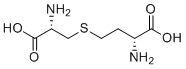
L-Cystathionine is a non-protein and sulfur-containing amino acid associated with the metabolism of sulfur-containing amino acids. As a key nonprotein amino acid related to metabolic conditions, it protects against Homocysteine-induced mitochondria-dependent apoptosis of vascular endothelial cells (HUVECs) and plays an important role in cardiovascular protection.
Physicochemical Properties
| Molecular Formula | C7H14N2O4S |
| Molecular Weight | 222.25 |
| Exact Mass | 222.067 |
| CAS # | 56-88-2 |
| Related CAS # | L-Cystathionine dihydrochloride;DL-Cystathionine;535-34-2;DL-Cystathionine dihydrochloride |
| PubChem CID | 439258 |
| Appearance | White to off-white solid powder |
| Density | 1.4±0.1 g/cm3 |
| Boiling Point | 481.0±45.0 °C at 760 mmHg |
| Melting Point | 312ºC |
| Flash Point | 244.7±28.7 °C |
| Vapour Pressure | 0.0±2.6 mmHg at 25°C |
| Index of Refraction | 1.592 |
| LogP | -0.13 |
| Hydrogen Bond Donor Count | 4 |
| Hydrogen Bond Acceptor Count | 7 |
| Rotatable Bond Count | 7 |
| Heavy Atom Count | 14 |
| Complexity | 212 |
| Defined Atom Stereocenter Count | 2 |
| SMILES | N[C@@H](CCSC[C@H](N)C(O)=O)C(O)=O |
| InChi Key | ILRYLPWNYFXEMH-WHFBIAKZSA-N |
| InChi Code | InChI=1S/C7H14N2O4S/c8-4(6(10)11)1-2-14-3-5(9)7(12)13/h4-5H,1-3,8-9H2,(H,10,11)(H,12,13)/t4-,5-/m0/s1 |
| Chemical Name | (2S)-2-amino-4-[(2R)-2-amino-2-carboxyethyl]sulfanylbutanoic acid |
| Synonyms | Cystathionine, L- L-(+)-Cystathionine L-Cystathionine |
| HS Tariff Code | 2934.99.9001 |
| Storage |
Powder-20°C 3 years 4°C 2 years In solvent -80°C 6 months -20°C 1 month Note: Please store this product in a sealed and protected environment (e.g. under nitrogen), avoid exposure to moisture. |
| Shipping Condition | Room temperature (This product is stable at ambient temperature for a few days during ordinary shipping and time spent in Customs) |
Biological Activity
| ln Vitro | Manhattan was markedly increased by homocysteine in HUVEC, an effect that L-cystathionine residues dramatically attenuated. Furthermore, L-cystathionine mitochondria increases mitochondrial membrane potential, inhibits the opening of the mitochondrial permeability transition pore (MPTP), decreases the production of superoxide label, and expresses Bax while blocking its transport to mitochondria. It also prevents cytochrome c from leaking from mitochondria into the cytoplasm. , and fold the caspase-3 and caspase-9 activities [1]. L-cystathionine plays a significant role in auxiliary tissues and is a mediator in the L-cysteine transsulfurization route of L-methionine via L-homocysteine [2]. |
| References |
[1]. L-Cystathionine Protects against Homocysteine-Induced Mitochondria-Dependent Apoptosis of Vascular Endothelial Cells. Oxid Med Cell Longev. 2019 Nov 25;2019:1253289. [2]. Synthesis and evaluation of L-cystathionine as a standard for amino acid analysis. Biosci Biotechnol Biochem. 2017 Jan;81(1):95-101. |
| Additional Infomation |
L-cystathionine is a modified amino acid generated by enzymic means from L-homocysteine and L-serine. It has a role as a human metabolite, a Saccharomyces cerevisiae metabolite, an Escherichia coli metabolite and a mouse metabolite. It is a tautomer of a L-cystathionine dizwitterion. L-Cystathionine is a metabolite found in or produced by Escherichia coli (strain K12, MG1655). Cystathionine is a metabolite found in or produced by Escherichia coli (strain K12, MG1655). L-cystathionine has been reported in Equisetum arvense, Daphnia pulex, and other organisms with data available. Cystathionine is an amino acid derivative that is an intermediate in the biosynthesis of cysteine. It is the product of the ligation of homocysteine and serine by cystathionine beta synthase. Sulfur-containing amino acid formed as an intermediate in the conversion of METHIONINE to CYSTEINE. |
Solubility Data
| Solubility (In Vitro) |
1M HCl : 50 mg/mL (~224.96 mM) H2O : ~25 mg/mL (~112.48 mM) DMSO : ~1 mg/mL (~4.50 mM) |
| Solubility (In Vivo) |
Solubility in Formulation 1: 3.33 mg/mL (14.98 mM) in PBS (add these co-solvents sequentially from left to right, and one by one), clear solution; with sonication. (Please use freshly prepared in vivo formulations for optimal results.) |
| Preparing Stock Solutions | 1 mg | 5 mg | 10 mg | |
| 1 mM | 4.4994 mL | 22.4972 mL | 44.9944 mL | |
| 5 mM | 0.8999 mL | 4.4994 mL | 8.9989 mL | |
| 10 mM | 0.4499 mL | 2.2497 mL | 4.4994 mL |