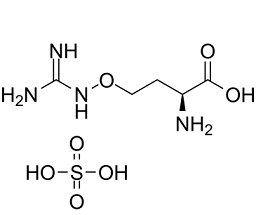
Physicochemical Properties
| Molecular Formula | C5H13N4O3+ |
| Molecular Weight | 177.18172 |
| Exact Mass | 274.058 |
| CAS # | 2219-31-0 |
| Related CAS # | L-Canavanine;543-38-4 |
| PubChem CID | 11957500 |
| Appearance | White to off-white solid powder |
| Boiling Point | 574ºC at 760mmHg |
| Melting Point | 160-165 °C (dec.) |
| Flash Point | 300.9ºC |
| Vapour Pressure | 1.21E-08mmHg at 25°C |
| LogP | 0.522 |
| Hydrogen Bond Donor Count | 6 |
| Hydrogen Bond Acceptor Count | 9 |
| Rotatable Bond Count | 5 |
| Heavy Atom Count | 17 |
| Complexity | 259 |
| Defined Atom Stereocenter Count | 1 |
| SMILES | C(CON=C(N)N)[C@@H](C(=O)O)N.OS(=O)(=O)O |
| InChi Key | MVIPJKVMOKFIEV-DFWYDOINSA-N |
| InChi Code | InChI=1S/C5H12N4O3.H2O4S/c6-3(4(10)11)1-2-12-9-5(7)8;1-5(2,3)4/h3H,1-2,6H2,(H,10,11)(H4,7,8,9);(H2,1,2,3,4)/t3-;/m0./s1 |
| Chemical Name | (2S)-2-amino-4-(diaminomethylideneamino)oxybutanoic acid;sulfuric acid |
| HS Tariff Code | 2934.99.9001 |
| Storage |
Powder-20°C 3 years 4°C 2 years In solvent -80°C 6 months -20°C 1 month Note: Please store this product in a sealed and protected environment, avoid exposure to moisture. |
| Shipping Condition | Room temperature (This product is stable at ambient temperature for a few days during ordinary shipping and time spent in Customs) |
Biological Activity
| ln Vitro | When L-canavanine sulfate (L-CAV) was given alone in arginine-rich media, it only slightly affected the cytotoxicity of HeLa, Hep G2, and SK-HEP-1 cells (IC50 values: 5 to 10 mM). L-canavanine sulfate's IC50 value in the HaCaT keratinocyte cell line was more than 10 mM, showing that it was not harmful to normal cells in vitro. The IC50 values of L-canavanine sulfate in HeLa, Hep G2, and SK-HEP-1 cells were 0.21±0.04, 0.64±0.16, and 1.18±0.14 mM in arginine-free media, respectively. When applied to HeLa and hepatocellular carcinoma cells, L-canavanine sulfate by itself has nearly little toxicity and can increase the cytotoxicity of vinblastine (VIN) and paclitaxel (PTX) [2]. |
| ln Vivo | L-canavanine sulfate (100 mg/kg) administration resulted in a complete attenuation of lipopolysaccharide-induced hypotension, a slight increase in mean arterial pressure of 20 mm Hg, and blood pressure close to basal levels. Eight hours following the treatment of L-canavanine sulfate (100 mg/kg), all endotoxemic rats (n = 7)[1] were administered lipopolysaccharide, with the exception of one. Li 210 leukemia animals live much longer when treated with L-canavanine, which suppresses DNA synthesis in Li 210 cells in vivo. A 44% increase in peak longevity was observed at the optimal dose of 18 g/kg. Due to medication toxicity, fatalities can happen at doses as low as 24 g/kg within the narrow therapeutic dose range [3]. |
| References |
[1]. L-canavanine restores blood pressure in a rat model of endotoxic shock. Eur J Pharmacol. 1994 Dec 12;271(1):87-92. [2]. Cytotoxic potentiation of vinblastine and paclitaxel by L-canavanine in human cervical cancer and hepatocellular carcinoma cells. Phytomedicine. 2015 Dec 15;22(14):1232-7. [3]. Antitumor activity of L-canavanine against L1210 murine leukemia. Cancer Res. 1980 Mar;40(3):535-7. |
| Additional Infomation | L-canavanine sulfate is an organic sulfate salt obtained by combining L-canavanine with one molar equivalent of sulfuric acid. It has a role as a plant metabolite. It contains a L-canavanine(1+). |
Solubility Data
| Solubility (In Vitro) | H2O : ~100 mg/mL (~364.63 mM) |
| Solubility (In Vivo) |
Solubility in Formulation 1: 50 mg/mL (182.32 mM) in PBS (add these co-solvents sequentially from left to right, and one by one), clear solution; with sonication. (Please use freshly prepared in vivo formulations for optimal results.) |
| Preparing Stock Solutions | 1 mg | 5 mg | 10 mg | |
| 1 mM | 5.6440 mL | 28.2199 mL | 56.4398 mL | |
| 5 mM | 1.1288 mL | 5.6440 mL | 11.2880 mL | |
| 10 mM | 0.5644 mL | 2.8220 mL | 5.6440 mL |