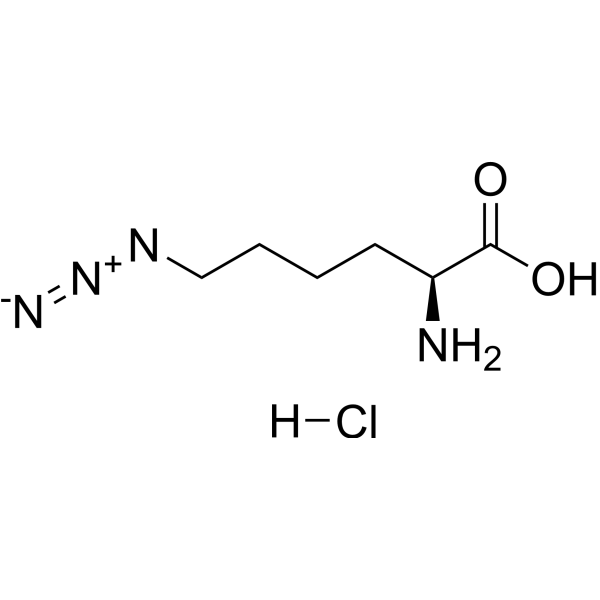
Physicochemical Properties
| Molecular Formula | C6H13CLN4O2 |
| Molecular Weight | 208.65 |
| Exact Mass | 208.072 |
| CAS # | 1454334-76-9 |
| PubChem CID | 121235322 |
| Appearance | White to off-white solid powder |
| Hydrogen Bond Donor Count | 3 |
| Hydrogen Bond Acceptor Count | 5 |
| Rotatable Bond Count | 6 |
| Heavy Atom Count | 13 |
| Complexity | 188 |
| Defined Atom Stereocenter Count | 1 |
| SMILES | C(CCN=[N+]=[N-])C[C@@H](C(=O)O)N.Cl |
| InChi Key | RCEAACZNVVRXSJ-JEDNCBNOSA-N |
| InChi Code | InChI=1S/C6H12N4O2.ClH/c7-5(6(11)12)3-1-2-4-9-10-8;/h5H,1-4,7H2,(H,11,12);1H/t5-;/m0./s1 |
| Chemical Name | (2S)-2-amino-6-azidohexanoic acid;hydrochloride |
| HS Tariff Code | 2934.99.9001 |
| Storage |
Powder-20°C 3 years 4°C 2 years In solvent -80°C 6 months -20°C 1 month Note: Please store this product in a sealed and protected environment, avoid exposure to moisture. |
| Shipping Condition | Room temperature (This product is stable at ambient temperature for a few days during ordinary shipping and time spent in Customs) |
Biological Activity
| ln Vitro | After being transfected with pMaRSC and treated for six hours with 1.5 mM of L-Azidonorleucine hydrochloride (AnI), CHO cells were permeabilized, fixed, and given alkyne-TAMRA treatment. Anl cells selectively incorporated cellular proteins, as evidenced by the observation of TAMRA fluorescence exclusively in mCherry-expressing cells [1]. |
| ln Vivo | To label and identify neuronal populations in the brain, an average daily intake of L-Azidonorleucine (ANL) of 0.9 mg/day/g body weight over a period of 21 days is advised when ANL is delivered through drinking water. Other cell types can be labeled with lower doses or shorter labeling times. It is advised to experiment with various intraperitoneal injection doses of L-azidonorleucine within the 4-400 mM range. It is advised to use intraperitoneal injection; to label specific neuronal populations (such as the excitatory neurons in the hippocampus), a 400 mM dose (ip volume: 10 ml/kg) should be administered once daily for one week. When labeling different cell types or when longer labeling times are needed, lower doses—such as 4 mM—may be used [2]. |
| References |
[1]. Engineered Aminoacyl-tRNA Synthetase for Cell-Selective Analysis of Mammalian Protein Synthesis. J Am Chem Soc. 2016 Apr 6;138(13):4278-81. [2]. Cell-type-specific metabolic labeling, detection and identification of nascent proteomes in vivo. Nat Protoc. 2019 Feb;14(2):556-575. |
Solubility Data
| Solubility (In Vitro) | H2O: 125 mg/mL (599.09 mM) |
| Solubility (In Vivo) |
Solubility in Formulation 1: 100 mg/mL (479.27 mM) in PBS (add these co-solvents sequentially from left to right, and one by one), clear solution; with sonication. (Please use freshly prepared in vivo formulations for optimal results.) |
| Preparing Stock Solutions | 1 mg | 5 mg | 10 mg | |
| 1 mM | 4.7927 mL | 23.9636 mL | 47.9272 mL | |
| 5 mM | 0.9585 mL | 4.7927 mL | 9.5854 mL | |
| 10 mM | 0.4793 mL | 2.3964 mL | 4.7927 mL |