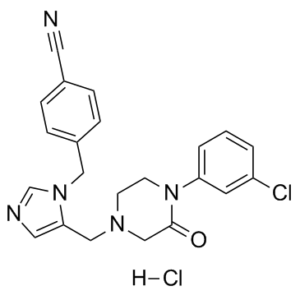
L-778123 (L778123) hydrochloride is a novel and potent inhibitor of FPTase (Farnesyl:protein transferase) and GGPTase-I (geranylgeranyl:protein transferase type-I) (IC50 = 2 nM and 98 nM) with anticancer activity. L-778123 can completely inhibit Ki-Ras prenylation. The combination of L-778,123 and radiotherapy at dose level 1 showed acceptable toxicity in patients with locally advanced pancreatic cancer. Radiosensitization of a patient-derived pancreatic cancer cell line was observed.
Physicochemical Properties
| Molecular Formula | C22H20N5OCL.HCL |
| Molecular Weight | 442.34104 |
| Exact Mass | 441.112 |
| CAS # | 253863-00-2 |
| Related CAS # | L-778123;183499-57-2 |
| PubChem CID | 216453 |
| Appearance | White to off-white solid powder |
| Boiling Point | 698.9ºC at 760 mmHg |
| Flash Point | 376.5ºC |
| Vapour Pressure | 2.22E-19mmHg at 25°C |
| LogP | 4.11 |
| Hydrogen Bond Donor Count | 1 |
| Hydrogen Bond Acceptor Count | 4 |
| Rotatable Bond Count | 5 |
| Heavy Atom Count | 30 |
| Complexity | 614 |
| Defined Atom Stereocenter Count | 0 |
| InChi Key | YNBSQYGTJLIPJS-UHFFFAOYSA-N |
| InChi Code | InChI=1S/C22H20ClN5O.ClH/c23-19-2-1-3-20(10-19)28-9-8-26(15-22(28)29)14-21-12-25-16-27(21)13-18-6-4-17(11-24)5-7-18;/h1-7,10,12,16H,8-9,13-15H2;1H |
| Chemical Name | 4-((5-((4-(3-chlorophenyl)-3-oxopiperazin-1-yl)methyl)-1H-imidazol-1-yl)methyl)benzonitrile dihydrochloride |
| Synonyms | L778123 HCl; L-778,123; L 778,123 HCl; L-778123; L 778123; L778,123; L-778123 hydrochloride |
| HS Tariff Code | 2934.99.9001 |
| Storage |
Powder-20°C 3 years 4°C 2 years In solvent -80°C 6 months -20°C 1 month Note: Please store this product in a sealed and protected environment, avoid exposure to moisture. |
| Shipping Condition | Room temperature (This product is stable at ambient temperature for a few days during ordinary shipping and time spent in Customs) |
Biological Activity
| ln Vitro |
L778123 showed weak cytotoxic activity with IC50 of 100 and 125 for A549 and HT-29 cell lines, respectively. The combination of doxorubicin and L778123 can decrease IC50 of doxorubicin in both cell lines significantly.[2] FTI L-778,123 substantially inhibited myeloid leukemia cell proliferation as quantified by MTS assays with IC50 values ranging from 0.2 μM–1.8 μM for cell lines and 0.1 μM–161.8 μM in primary samples. [3] L-778,123 induced a G2M blockade followed by apoptosis in NB-4 (FAB M3) cells. Western blotting demonstrated that blockade of RAS protein prenylation by L-778,123 was both time- and concentration-dependent. H-RAS prenylation in HL-60 cells was almost completely inhibited within 12 hours of treatment with 0.1, 0.5 or 1 μM L-778,123, and by 6 hours with 5 μM of the drug.[3] Western blotting and FACS analysis showed that L-778,123 also inhibited phosphorylation of MEK-1/2 and MAPK-1/2, down-stream components of the RAS-to-MAPK signaling cascade. Treatment of HL-60 cells with L-778,123 (5 μM, 24 hours) led to approximately 40–50% lower levels of intracellular phosphorylated MEK-1/2. Similarly, L-778,123 treatment caused both time- and concentration-dependent reduction of activated, diphosphorylated MAPK-1/2 levels. Higher L-778,123 concentrations (0.5, 1 and 5 μM) potently decreased diphosphorylated MAPK-1/2 levels within 6 to 12 hours, while a lower drug concentration (0.1 μM) elicited similar effects after 36 to 48 hours.[3] The effect of L-778,123 on T cell activation (CD71 or CD25 surface expression) was determined by flow cytometry. Peripheral blood mononuclear cell (PBMC) proliferation in the presence of L-778,123 and/or cyclosporine (CsA) was determined by [3H]thymidine incorporation. The ability of L-778,123 to inhibit IL-2 receptor signaling was investigated by measuring IL-2 induced proliferation in CTLL-2 cells and IL-2 prevention of apoptosis in activated human PBMC. L-778,123 inhibited lectin induced expression of CD71 and CD25 with IC50's of 6.48 +/- 1.31 microM and 84.1 +/- 50.0 microM, respectively. PBMC proliferation was inhibited by L-778,123 with an IC50 of 0.92 +/- 0.23 microM, and addition of CsA did not increase the potency. L-778,123 did not inhibit IL-2 and IFN-gamma production by T cells. L-778,123 abrogated IL-2 induced proliferation of CTLL-2 cells with an IC50 of 0.81 +/- 0.44 microM. However, L-778,123 minimally reversed the prosurvival effect of IL-2 in activated lymphocytes. IL-2 ligand and receptor production during T cell activation are relatively unaffected by L-778,123. However, the activation and proliferative effects of IL-2 on T cells are potently blocked by L-778,123. [4] |
| References |
[1]. Preclinical and clinical pharmacodynamic assessment of L-778,123, a dual inhibitor of farnesyl:protein transferase and geranylgeranyl:protein transferase type-I. Mol Cancer Ther. 2002 Jul;1(9):747-758. [2]. Comparison of Cytotoxic Activity of L778123 as a Farnesyltranferase Inhibitor and Doxorubicin against A549 and HT-29 Cell Lines. Adv Pharm Bull. 2013;3(1):73-77. [3]. The Farnesyltransferase Inhibitor (FTI) L-778,123 Displays Promising Anti-Leukemia Activity. Blood (2008); 112 (11): 2627. [4]. Inhibition of lymphocyte activation and function by the prenylation inhibitor L-778,123. Invest New Drugs. 2005 Jan;23(1):21-9. |
| Additional Infomation |
L-778,123 hydrochloride is the hydrochloride salt of L-778,123. It is a dual inhibitor of FPTase and GGPTase-I (IC50 of 2nM and 98nm, respectively) and exhibits anti-cancer properties. It has a role as an antineoplastic agent, an EC 2.5.1.58 (protein farnesyltransferase) inhibitor, an EC 2.5.1.59 (protein geranylgeranyltransferase type I) inhibitor and a radiosensitizing agent. It contains a L-778,123 (free base). Farnesyltransferase/Geranylgeranyltransferase Inhibitor L-778,123 is a benzonitrile derivative capable of inhibiting some prenyltransferases. L-778,123 is a dual inhibitor of farnesyl:protein and geranylgeranyl:protein transferases; both enzymes catalyze prenylation of oncoprotein KRAS, a prerequisite step in activation of KRAS in signal transduction pathway of apoptosis. Although this agent was developed in part as an anti-KRAS agent, L-778,123 failed in a Phase I trial to inhibit KRAS, which is associated with many types of solid tumors. |
Solubility Data
| Solubility (In Vitro) |
DMSO : ≥ 25 mg/mL (~56.52 mM) H2O : ~25 mg/mL (~56.52 mM) |
| Solubility (In Vivo) |
Solubility in Formulation 1: ≥ 2.25 mg/mL (5.09 mM) (saturation unknown) in 10% DMSO + 40% PEG300 + 5% Tween80 + 45% Saline (add these co-solvents sequentially from left to right, and one by one), clear solution. For example, if 1 mL of working solution is to be prepared, you can add 100 μL of 22.5 mg/mL clear DMSO stock solution to 400 μL PEG300 and mix evenly; then add 50 μL Tween-80 to the above solution and mix evenly; then add 450 μL normal saline to adjust the volume to 1 mL. Preparation of saline: Dissolve 0.9 g of sodium chloride in 100 mL ddH₂ O to obtain a clear solution. Solubility in Formulation 2: ≥ 2.25 mg/mL (5.09 mM) (saturation unknown) in 10% DMSO + 90% (20% SBE-β-CD in Saline) (add these co-solvents sequentially from left to right, and one by one), clear solution. For example, if 1 mL of working solution is to be prepared, you can add 100 μL of 22.5 mg/mL clear DMSO stock solution to 900 μL of 20% SBE-β-CD physiological saline solution and mix evenly. Preparation of 20% SBE-β-CD in Saline (4°C,1 week): Dissolve 2 g SBE-β-CD in 10 mL saline to obtain a clear solution. Solubility in Formulation 3: ≥ 2.25 mg/mL (5.09 mM) (saturation unknown) in 10% DMSO + 90% Corn Oil (add these co-solvents sequentially from left to right, and one by one), clear solution. For example, if 1 mL of working solution is to be prepared, you can add 100 μL of 22.5 mg/mL clear DMSO stock solution to 900 μL of corn oil and mix evenly. Solubility in Formulation 4: 100 mg/mL (226.07 mM) in PBS (add these co-solvents sequentially from left to right, and one by one), suspension solution; Need ultrasonic and adjust pH to 5 with 1M HCl. (Please use freshly prepared in vivo formulations for optimal results.) |
| Preparing Stock Solutions | 1 mg | 5 mg | 10 mg | |
| 1 mM | 2.2607 mL | 11.3035 mL | 22.6070 mL | |
| 5 mM | 0.4521 mL | 2.2607 mL | 4.5214 mL | |
| 10 mM | 0.2261 mL | 1.1304 mL | 2.2607 mL |