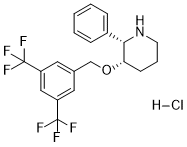
L-733,060 HCl (L-733060) is a novel and potent antagonist for the NK1 receptor with a Ki of 0.08 nM. It has antiinflammatory, anticancer and anti-hepatotoxic effects in animal models.
Physicochemical Properties
| Molecular Formula | C20H20CLF6NO |
| Molecular Weight | 439.8264 |
| Exact Mass | 439.114 |
| Elemental Analysis | C, 54.62; H, 4.58; Cl, 8.06; F, 25.92; N, 3.18; O, 3.64 |
| CAS # | 148687-76-7 |
| Related CAS # | 148687-76-7 (HCl);148700-85-0; |
| PubChem CID | 11957600 |
| Appearance | White to off-white solid powder |
| LogP | 6.864 |
| Hydrogen Bond Donor Count | 2 |
| Hydrogen Bond Acceptor Count | 8 |
| Rotatable Bond Count | 4 |
| Heavy Atom Count | 29 |
| Complexity | 466 |
| Defined Atom Stereocenter Count | 2 |
| SMILES | Cl.C1C=CC([C@H]2NCCC[C@H]2OCC2C=C(C(F)(F)F)C=C(C(F)(F)F)C=2)=CC=1 |
| InChi Key | DYEUTIUITGHIEO-APTPAJQOSA-N |
| InChi Code | InChI=1S/C20H19F6NO.ClH/c21-19(22,23)15-9-13(10-16(11-15)20(24,25)26)12-28-17-7-4-8-27-18(17)14-5-2-1-3-6-14/h1-3,5-6,9-11,17-18,27H,4,7-8,12H21H/t17-,18-/m0./s1 |
| Chemical Name | (2S,3S)-3-{[3,5-bis(trifluoromethyl)benzyl]oxy}-2-phenylpiperidine hydrochloride |
| Synonyms | L-733060; L733060; L 733060; L-733,060; L733,060;L-733060 hydrochloride; (2R,3R)-3-[[3,5-bis(trifluoromethyl)phenyl]methoxy]-2-phenylpiperidine;hydrochloride; MLS002153399; 3-([3,5-BIS(TRIFLUOROMETHYL)PHENYL]METHOXY)-2-PHENYL-PIPERIDINE HYDROCHLORIDE; SMR001230778; SCHEMBL8537737; L 733,060 |
| HS Tariff Code | 2934.99.9001 |
| Storage |
Powder-20°C 3 years 4°C 2 years In solvent -80°C 6 months -20°C 1 month Note: Please store this product in a sealed and protected environment, avoid exposure to moisture. |
| Shipping Condition | Room temperature (This product is stable at ambient temperature for a few days during ordinary shipping and time spent in Customs) |
Biological Activity
| Targets | NK1 receptor |
| ln Vitro | In CHO cells transfected with the human tachykinin NK1 receptor, L-733060 (30-300 nM) suppresses in a concentration-dependent manner the [Ca2+]i mobilization elicited by substance P (100 nM) [1]. L-733060 (2.5–20 μM; 48–96 hours) cytotoxically affects COLO 858 cells in a concentration-dependent manner [2]. With an IC50 of 27.5 μM and 18.9 μM at 24 and 48 hours, respectively, L-733060 (10-30 μM; 24 and 48 hours) suppresses the proliferation of MEL H0 cells [2]. With an IC50 of 33.8 μM and 31.5 μM at 30 h and 72 h, respectively, L-733060 (20-50 μM; and/or 72 h) suppresses the proliferation of COLO 679 cells [2]. |
| ln Vivo | Rat dura mater electrically driven plasma extravasation is inhibited by L-733060 (10-1000 μg/kg; iv) [1]. L-733060 (300-3000 μg/kg; iv) In rats, both awake and under anesthesia, no noteworthy hypotensive or bradycardic effects were noted at dosages <3000 μg/kg [1]. |
| Enzyme Assay | This study investigated the properties of a novel piperidine ether-based tachykinin NK1 receptor antagonist L-733,060, ((2S,3S)-3-((3,5-bis(trifluoromethyl)phenyl)methyloxy)-2-phenyl piperidine and its 2R,3R-enantiomer L-733,061 on [Ca2+]i mobilisation in Chinese hamster ovary cells transfected with human tachykinin NK1 receptors, compared to their effects in rodent cardiovascular and neurogenic plasma extravasation assays. Using FURA-2-imaging techniques, L-733,060 inhibited substance P-induced [Ca2+]i mobilisation with an estimated affinity of 0.8 nM whereas L-733,061 (30-300 nM) did not. No significant effects of L-733,060 were observed on mean arterial blood pressure or heart rate in conscious or anaesthetised rats at doses of < 3000 micrograms kg-1 i.v. L-733,060 also stereoselectively inhibited neurogenic plasma extravasation in rat dura produced by electrical stimulation of trigeminal nerves with an ID50 of 212 +/- 19 micrograms kg-1 i.v. Thus, L-733,060 is a novel antagonist of human tachykinin NK1 receptors which stereoselectively inhibits neurogenic plasma extravasation at doses that do not cause adverse cardiovascular effects[1]. |
| Cell Assay |
Cell proliferation assay [2] Cell Types: COLO 858 Cell Tested Concentrations: 2.5, 5, 10, 20 μM Incubation Duration: 0, 48, 96 h Experimental Results: Inhibited cell growth, IC50 at 48 h and 96 h were 8.7 μM and 96 h, respectively 7.1 μM, respectively. |
| Animal Protocol |
Animal/Disease Models: Male SD (SD (Sprague-Dawley)) rat (200 g), electrical stimulation of the trigeminal ganglion [1] Doses: 10, 100, 1000 mg/kg Route of Administration: intravenous (iv) (iv)injection Experimental Results: Significant dose-related effects on plasma extravasation The inhibitory effect ID50 is 212±19 μg/kg. |
| References |
[1]. L-733,060, a novel tachykinin NK1 receptor antagonist; effects in [Ca2+]i mobilisation, cardiovascular and dural extravasation assays. Eur J Pharmacol. 1996 Dec 12; 317(1):129-35. [2]. Antitumoral action of the neurokinin-1 receptor antagonist L-733 060 on human melanoma cell lines. Melanoma Res. 2004 Jun;14(3):183-8. |
| Additional Infomation |
Melanoma represents 1% of all cancers and accounts for approximately 65% of skin cancer deaths. At present, effective treatment does not exist. Substance P (SP) is a neuropeptide expressed in invasive malignant melanomas. We studied the in vitro growth inhibitory capacity of the potent and long-acting neurokinin-1 (NK1) receptor antagonist L-733 060 at concentration ranges of 2.5-20 microM, 10-30 microM and 20-50 microM in the melanoma cell lines COLO 858, MEL H0 and COLO 679, respectively. A Coulter counter was used to determine the number of viable cells, and the tetrazolium compound 3-(4,5-dimethylthiazol-2-yl)-5-(3-carboxymethoxyphenyl)2-(4-sulphophenyl)-2H-tetrazolium, inner salt (MTS) colorimetric method was used to evaluate cell proliferation. L-733 060 inhibited the growth of all three cell lines in a dose-dependent manner. The 50% inhibition concentration (IC(50)) was 8.7 microM at 48 h and 7.1 microM at 96 h for COLO 858, 27.5 microM at 24 h and 18.9 microM at 48 h for MEL H0, and 33.8 microM at 30 h and 31.5 microM at 72 h for COLO 679. These findings indicate that the NK1 receptor antagonist L-733 060 acts as an antitumoral agent. This action, shown here for the first time, suggests that the NK1 receptor antagonist L-733 060 could be a promising therapeutic drug in the treatment of the human melanoma.[2] The antitumoral activity of L-733 060 reported here is dose-dependent. We observed maximal cytotoxicity at 20 μM for COLO 858, 30 μM for MEL H0 and 50 μM for COLO 679. It is possible that these differences could be related to the number of NK1 receptors expressed in each cell line. In addition, they may be correlated with the stage of tumour progression of each tumour cell line, as denoted by aggressiveness of the tumour (COLO 679 is from a soft tissue metastasis of a malignant melanoma, MEL-HO is from primary tumour cells expressing oncogene c-myc mRNA, and COLO 858 is from a lymph node).[2] The data mentioned above suggest that treatment with NK1 receptor antagonists in cancer cell lines expressing SP could have an anticancer effect. Further studies are necessary in order to know more about the mechanisms by which antagonists of the tachykinin receptors produce growth inhibition of cancer cell lines. It would be very interesting to know whether the treatment of cancer cell lines with NK1 receptor inhibitors that have been studied initially in humans, such as vofopitant (GR-205171), CP-122721, ezlopitant (CJ-11974), MK-869 (L-754030) and its prodrug L-758298 [26], would produce the same growth inhibitory action as found using L-733 060.[2] It is known that the NK1 antagonist aprepitant (MK-869), an agent structurally unrelated to L-733 060 that has antidepressant activity, was as efficient as the antidepressant drug paroxetine in the treatment of the depression. This NK1 antagonist was well tolerated and no statistically significant differences in the frequency of adverse events compared with placebo were observed. SP and NK1 receptors are present in the limbic system, including the hypothalamus and amygdala. In addition, SP may be involved in the integration of the emotional response to stress, suggesting the possibility that in the pathogenesis of depression there is an alteration in the SP/NK1 receptor system [6]. Finally, as we have demonstrated here, the NK1 receptor antagonist L-733 060 has antitumoral activity in human melanoma cell lines. These findings suggest that emotional behaviour and cancer may have a similar mechanism related to alterations in the SP/NK1 receptor system.[2] In summary, the antitumoral activity of the NK1 receptor antagonist L-733 060 on melanoma human cell lines in vitro is described for the first time in this study. This observation suggests that inhibition of the SP/NK1 receptor system may be a potentially useful novel treatment for the management of melanoma.[2] |
Solubility Data
| Solubility (In Vitro) | H2O : ~22 mg/mL (~50.02 mM) |
| Solubility (In Vivo) |
Note: Listed below are some common formulations that may be used to formulate products with low water solubility (e.g. < 1 mg/mL), you may test these formulations using a minute amount of products to avoid loss of samples. Injection Formulations (e.g. IP/IV/IM/SC) Injection Formulation 1: DMSO : Tween 80: Saline = 10 : 5 : 85 (i.e. 100 μL DMSO stock solution → 50 μL Tween 80 → 850 μL Saline) *Preparation of saline: Dissolve 0.9 g of sodium chloride in 100 mL ddH ₂ O to obtain a clear solution. Injection Formulation 2: DMSO : PEG300 :Tween 80 : Saline = 10 : 40 : 5 : 45 (i.e. 100 μL DMSO → 400 μLPEG300 → 50 μL Tween 80 → 450 μL Saline) Injection Formulation 3: DMSO : Corn oil = 10 : 90 (i.e. 100 μL DMSO → 900 μL Corn oil) Example: Take the Injection Formulation 3 (DMSO : Corn oil = 10 : 90) as an example, if 1 mL of 2.5 mg/mL working solution is to be prepared, you can take 100 μL 25 mg/mL DMSO stock solution and add to 900 μL corn oil, mix well to obtain a clear or suspension solution (2.5 mg/mL, ready for use in animals). Injection Formulation 4: DMSO : 20% SBE-β-CD in saline = 10 : 90 [i.e. 100 μL DMSO → 900 μL (20% SBE-β-CD in saline)] *Preparation of 20% SBE-β-CD in Saline (4°C,1 week): Dissolve 2 g SBE-β-CD in 10 mL saline to obtain a clear solution. Injection Formulation 5: 2-Hydroxypropyl-β-cyclodextrin : Saline = 50 : 50 (i.e. 500 μL 2-Hydroxypropyl-β-cyclodextrin → 500 μL Saline) Injection Formulation 6: DMSO : PEG300 : castor oil : Saline = 5 : 10 : 20 : 65 (i.e. 50 μL DMSO → 100 μLPEG300 → 200 μL castor oil → 650 μL Saline) Injection Formulation 7: Ethanol : Cremophor : Saline = 10: 10 : 80 (i.e. 100 μL Ethanol → 100 μL Cremophor → 800 μL Saline) Injection Formulation 8: Dissolve in Cremophor/Ethanol (50 : 50), then diluted by Saline Injection Formulation 9: EtOH : Corn oil = 10 : 90 (i.e. 100 μL EtOH → 900 μL Corn oil) Injection Formulation 10: EtOH : PEG300:Tween 80 : Saline = 10 : 40 : 5 : 45 (i.e. 100 μL EtOH → 400 μLPEG300 → 50 μL Tween 80 → 450 μL Saline) Oral Formulations Oral Formulation 1: Suspend in 0.5% CMC Na (carboxymethylcellulose sodium) Oral Formulation 2: Suspend in 0.5% Carboxymethyl cellulose Example: Take the Oral Formulation 1 (Suspend in 0.5% CMC Na) as an example, if 100 mL of 2.5 mg/mL working solution is to be prepared, you can first prepare 0.5% CMC Na solution by measuring 0.5 g CMC Na and dissolve it in 100 mL ddH2O to obtain a clear solution; then add 250 mg of the product to 100 mL 0.5% CMC Na solution, to make the suspension solution (2.5 mg/mL, ready for use in animals). Oral Formulation 3: Dissolved in PEG400 Oral Formulation 4: Suspend in 0.2% Carboxymethyl cellulose Oral Formulation 5: Dissolve in 0.25% Tween 80 and 0.5% Carboxymethyl cellulose Oral Formulation 6: Mixing with food powders Note: Please be aware that the above formulations are for reference only. InvivoChem strongly recommends customers to read literature methods/protocols carefully before determining which formulation you should use for in vivo studies, as different compounds have different solubility properties and have to be formulated differently. (Please use freshly prepared in vivo formulations for optimal results.) |
| Preparing Stock Solutions | 1 mg | 5 mg | 10 mg | |
| 1 mM | 2.2736 mL | 11.3680 mL | 22.7361 mL | |
| 5 mM | 0.4547 mL | 2.2736 mL | 4.5472 mL | |
| 10 mM | 0.2274 mL | 1.1368 mL | 2.2736 mL |