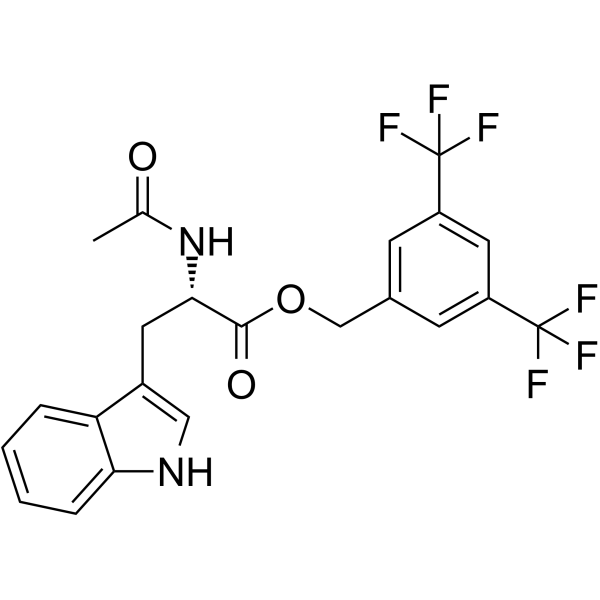
Physicochemical Properties
| Molecular Formula | C22H18F6N2O3 |
| Molecular Weight | 472.39 |
| Exact Mass | 472.122 |
| CAS # | 148451-96-1 |
| PubChem CID | 132837 |
| Appearance | White to off-white solid powder |
| Melting Point | 147-148 ℃(lit.) |
| LogP | 5.387 |
| Hydrogen Bond Donor Count | 2 |
| Hydrogen Bond Acceptor Count | 9 |
| Rotatable Bond Count | 7 |
| Heavy Atom Count | 33 |
| Complexity | 677 |
| Defined Atom Stereocenter Count | 1 |
| SMILES | CC(=O)N[C@@H](CC1=CNC2=CC=CC=C21)C(=O)OCC3=CC(=CC(=C3)C(F)(F)F)C(F)(F)F |
| InChi Key | BYYQYXVAWXAYQC-IBGZPJMESA-N |
| InChi Code | InChI=1S/C22H18F6N2O3/c1-12(31)30-19(8-14-10-29-18-5-3-2-4-17(14)18)20(32)33-11-13-6-15(21(23,24)25)9-16(7-13)22(26,27)28/h2-7,9-10,19,29H,8,11H2,1H3,(H,30,31)/t19-/m0/s1 |
| Chemical Name | [3,5-bis(trifluoromethyl)phenyl]methyl (2S)-2-acetamido-3-(1H-indol-3-yl)propanoate |
| Synonyms | L 732138; L732138; 3,5-bis(TFM)Bz NAcTrp |
| HS Tariff Code | 2934.99.9001 |
| Storage |
Powder-20°C 3 years 4°C 2 years In solvent -80°C 6 months -20°C 1 month |
| Shipping Condition | Room temperature (This product is stable at ambient temperature for a few days during ordinary shipping and time spent in Customs) |
Biological Activity
| ln Vitro | Cytotoxicity is concentration-dependent and is produced in COLO 858, MEL HO, and COLO 679 cells treated with L-732138 (0 -100 µM; initial doubling time). With an IC50 of 44.6 μM in COLO 858 cells, 76.3 μM in MEL HO cells, and 64.2 μM in COLO 679 cells, L-732138 suppresses cell growth. Substance P (SP) mitogen stimulation is blocked by L-732138 [1]. Following L-732,138 treatment, a significant number of apoptotic cells were discovered in the melanoma cell lines COLO 858, MEL HO, and COLO 679. Three melanoma cell lines had an IC50 concentration of 43.6% apoptotic cells in DAPI-stained cultures, and an IC100 concentration of 51.4% apoptotic cells [1]. |
| ln Vivo | Vagus nerve-induced plasma extravasation was eliminated and LPS enhancement was markedly decreased in male Dunkin-Hartley guinea pigs treated with L-732138 (10-4-10-2 mol/kg; intravenous injection; 15 min duration). LPS-enhanced vagus nerve-induced plasma extravasation cannot be fully inhibited by L-732138 or SOD administration alone, but it can be blocked by the combination of the two pretreatments [3]. |
| Cell Assay |
Cell Proliferation Assay[1] Cell Types: COLO 858, MEL HO and COLO 679 Cell Tested Concentrations: 0 µM, 20 µM, 40 µM, 60 µM, 80 µM, 100 µM Incubation Duration: First Doubling Time Experimental Results: Produced Concentration - dependent cytotoxicity. |
| Animal Protocol |
Animal/Disease Models: Male Dunkin-Hartley guinea pigs (350-500 g) injected with lipopolysaccharide (LPS) [3] Doses: 10-4 mol/kg, 10-3 mol/kg and 10-2 mol/kg Route of Administration: intravenous (iv) (iv)Injection Injection; 15 min Experimental Results: Eliminates vagus nerve-induced plasma leakage in tracheobronchial tissue and dose-dependently inhibits vagus nerve-induced plasma leakage in LPS-enhanced tracheobronchial tissue. |
| References |
[1]. The NK-1 Receptor Antagonist L-732,138 Induces Apoptosis and Counteracts Substance P-Related Mitogenesis in Human Melanoma Cell Lines. Cancers (Basel). 2010 Apr 20;2(2):611-23. [2]. Characterization of the interaction of N-acyl-L-tryptophan benzyl ester neurokinin antagonists with the human neurokinin-1 receptor. J Biol Chem. 1994 Mar 4;269(9):6587-91. [3]. Lipopolysaccharide enhances neurogenic plasma exudation in guinea-pig airways. Br J Pharmacol. 1998 Oct;125(4):711-6. |
Solubility Data
| Solubility (In Vitro) | DMSO : ~250 mg/mL (~529.23 mM) |
| Solubility (In Vivo) |
Solubility in Formulation 1: ≥ 6.25 mg/mL (13.23 mM) (saturation unknown) in 10% DMSO + 40% PEG300 + 5% Tween80 + 45% Saline (add these co-solvents sequentially from left to right, and one by one), clear solution. For example, if 1 mL of working solution is to be prepared, you can add 100 μL of 62.5 mg/mL clear DMSO stock solution to 400 μL PEG300 and mix evenly; then add 50 μL Tween-80 to the above solution and mix evenly; then add 450 μL normal saline to adjust the volume to 1 mL. Preparation of saline: Dissolve 0.9 g of sodium chloride in 100 mL ddH₂ O to obtain a clear solution. Solubility in Formulation 2: ≥ 6.25 mg/mL (13.23 mM) (saturation unknown) in 10% DMSO + 90% Corn Oil (add these co-solvents sequentially from left to right, and one by one), clear solution. For example, if 1 mL of working solution is to be prepared, you can add 100 μL of 62.5 mg/mL clear DMSO stock solution to 900 μL corn oil and mix evenly. (Please use freshly prepared in vivo formulations for optimal results.) |
| Preparing Stock Solutions | 1 mg | 5 mg | 10 mg | |
| 1 mM | 2.1169 mL | 10.5845 mL | 21.1689 mL | |
| 5 mM | 0.4234 mL | 2.1169 mL | 4.2338 mL | |
| 10 mM | 0.2117 mL | 1.0584 mL | 2.1169 mL |