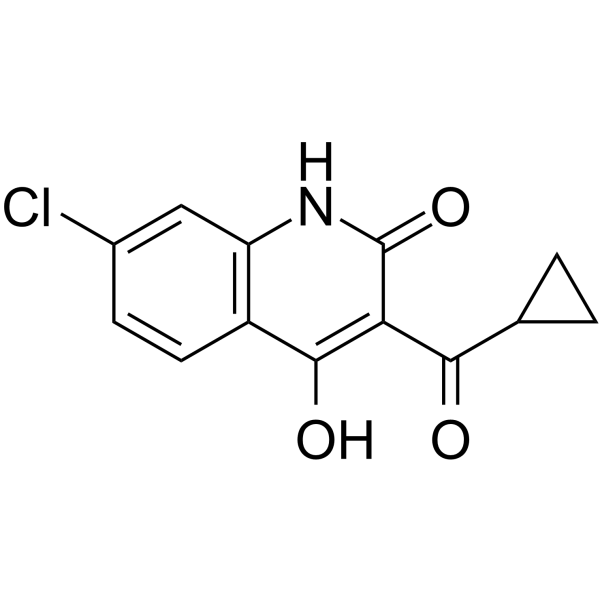
Physicochemical Properties
| Molecular Formula | C13H10NO3CL |
| Molecular Weight | 263.6764 |
| Exact Mass | 263.035 |
| CAS # | 151057-13-5 |
| PubChem CID | 54687453 |
| Appearance | White to off-white solid powder |
| Density | 1.573g/cm3 |
| Boiling Point | 437.3ºC at 760mmHg |
| Flash Point | 218.3ºC |
| Vapour Pressure | 2.03E-08mmHg at 25°C |
| Index of Refraction | 1.694 |
| LogP | 2.479 |
| Hydrogen Bond Donor Count | 2 |
| Hydrogen Bond Acceptor Count | 3 |
| Rotatable Bond Count | 2 |
| Heavy Atom Count | 18 |
| Complexity | 442 |
| Defined Atom Stereocenter Count | 0 |
| InChi Key | MXEFWCFPCLDOOG-UHFFFAOYSA-N |
| InChi Code | InChI=1S/C13H10ClNO3/c14-7-3-4-8-9(5-7)15-13(18)10(12(8)17)11(16)6-1-2-6/h3-6H,1-2H2,(H2,15,17,18) |
| Chemical Name | 7-chloro-3-(cyclopropanecarbonyl)-4-hydroxy-1H-quinolin-2-one |
| HS Tariff Code | 2934.99.9001 |
| Storage |
Powder-20°C 3 years 4°C 2 years In solvent -80°C 6 months -20°C 1 month |
| Shipping Condition | Room temperature (This product is stable at ambient temperature for a few days during ordinary shipping and time spent in Customs) |
Biological Activity
| ln Vivo | L-701252 (50 mg/kg; intraperitoneally) offered small but not significant protection [1]. |
| Animal Protocol |
Animal/Disease Models: 3-month-old male Mongolian gerbil (60 g) [1] Doses: 50 mg/kg Route of Administration: intraperitoneal (ip) injection Experimental Results: Provided a small but insignificant protective effect. |
| References |
[1]. Stone TW. Development and therapeutic potential of kynurenic acid and kynurenine derivatives for neuroprotection. Trends Pharmacol Sci. 2000;21(4):149-154. [2]. Failure of glycine site NMDA receptor antagonists to protect against L-2-chloropropionic acid-induced neurotoxicity highlights the uniqueness of cerebellar NMDA receptors. Brain Res. 1996;738(2):236-242. |
| Additional Infomation | 7-chloro-3-[cyclopropyl(oxo)methyl]-4-hydroxy-1H-quinolin-2-one is a quinolone and a hydroxyquinoline. |
Solubility Data
| Solubility (In Vitro) | DMSO : ~10 mg/mL (~37.92 mM) |
| Solubility (In Vivo) |
Solubility in Formulation 1: ≥ 1 mg/mL (3.79 mM) (saturation unknown) in 10% DMSO + 90% Corn Oil (add these co-solvents sequentially from left to right, and one by one), clear solution. For example, if 1 mL of working solution is to be prepared, you can add 100 μL of 10.0 mg/mL clear DMSO stock solution to 900 μL of corn oil and mix evenly. (Please use freshly prepared in vivo formulations for optimal results.) |
| Preparing Stock Solutions | 1 mg | 5 mg | 10 mg | |
| 1 mM | 3.7925 mL | 18.9624 mL | 37.9248 mL | |
| 5 mM | 0.7585 mL | 3.7925 mL | 7.5850 mL | |
| 10 mM | 0.3792 mL | 1.8962 mL | 3.7925 mL |