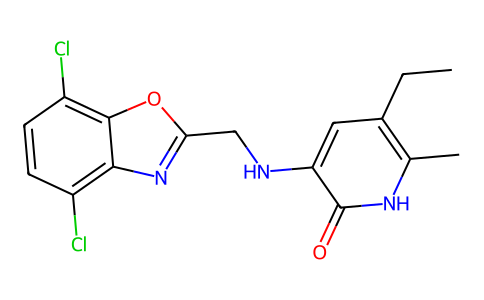
Physicochemical Properties
| Molecular Formula | C16H15CL2N3O2 |
| Molecular Weight | 352.21 |
| Exact Mass | 351.054 |
| Elemental Analysis | C, 54.56; H, 4.29; Cl, 20.13; N, 11.93; O, 9.08 |
| CAS # | 135525-78-9 |
| PubChem CID | 65002 |
| Appearance | Typically exists as solid at room temperature |
| Boiling Point | 558.6ºC at 760 mmHg |
| Flash Point | 291.6ºC |
| Vapour Pressure | 1.65E-12mmHg at 25°C |
| Index of Refraction | 1.649 |
| LogP | 4.791 |
| Hydrogen Bond Donor Count | 2 |
| Hydrogen Bond Acceptor Count | 4 |
| Rotatable Bond Count | 4 |
| Heavy Atom Count | 23 |
| Complexity | 549 |
| Defined Atom Stereocenter Count | 0 |
| SMILES | CCC1=C(NC(=O)C(=C1)NCC2=NC3=C(C=CC(=C3O2)Cl)Cl)C |
| InChi Key | WHFRDXVXYMGAJD-UHFFFAOYSA-N |
| InChi Code | InChI=1S/C16H15Cl2N3O2/c1-3-9-6-12(16(22)20-8(9)2)19-7-13-21-14-10(17)4-5-11(18)15(14)23-13/h4-6,19H,3,7H2,1-2H3,(H,20,22) |
| Chemical Name | 3-[(4,7-dichloro-1,3-benzoxazol-2-yl)methylamino]-5-ethyl-6-methyl-1H-pyridin-2-one |
| Synonyms | L697661; L 697661; 135525-78-9; L-697661; 3-(((4,7-Dichloro-1,3-benzoxazol-2-yl)methyl)amino)-5-ethyl-6-methylpyridin-2(1H)-one; 3-[(4,7-dichloro-1,3-benzoxazol-2-yl)methylamino]-5-ethyl-6-methyl-1H-pyridin-2-one; L-697,661; CHEMBL268871; 3-(((4,7-Dichlorobenzo[d]oxazol-2-yl)methyl)amino)-5-ethyl-6-methylpyridin-2(1H)-one; 4660N666EZ; L-697661 |
| HS Tariff Code | 2934.99.9001 |
| Storage |
Powder-20°C 3 years 4°C 2 years In solvent -80°C 6 months -20°C 1 month |
| Shipping Condition | Room temperature (This product is stable at ambient temperature for a few days during ordinary shipping and time spent in Customs) |
Biological Activity
| Targets | HIV-1 RT/reverse transcriptase |
| ln Vivo | Both L-697,661 and zidovudine were well tolerated. Transient increases in CD4 counts were noted in the patients with fewer than 200 CD4 cells per cubic millimeter who received the two higher doses of L-697,661, but not in those who received the lowest dose or zidovudine. Patients who received L-697,661 had rapid, dose-related decreases in plasma p24 antigen levels. However, this response virtually disappeared after six weeks in some patients receiving L-697,661, coincidently with the emergence of resistant viruses. This change in susceptibility was more frequent among patients receiving the higher doses of L-697,661 and was associated with amino acid substitutions at positions 103 and 181 in the HIV-1 reverse transcriptase gene. Conclusions: L-697,661 is safe and well tolerated and has significant dose-related activity against HIV-1. However, resistant strains of the virus emerge rapidly and may limit the effectiveness of non-nucleoside reverse transcriptase inhibitors as monotherapy for HIV-1 infection[1]. |
| Animal Protocol | Researchers evaluated a pyridinone non-nucleoside reverse transcriptase inhibitor, L-697,661, in separate six-week double-blind trials in patients with HIV-1 infection whose CD4 counts ranged from 200 to 500 cells per cubic millimeter (68 patients) or less than 200 cells per cubic millimeter (67 patients). Eligible patients were randomly assigned to receive L-697,661 orally in one of three doses (25 mg twice a day, 100 mg three times a day, or 500 mg twice a day) or zidovudine (100 mg five times a day). Clinical and laboratory assessments were performed weekly. Viral isolates were obtained from a subgroup of patients before and after treatment and were evaluated for in vitro sensitivity to L-697,661.[1] |
| Additional Infomation |
Reverse Transcriptase Inhibitors:
Inhibitors of reverse transcriptase (RNA-DIRECTED DNA POLYMERASE), an enzyme that synthesizes DNA on an RNA template.
Antiviral Agents: Agents used in the prophylaxis or therapy of VIRUS DISEASES. Some of the ways they may act include preventing viral replication by inhibiting viral DNA polymerase; binding to specific cell-surface receptors and inhibiting viral penetration or uncoating; inhibiting viral protein synthesis; or blocking late stages of virus assembly. |
Solubility Data
| Solubility (In Vitro) | May dissolve in DMSO (in most cases), if not, try other solvents such as H2O, Ethanol, or DMF with a minute amount of products to avoid loss of samples |
| Solubility (In Vivo) |
Note: Listed below are some common formulations that may be used to formulate products with low water solubility (e.g. < 1 mg/mL), you may test these formulations using a minute amount of products to avoid loss of samples. Injection Formulations (e.g. IP/IV/IM/SC) Injection Formulation 1: DMSO : Tween 80: Saline = 10 : 5 : 85 (i.e. 100 μL DMSO stock solution → 50 μL Tween 80 → 850 μL Saline) *Preparation of saline: Dissolve 0.9 g of sodium chloride in 100 mL ddH ₂ O to obtain a clear solution. Injection Formulation 2: DMSO : PEG300 :Tween 80 : Saline = 10 : 40 : 5 : 45 (i.e. 100 μL DMSO → 400 μLPEG300 → 50 μL Tween 80 → 450 μL Saline) Injection Formulation 3: DMSO : Corn oil = 10 : 90 (i.e. 100 μL DMSO → 900 μL Corn oil) Example: Take the Injection Formulation 3 (DMSO : Corn oil = 10 : 90) as an example, if 1 mL of 2.5 mg/mL working solution is to be prepared, you can take 100 μL 25 mg/mL DMSO stock solution and add to 900 μL corn oil, mix well to obtain a clear or suspension solution (2.5 mg/mL, ready for use in animals). Injection Formulation 4: DMSO : 20% SBE-β-CD in saline = 10 : 90 [i.e. 100 μL DMSO → 900 μL (20% SBE-β-CD in saline)] *Preparation of 20% SBE-β-CD in Saline (4°C,1 week): Dissolve 2 g SBE-β-CD in 10 mL saline to obtain a clear solution. Injection Formulation 5: 2-Hydroxypropyl-β-cyclodextrin : Saline = 50 : 50 (i.e. 500 μL 2-Hydroxypropyl-β-cyclodextrin → 500 μL Saline) Injection Formulation 6: DMSO : PEG300 : castor oil : Saline = 5 : 10 : 20 : 65 (i.e. 50 μL DMSO → 100 μLPEG300 → 200 μL castor oil → 650 μL Saline) Injection Formulation 7: Ethanol : Cremophor : Saline = 10: 10 : 80 (i.e. 100 μL Ethanol → 100 μL Cremophor → 800 μL Saline) Injection Formulation 8: Dissolve in Cremophor/Ethanol (50 : 50), then diluted by Saline Injection Formulation 9: EtOH : Corn oil = 10 : 90 (i.e. 100 μL EtOH → 900 μL Corn oil) Injection Formulation 10: EtOH : PEG300:Tween 80 : Saline = 10 : 40 : 5 : 45 (i.e. 100 μL EtOH → 400 μLPEG300 → 50 μL Tween 80 → 450 μL Saline) Oral Formulations Oral Formulation 1: Suspend in 0.5% CMC Na (carboxymethylcellulose sodium) Oral Formulation 2: Suspend in 0.5% Carboxymethyl cellulose Example: Take the Oral Formulation 1 (Suspend in 0.5% CMC Na) as an example, if 100 mL of 2.5 mg/mL working solution is to be prepared, you can first prepare 0.5% CMC Na solution by measuring 0.5 g CMC Na and dissolve it in 100 mL ddH2O to obtain a clear solution; then add 250 mg of the product to 100 mL 0.5% CMC Na solution, to make the suspension solution (2.5 mg/mL, ready for use in animals). Oral Formulation 3: Dissolved in PEG400 Oral Formulation 4: Suspend in 0.2% Carboxymethyl cellulose Oral Formulation 5: Dissolve in 0.25% Tween 80 and 0.5% Carboxymethyl cellulose Oral Formulation 6: Mixing with food powders Note: Please be aware that the above formulations are for reference only. InvivoChem strongly recommends customers to read literature methods/protocols carefully before determining which formulation you should use for in vivo studies, as different compounds have different solubility properties and have to be formulated differently. (Please use freshly prepared in vivo formulations for optimal results.) |
| Preparing Stock Solutions | 1 mg | 5 mg | 10 mg | |
| 1 mM | 2.8392 mL | 14.1961 mL | 28.3922 mL | |
| 5 mM | 0.5678 mL | 2.8392 mL | 5.6784 mL | |
| 10 mM | 0.2839 mL | 1.4196 mL | 2.8392 mL |