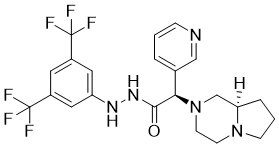
L-692,429 is a new, potent nonpeptidyl growth hormone secretagogue (GHS) acting as an agonist of GHS with a Ki of 63 nM for binding to the GPCR.
Physicochemical Properties
| Molecular Formula | C29H31N7O2 |
| Molecular Weight | 509.6021 |
| Exact Mass | 509.254 |
| CAS # | 145455-23-8 |
| Related CAS # | 169188-19-6 (HCl);145455-23-8;145455-80-7 (TFA); |
| PubChem CID | 121879 |
| Appearance | White to off-white solid powder |
| Density | 1.33g/cm3 |
| Index of Refraction | 1.678 |
| LogP | 5.23 |
| Hydrogen Bond Donor Count | 3 |
| Hydrogen Bond Acceptor Count | 6 |
| Rotatable Bond Count | 7 |
| Heavy Atom Count | 38 |
| Complexity | 815 |
| Defined Atom Stereocenter Count | 1 |
| SMILES | CC(C)(CC(=O)N[C@@H]1CCC2=CC=CC=C2N(C1=O)CC3=CC=C(C=C3)C4=CC=CC=C4C5=NNN=N5)N |
| InChi Key | SBJLJOFPWOYATP-XMMPIXPASA-N |
| InChi Code | InChI=1S/C29H31N7O2/c1-29(2,30)17-26(37)31-24-16-15-21-7-3-6-10-25(21)36(28(24)38)18-19-11-13-20(14-12-19)22-8-4-5-9-23(22)27-32-34-35-33-27/h3-14,24H,15-18,30H2,1-2H3,(H,31,37)(H,32,33,34,35)/t24-/m1/s1 |
| Chemical Name | 3-amino-3-methyl-N-[(3R)-2-oxo-1-[[4-[2-(2H-tetrazol-5-yl)phenyl]phenyl]methyl]-4,5-dihydro-3H-1-benzazepin-3-yl]butanamide |
| Synonyms | L-692429L-692,429 L 692429 L 692,429 L692,429 L692429. |
| HS Tariff Code | 2934.99.9001 |
| Storage |
Powder-20°C 3 years 4°C 2 years In solvent -80°C 6 months -20°C 1 month |
| Shipping Condition | Room temperature (This product is stable at ambient temperature for a few days during ordinary shipping and time spent in Customs) |
Biological Activity
| ln Vitro | With EC50 values of 26 nM, 47 nM, 60 nM, 63 nM, and 58 nM, respectively, L-692429 stimulates intracellular calcium release, inositol phosphate (IP) turnover, cAMP response element binding protein (CREB) activity, serum response element activity, and bioluminescence resonance energy transfer (BRET) activity[2]. L-692429 was applied to HeLa-T4 cells that were transiently expressing the epitope-tagged growth hormone secretagogue (GHS) receptor. Calcium release within cells is measured by a fluorometric technique employing the calcium indicator dye Fluo-3/AM. L-692429 treatment had no effect on untransfected HeLa-T4 cells, however it did boost the fluorescence emission of HeLa-T4 cells that were transiently expressing GHS receptors. Following L-692429 administration, luciferase activity dramatically increased, suggesting that GHS receptor activation activates the MAPK pathway [3]. |
| ln Vivo | L-756867 demonstrated a dose-dependent inhibition of L-692429 (100 μg/kg)-stimulated GH production in Wistar rats under anesthesia. At an intravenous dosage of 100 μg/kg, L-756867 showed complete inhibition [1]. |
| References |
[1]. Inhibition of L-692,429-stimulated rat growth hormone release by a weak substance P antagonist: L-756,867. J Endocrinol. 1997 Jan;152(1):155-8. [2]. Nonpeptide and peptide growth hormone secretagogues act both as ghrelin receptor agonist and as positive or negative allosteric modulators of ghrelin signaling. Mol Endocrinol. 2005 Sep;19(9):2400-11. [3]. Ghrelin and growth hormone (GH) secretagogues potentiate GH-releasing hormone (GHRH)-induced cyclic adenosine 3',5'-monophosphate production in cells expressing transfected GHRH and GH secretagogue receptors. Endocrinology. 2002 Dec;143(1. |
Solubility Data
| Solubility (In Vitro) | DMSO : ~50 mg/mL (~98.12 mM) |
| Solubility (In Vivo) |
Solubility in Formulation 1: ≥ 2.5 mg/mL (4.91 mM) (saturation unknown) in 10% DMSO + 40% PEG300 + 5% Tween80 + 45% Saline (add these co-solvents sequentially from left to right, and one by one), clear solution. For example, if 1 mL of working solution is to be prepared, you can add 100 μL of 25.0 mg/mL clear DMSO stock solution to 400 μL PEG300 and mix evenly; then add 50 μL Tween-80 to the above solution and mix evenly; then add 450 μL normal saline to adjust the volume to 1 mL. Preparation of saline: Dissolve 0.9 g of sodium chloride in 100 mL ddH₂ O to obtain a clear solution. Solubility in Formulation 2: ≥ 2.5 mg/mL (4.91 mM) (saturation unknown) in 10% DMSO + 90% (20% SBE-β-CD in Saline) (add these co-solvents sequentially from left to right, and one by one), clear solution. For example, if 1 mL of working solution is to be prepared, you can add 100 μL of 25.0 mg/mL clear DMSO stock solution to 900 μL of 20% SBE-β-CD physiological saline solution and mix evenly. Preparation of 20% SBE-β-CD in Saline (4°C,1 week): Dissolve 2 g SBE-β-CD in 10 mL saline to obtain a clear solution. Solubility in Formulation 3: ≥ 2.5 mg/mL (4.91 mM) (saturation unknown) in 10% DMSO + 90% Corn Oil (add these co-solvents sequentially from left to right, and one by one), clear solution. For example, if 1 mL of working solution is to be prepared, you can add 100 μL of 25.0 mg/mL clear DMSO stock solution to 900 μL of corn oil and mix evenly. (Please use freshly prepared in vivo formulations for optimal results.) |
| Preparing Stock Solutions | 1 mg | 5 mg | 10 mg | |
| 1 mM | 1.9623 mL | 9.8116 mL | 19.6232 mL | |
| 5 mM | 0.3925 mL | 1.9623 mL | 3.9246 mL | |
| 10 mM | 0.1962 mL | 0.9812 mL | 1.9623 mL |