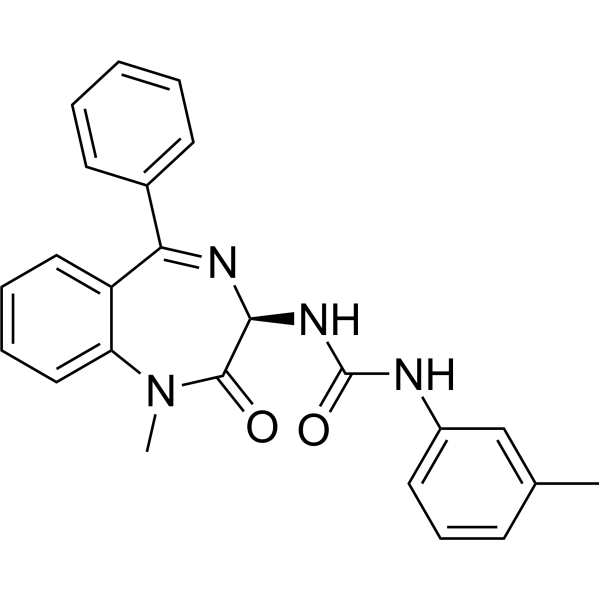
Physicochemical Properties
| Molecular Formula | C24H22N4O2 |
| Molecular Weight | 398.47 |
| Exact Mass | 398.174 |
| CAS # | 118101-09-0 |
| Related CAS # | L-365260 hemihydrate |
| PubChem CID | 5311201 |
| Appearance | White to off-white solid powder |
| Density | 1.23g/cm3 |
| Boiling Point | 611.5ºC at 760 mmHg |
| Flash Point | 323.6ºC |
| Vapour Pressure | 6.85E-15mmHg at 25°C |
| Index of Refraction | 1.648 |
| LogP | 3.921 |
| Hydrogen Bond Donor Count | 2 |
| Hydrogen Bond Acceptor Count | 3 |
| Rotatable Bond Count | 3 |
| Heavy Atom Count | 30 |
| Complexity | 658 |
| Defined Atom Stereocenter Count | 1 |
| SMILES | CC1=CC(=CC=C1)NC(=O)N[C@H]2C(=O)N(C3=CC=CC=C3C(=N2)C4=CC=CC=C4)C |
| InChi Key | KDFQABSFVYLGPM-QFIPXVFZSA-N |
| InChi Code | InChI=1S/C24H22N4O2/c1-16-9-8-12-18(15-16)25-24(30)27-22-23(29)28(2)20-14-7-6-13-19(20)21(26-22)17-10-4-3-5-11-17/h3-15,22H,1-2H3,(H2,25,27,30)/t22-/m0/s1 |
| Chemical Name | 1-[(3R)-1-methyl-2-oxo-5-phenyl-3H-1,4-benzodiazepin-3-yl]-3-(3-methylphenyl)urea |
| Synonyms | L365260; L 365260; L-365260 |
| HS Tariff Code | 2934.99.9001 |
| Storage |
Powder-20°C 3 years 4°C 2 years In solvent -80°C 6 months -20°C 1 month |
| Shipping Condition | Room temperature (This product is stable at ambient temperature for a few days during ordinary shipping and time spent in Customs) |
Biological Activity
| ln Vitro | In many neurons, CCK8S- and CCK4-mediated depolarization is significantly attenuated by L-365260 (1 μM) [2]. For CCK-B receptors in the brains of rats, mice, and humans, L-365260 demonstrates a comparable high affinity, whereas its affinity for gastrin and brain CCK-B (IC50=20–40 nM) receptors in dog tissue is lower[1]. |
| ln Vivo | Rats given submaximal doses of morphine (4 mg/kg) experience analgesia that is potentiated by L-365260 (0.01-10 mg/kg; subcutaneous injection) [3]. In rats, the duration of morphine analgesia was greatly extended by L-365260 (0.2 mg/kg; subcutaneous injection twice daily for 5 days) [3]. Gastrin enhancement of acid secretion in mice (ED50=0.03 mg/kg), rats (ED50=0.9 mg/kg), and guinea pigs (ED50=5.1 mg/kg) is antagonized by L-365260 (0.1-30 mg/kg; po)[1]. |
| Animal Protocol |
Animal/Disease Models: Male SD (SD (Sprague-Dawley)) rats (300-350 g) injected with morphine [3] Doses: 0.01, 0.05, 0.1, 0.2, 0.75, 1.0, 10.0 mg/kg Route of Administration: 10 minutes before subcutaneous injection 4 mg/kg Morphine Experimental Results: The analgesic effect of morphine is enhanced. |
| References |
[1]. A new potent and selective non-peptide gastrin antagonist and brain cholecystokinin receptor (CCK-B) ligand: L-365,260. Eur J Pharmacol. 1989 Mar 21;162(2):273-80. [2]. Cholecystokinin action on layer 6b neurons in somatosensory cortex. Brain Res. 2009 Jul 28;1282:10-9. [3]. The selective CCK-B receptor antagonist L-365,260 enhances morphine analgesia and prevents morphine tolerance in the rat. Eur J Pharmacol. 1990 Jan 25;176(1):35-44. |
| Additional Infomation | L-365260 is a benzodiazepine. |
Solubility Data
| Solubility (In Vitro) | DMSO : ~100 mg/mL (~250.97 mM) |
| Solubility (In Vivo) |
Solubility in Formulation 1: ≥ 2.5 mg/mL (6.27 mM) (saturation unknown) in 10% DMSO + 40% PEG300 + 5% Tween80 + 45% Saline (add these co-solvents sequentially from left to right, and one by one), clear solution. For example, if 1 mL of working solution is to be prepared, you can add 100 μL of 25.0 mg/mL clear DMSO stock solution to 400 μL PEG300 and mix evenly; then add 50 μL Tween-80 to the above solution and mix evenly; then add 450 μL normal saline to adjust the volume to 1 mL. Preparation of saline: Dissolve 0.9 g of sodium chloride in 100 mL ddH₂ O to obtain a clear solution. Solubility in Formulation 2: ≥ 2.5 mg/mL (6.27 mM) (saturation unknown) in 10% DMSO + 90% Corn Oil (add these co-solvents sequentially from left to right, and one by one), clear solution. For example, if 1 mL of working solution is to be prepared, you can add 100 μL of 25.0 mg/mL clear DMSO stock solution to 900 μL of corn oil and mix evenly. (Please use freshly prepared in vivo formulations for optimal results.) |
| Preparing Stock Solutions | 1 mg | 5 mg | 10 mg | |
| 1 mM | 2.5096 mL | 12.5480 mL | 25.0960 mL | |
| 5 mM | 0.5019 mL | 2.5096 mL | 5.0192 mL | |
| 10 mM | 0.2510 mL | 1.2548 mL | 2.5096 mL |