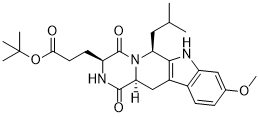
Ko-143 (Ko143) is a novel and potent breast cancer resistance protein multidrug transporter (BCRP) inhibitor, or an ATP-binding cassette sub-family G member 2 (ABCG2) inhibitor.
Physicochemical Properties
| Molecular Formula | C26H35N3O5 |
| Molecular Weight | 469.582 |
| Exact Mass | 469.257 |
| CAS # | 461054-93-3 |
| PubChem CID | 10322450 |
| Appearance | White to off-white solid powder |
| Density | 1.2±0.1 g/cm3 |
| Boiling Point | 689.8±55.0 °C at 760 mmHg |
| Melting Point | 147ºC |
| Flash Point | 371.0±31.5 °C |
| Vapour Pressure | 0.0±2.2 mmHg at 25°C |
| Index of Refraction | 1.597 |
| LogP | 2.42 |
| Hydrogen Bond Donor Count | 2 |
| Hydrogen Bond Acceptor Count | 5 |
| Rotatable Bond Count | 8 |
| Heavy Atom Count | 34 |
| Complexity | 794 |
| Defined Atom Stereocenter Count | 3 |
| SMILES | CC(C)C[C@H]1C2=C(C[C@@H]3N1C(=O)[C@@H](NC3=O)CCC(=O)OC(C)(C)C)C4=C(N2)C=C(C=C4)OC |
| InChi Key | NXNRAECHCJZNRF-JBACZVJFSA-N |
| InChi Code | InChI=1S/C26H35N3O5/c1-14(2)11-20-23-17(16-8-7-15(33-6)12-19(16)27-23)13-21-24(31)28-18(25(32)29(20)21)9-10-22(30)34-26(3,4)5/h7-8,12,14,18,20-21,27H,9-11,13H2,1-6H3,(H,28,31)/t18-,20-,21-/m0/s1 |
| Chemical Name | tert-butyl 3-((3S,6S,12aS)-6-isobutyl-9-methoxy-1,4-dioxo-1,2,3,4,6,7,12,12a-octahydropyrazino[1',2' |
| Synonyms | Ko-143 Ko-143 Ko-143 |
| HS Tariff Code | 2934.99.9001 |
| Storage |
Powder-20°C 3 years 4°C 2 years In solvent -80°C 6 months -20°C 1 month |
| Shipping Condition | Room temperature (This product is stable at ambient temperature for a few days during ordinary shipping and time spent in Customs) |
Biological Activity
| Targets |
|
|
| ln Vitro | Ko143 (10 nM) dramatically lowers the IC50 of MTX on mouse G2 and HEK G2 cells by a factor of 2.5. ABC transporter function is not inhibited by Ko143 (1-100 μM) metabolites [1]. Ko143, an FTC analog, overcomes drug resistance in human IGROV1/T8 cells and mouse MEF3.8/T6400 cells chosen with SKF 104864A. At zero, one, or eight times the EC90 of 25 nM, Ko143 can be utilized [2]. In Madin-Darby canine kidney (MDCK) 2-BCRP421CC (wild-type) and MDCK2-BCRP421AA (mutant) cells, Ko143 inhibits BCRP-mediated ZD 4522 trafficking [3]. | |
| ln Vivo | In mice, Ko143 (10 mg/kg, po) raises SKF 104864A's oral availability [2]. Ko143 has a major impact on ZD 4522's pharmacokinetics in rats [3]. | |
| Cell Assay |
|
|
| References |
[1]. The Inhibitor Ko143 Is Not Specific for ABCG2. J Pharmacol Exp Ther. 2015 Sep;354(3):384-93. [2]. Potent and Specific Inhibition of the Breast Cancer Resistance Protein Multidrug Transporter in Vitro and in Mouse Intestine by a Novel Analogue of Fumitremorgin C. Mol. Cancer Ther. 2002, 1, 417-425. [3]. Effect of Ursolic Acid on Breast Cancer Resistance Protein-mediated Transport of ZD 4522 In Vivo and Vitro. Chin Med Sci J. 2015 Dec;30(4):218-25. [4]. Quantitative determination and pharmacokinetic study of the novel anti-Parkinson's disease candidate drug FLZ in rat brain by high performance liquid chromatography-tandem mass spectrometry. J Pharm Biomed Anal. 2012 Jul;66:232-9. [5]. Metabolism of KO143, an ABCG2 inhibitor. Drug Metab Pharmacokinet. 2017 Aug;32(4):193-200. |
|
| Additional Infomation | LSM-6260 is a member of beta-carbolines and a tert-butyl ester. |
Solubility Data
| Solubility (In Vitro) | DMSO : ~100 mg/mL (~212.96 mM) |
| Solubility (In Vivo) |
Solubility in Formulation 1: ≥ 2.5 mg/mL (5.32 mM) (saturation unknown) in 10% DMSO + 40% PEG300 + 5% Tween80 + 45% Saline (add these co-solvents sequentially from left to right, and one by one), clear solution. For example, if 1 mL of working solution is to be prepared, you can add 100 μL of 25.0 mg/mL clear DMSO stock solution to 400 μL PEG300 and mix evenly; then add 50 μL Tween-80 to the above solution and mix evenly; then add 450 μL normal saline to adjust the volume to 1 mL. Preparation of saline: Dissolve 0.9 g of sodium chloride in 100 mL ddH₂ O to obtain a clear solution. Solubility in Formulation 2: 2.5 mg/mL (5.32 mM) in 10% DMSO + 90% (20% SBE-β-CD in Saline) (add these co-solvents sequentially from left to right, and one by one), suspension solution; with ultrasonication (<50°C). For example, if 1 mL of working solution is to be prepared, you can add 100 μL of 25.0 mg/mL clear DMSO stock solution to 900 μL of 20% SBE-β-CD physiological saline solution and mix evenly. Preparation of 20% SBE-β-CD in Saline (4°C,1 week): Dissolve 2 g SBE-β-CD in 10 mL saline to obtain a clear solution. Solubility in Formulation 3: ≥ 2.5 mg/mL (5.32 mM) (saturation unknown) in 10% DMSO + 90% Corn Oil (add these co-solvents sequentially from left to right, and one by one), clear solution. For example, if 1 mL of working solution is to be prepared, you can add 100 μL of 25.0 mg/mL clear DMSO stock solution to 900 μL of corn oil and mix evenly. Solubility in Formulation 4: 2.5 mg/mL (5.32 mM) in 5% DMSO + 40% PEG300 + 5% Tween80 + 50% Saline (add these co-solvents sequentially from left to right, and one by one), suspension solution; with ultrasonication. Preparation of saline: Dissolve 0.9 g of sodium chloride in 100 mL ddH₂ O to obtain a clear solution. (Please use freshly prepared in vivo formulations for optimal results.) |
| Preparing Stock Solutions | 1 mg | 5 mg | 10 mg | |
| 1 mM | 2.1296 mL | 10.6478 mL | 21.2956 mL | |
| 5 mM | 0.4259 mL | 2.1296 mL | 4.2591 mL | |
| 10 mM | 0.2130 mL | 1.0648 mL | 2.1296 mL |