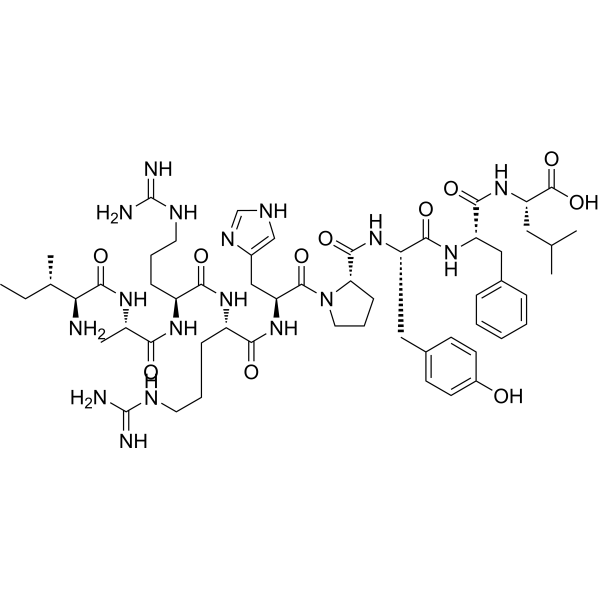
Physicochemical Properties
| Molecular Formula | C56H85N17O11 |
| Molecular Weight | 1172.3814 |
| Exact Mass | 1171.66 |
| CAS # | 103131-69-7 |
| Related CAS # | 103131-69-7; Kinetensin TFA salt; |
| PubChem CID | 147043 |
| Appearance | White to off-white solid powder |
| Density | 1.41 g/cm3 |
| Index of Refraction | 1.661 |
| LogP | 4.334 |
| Hydrogen Bond Donor Count | 15 |
| Hydrogen Bond Acceptor Count | 15 |
| Rotatable Bond Count | 34 |
| Heavy Atom Count | 84 |
| Complexity | 2240 |
| Defined Atom Stereocenter Count | 10 |
| SMILES | CC[C@H](C)[C@@H](C(=O)N[C@@H](C)C(=O)N[C@@H](CCCN=C(N)N)C(=O)N[C@@H](CCCN=C(N)N)C(=O)N[C@@H](CC1=CN=CN1)C(=O)N2CCC[C@H]2C(=O)N[C@@H](CC3=CC=C(C=C3)O)C(=O)N[C@@H](CC4=CC=CC=C4)C(=O)N[C@@H](CC(C)C)C(=O)O)N |
| InChi Key | PANUJGMSOSQAAY-IHXGQVBNSA-N |
| InChi Code | InChI=1S/C56H85N17O11/c1-6-32(4)45(57)52(81)66-33(5)46(75)67-38(15-10-22-63-55(58)59)47(76)68-39(16-11-23-64-56(60)61)48(77)71-42(28-36-29-62-30-65-36)53(82)73-24-12-17-44(73)51(80)70-41(27-35-18-20-37(74)21-19-35)49(78)69-40(26-34-13-8-7-9-14-34)50(79)72-43(54(83)84)25-31(2)3/h7-9,13-14,18-21,29-33,38-45,74H,6,10-12,15-17,22-28,57H2,1-5H3,(H,62,65)(H,66,81)(H,67,75)(H,68,76)(H,69,78)(H,70,80)(H,71,77)(H,72,79)(H,83,84)(H4,58,59,63)(H4,60,61,64)/t32-,33-,38-,39-,40-,41-,42-,43-,44-,45-/m0/s1 |
| Chemical Name | (2S)-2-[[(2S)-2-[[(2S)-2-[[(2S)-1-[(2S)-2-[[(2S)-2-[[(2S)-2-[[(2S)-2-[[(2S,3S)-2-amino-3-methylpentanoyl]amino]propanoyl]amino]-5-(diaminomethylideneamino)pentanoyl]amino]-5-(diaminomethylideneamino)pentanoyl]amino]-3-(1H-imidazol-5-yl)propanoyl]pyrrolidine-2-carbonyl]amino]-3-(4-hydroxyphenyl)propanoyl]amino]-3-phenylpropanoyl]amino]-4-methylpentanoic acid |
| HS Tariff Code | 2934.99.9001 |
| Storage |
Powder-20°C 3 years 4°C 2 years In solvent -80°C 6 months -20°C 1 month Note: Please store this product in a sealed and protected environment (e.g. under nitrogen), avoid exposure to moisture and light. |
| Shipping Condition | Room temperature (This product is stable at ambient temperature for a few days during ordinary shipping and time spent in Customs) |
Biological Activity
| ln Vitro | When rat peritoneal mast cells are exposed to the peptide kinesin, which was extracted from human plasma treated with pepsin, it causes a dose-dependent release of histamine. The ideal concentration, which releases 80% of the total histamine, is between 100 and 1000 μM. The threshold concentration is roughly 1 μM, while the ED50 is 10 μM. Kinesin is comparable to the opioid peptide dynorphin and has a potency that is 10–100 times lower than neurotensin. Histamine releases at a temperature that is largely dependent on temperature; no release happens at 0 or 45 °C, and 37 °C is about the ideal. When extracellular calcium is not present, histamine release is greatly inhibited [2]. |
| ln Vivo | Rats administered intradermally with dynamictensin also exhibit a dose-dependent increase in vascular permeability [2]. |
| References |
[1]. The amino acid sequence of kinetensin, a novel peptide isolated from pepsin-treated human plasma: homology with human serum albumin, neurotensin and angiotensin. Biochem Biophys Res Commun. 1986 May 14;136(3):983-8. [2]. Stimulation of histamine release by the peptide kinetensin. Agents Actions. 1989 Apr;27(1-2):68-71. |
| Additional Infomation | Kinetensin is an oligopeptide comprising of nine amino acids with sequence L-Ile-L-Ala-L-Arg-L-Arg-L-His-L-Pro-L-Tyr-L-Phe-L-Leu. It was originally isolated from pepsin-treated human plasma and shares some sequence homology with the C-terminal end of neurotensin. It is a potent histamine releaser and may serve as an inflammatory mediator. It has a role as a human metabolite and a histamine releasing agent. It is a conjugate base of a kinetensin(2+). |
Solubility Data
| Solubility (In Vitro) | DMSO : ~100 mg/mL (~85.30 mM) |
| Solubility (In Vivo) |
Solubility in Formulation 1: ≥ 2.5 mg/mL (2.13 mM) (saturation unknown) in 10% DMSO + 40% PEG300 + 5% Tween80 + 45% Saline (add these co-solvents sequentially from left to right, and one by one), clear solution. For example, if 1 mL of working solution is to be prepared, you can add 100 μL of 25.0 mg/mL clear DMSO stock solution to 400 μL PEG300 and mix evenly; then add 50 μL Tween-80 to the above solution and mix evenly; then add 450 μL normal saline to adjust the volume to 1 mL. Preparation of saline: Dissolve 0.9 g of sodium chloride in 100 mL ddH₂ O to obtain a clear solution. Solubility in Formulation 2: ≥ 2.5 mg/mL (2.13 mM) (saturation unknown) in 10% DMSO + 90% (20% SBE-β-CD in Saline) (add these co-solvents sequentially from left to right, and one by one), clear solution. For example, if 1 mL of working solution is to be prepared, you can add 100 μL of 25.0 mg/mL clear DMSO stock solution to 900 μL of 20% SBE-β-CD physiological saline solution and mix evenly. Preparation of 20% SBE-β-CD in Saline (4°C,1 week): Dissolve 2 g SBE-β-CD in 10 mL saline to obtain a clear solution. Solubility in Formulation 3: ≥ 2.5 mg/mL (2.13 mM) (saturation unknown) in 10% DMSO + 90% Corn Oil (add these co-solvents sequentially from left to right, and one by one), clear solution. For example, if 1 mL of working solution is to be prepared, you can add 100 μL of 25.0 mg/mL clear DMSO stock solution to 900 μL of corn oil and mix evenly. (Please use freshly prepared in vivo formulations for optimal results.) |
| Preparing Stock Solutions | 1 mg | 5 mg | 10 mg | |
| 1 mM | 0.8530 mL | 4.2648 mL | 8.5297 mL | |
| 5 mM | 0.1706 mL | 0.8530 mL | 1.7059 mL | |
| 10 mM | 0.0853 mL | 0.4265 mL | 0.8530 mL |