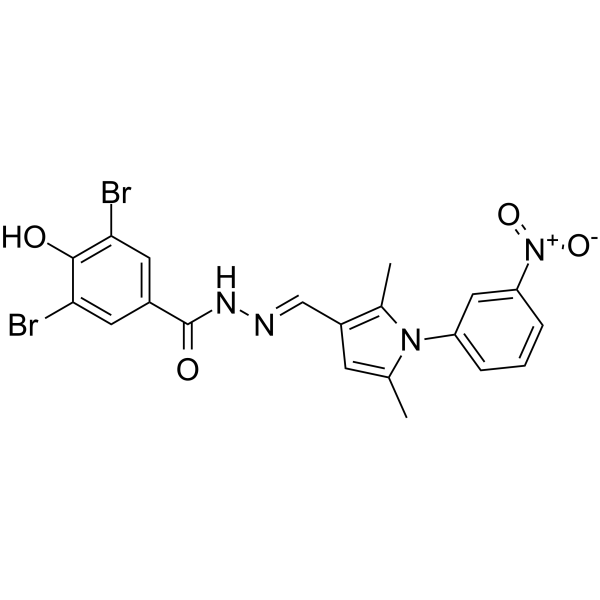
Physicochemical Properties
| Molecular Formula | C20H16BR2N4O4 |
| Molecular Weight | 536.173442840576 |
| Exact Mass | 533.953 |
| CAS # | 363571-83-9 |
| PubChem CID | 5349470 |
| Appearance | Light yellow to yellow solid powder |
| Density | 1.7±0.1 g/cm3 |
| Index of Refraction | 1.689 |
| LogP | 5.49 |
| Hydrogen Bond Donor Count | 2 |
| Hydrogen Bond Acceptor Count | 5 |
| Rotatable Bond Count | 4 |
| Heavy Atom Count | 30 |
| Complexity | 649 |
| Defined Atom Stereocenter Count | 0 |
| SMILES | BrC1C(=C(C=C(C=1)C(N/N=C\C1C=C(C)N(C2C=CC=C(C=2)[N+](=O)[O-])C=1C)=O)Br)O |
| InChi Key | DUGCMEGLYHBMAR-AUEPDCJTSA-N |
| InChi Code | InChI=1S/C20H16Br2N4O4/c1-11-6-14(12(2)25(11)15-4-3-5-16(9-15)26(29)30)10-23-24-20(28)13-7-17(21)19(27)18(22)8-13/h3-10,27H,1-2H3,(H,24,28)/b23-10+ |
| Chemical Name | 3,5-dibromo-N-[(E)-[2,5-dimethyl-1-(3-nitrophenyl)pyrrol-3-yl]methylideneamino]-4-hydroxybenzamide |
| HS Tariff Code | 2934.99.9001 |
| Storage |
Powder-20°C 3 years 4°C 2 years In solvent -80°C 6 months -20°C 1 month |
| Shipping Condition | Room temperature (This product is stable at ambient temperature for a few days during ordinary shipping and time spent in Customs) |
Biological Activity
| ln Vitro | It is remarkable that the microtubule network was entirely rearranged into a network of rings and bundles in kinesore-treated cells. Moreover, lysosomal compartments are concentrated in juxtanuclear regions with a low microtubule count. This phenotype was very permeable at 50 μM kinesore; 95±2.4% (n=3, 200 cells total) of the cells had a rearranged non-radial microtubule network. This phenotype was observed in titration tests in cells treated for 1 hour at 25 μM kinesore concentrations; at 12.5 μM doses or lower, the effect was negligible. This impact is reversible since radial microtubule arrays are reconstituted once kinesore is washed out of cells treated with one hour and then for two hours. The microtubule network was shown to be reorganized by kinetin in a panel of cancer and normal mammalian cell lines. 50 μM kinesore causes the microtubule network to reorganize and large microtubule-rich projections to develop in wild-type cells. Kif5B mutant cells showed a substantial suppression of this phenotype, indicating that kinesin-1 is required for the microtubule remodeling caused by kinesore [1]. |
| References |
[1]. A small-molecule activator of kinesin-1 drives remodeling of the microtubule network. Proc Natl Acad Sci U S A. 2017 Dec 26;114(52):13738-13743. |
| Additional Infomation | 3,5-Dibromo-N'-((2,5-dimethyl-1-(3-nitrophenyl)-1H-pyrrol-3-yl)methylene)-4-hydroxybenzohydrazide is kinesin-1 modulator |
Solubility Data
| Solubility (In Vitro) | DMSO : ~125 mg/mL (~233.14 mM) |
| Solubility (In Vivo) |
Solubility in Formulation 1: 2.08 mg/mL (3.88 mM) in 10% DMSO + 40% PEG300 +5% Tween-80 + 45% Saline (add these co-solvents sequentially from left to right, and one by one), suspension solution; with sonication. For example, if 1 mL of working solution is to be prepared, you can add 100 μL of 20.8 mg/mL clear DMSO stock solution to 400 μL PEG300 and mix evenly; then add 50 μL Tween-80 + to the above solution and mix evenly; then add 450 μL normal saline to adjust the volume to 1 mL. Preparation of saline: Dissolve 0.9 g of sodium chloride in 100 mL ddH₂ O to obtain a clear solution. (Please use freshly prepared in vivo formulations for optimal results.) |
| Preparing Stock Solutions | 1 mg | 5 mg | 10 mg | |
| 1 mM | 1.8651 mL | 9.3254 mL | 18.6508 mL | |
| 5 mM | 0.3730 mL | 1.8651 mL | 3.7302 mL | |
| 10 mM | 0.1865 mL | 0.9325 mL | 1.8651 mL |