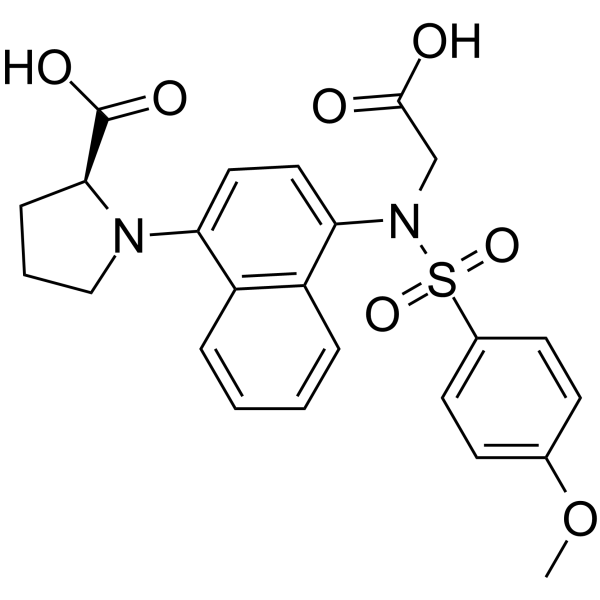
Physicochemical Properties
| Molecular Formula | C24H24N2O7S |
| Molecular Weight | 0 |
| Exact Mass | 484.13 |
| CAS # | 2232112-72-8 |
| PubChem CID | 138911332 |
| Appearance | Typically exists as solid at room temperature |
| LogP | 3.7 |
| Hydrogen Bond Donor Count | 2 |
| Hydrogen Bond Acceptor Count | 9 |
| Rotatable Bond Count | 8 |
| Heavy Atom Count | 34 |
| Complexity | 837 |
| Defined Atom Stereocenter Count | 1 |
| SMILES | N(C1=CC=C(N2CCC[C@H]2C(=O)O)C2C=CC=CC1=2)(CC(=O)O)S(C1C=CC(OC)=CC=1)(=O)=O |
| InChi Key | XIIZECUWKNXLCU-QFIPXVFZSA-N |
| InChi Code | InChI=1S/C24H24N2O7S/c1-33-16-8-10-17(11-9-16)34(31,32)26(15-23(27)28)21-13-12-20(18-5-2-3-6-19(18)21)25-14-4-7-22(25)24(29)30/h2-3,5-6,8-13,22H,4,7,14-15H2,1H3,(H,27,28)(H,29,30)/t22-/m0/s1 |
| Chemical Name | (2S)-1-[4-[carboxymethyl-(4-methoxyphenyl)sulfonylamino]naphthalen-1-yl]pyrrolidine-2-carboxylic acid |
| HS Tariff Code | 2934.99.9001 |
| Storage |
Powder-20°C 3 years 4°C 2 years In solvent -80°C 6 months -20°C 1 month |
| Shipping Condition | Room temperature (This product is stable at ambient temperature for a few days during ordinary shipping and time spent in Customs) |
Biological Activity
| ln Vitro | In L02 cells, KEAP1-Nrf2-IN-1 (compound 35) concentration-dependently raises the mRNA levels of the Nrf2 regulatory genes NEFL2L (encoding Nrf2 protein), HO-1, NQO-1, and GCLM [1]. Keap1-Nrf2-IN-1 (0.1-10 μM; 12 hours) increases Nrf2, heme oxygen-1 (HO-1), NAD (P) H dehydrogenase (quinone) in L02 cells 1 (NQO-1) and glutamate-cysteine ligase regulatory subunit (GCLM) protein levels in a concentration-dependent manner [1]. Acetaminophen-induced L02 cell damage is protected against by the cytoprotective actions of Keap1-Nrf2-IN-1 (1 – 20 μM; 12 hours) [1]. |
| ln Vivo | In an in vivo model, acetaminophen-induced liver injury is countered by Keap1-Nrf2-IN-1 (40 mg/kg; i.p.) [1]. |
| Cell Assay |
Western Blot Analysis[1] Cell Types: L02 cells Tested Concentrations: 0.1 μM, 1 μM, 5 μM, 10 μM Incubation Duration: 12 hrs (hours) Experimental Results: Up-regulated the protein levels of Nrf2 and Nrf2 downstream proteins. |
| Animal Protocol |
Animal/Disease Models: 6-8 weeks female C57BL/6 mice (18-20 g)[1] Doses: 40 mg/kg Route of Administration: intraperitoneal (ip)injection Experimental Results: Ameliorated the pathological symptoms in the Acetaminophen (400 mg/kg; ip)-induced mouse model of acute liver injury. |
| References | [1]. Lu MC, et al. Discovery of a Potent Kelch-Like ECH-Associated Protein 1-Nuclear Factor Erythroid 2-Related Factor 2 (Keap1-Nrf2) Protein-Protein Interaction Inhibitor with Natural Proline Structure as a Cytoprotective Agent against Acetaminophen-Induced Hepatotoxicity. J Med Chem. 2019 Jul 25;62(14):6796-6813. |
Solubility Data
| Solubility (In Vitro) | DMSO : ~100 mg/mL (~206.39 mM) |
| Solubility (In Vivo) |
Solubility in Formulation 1: ≥ 4.55 mg/mL (9.39 mM) (saturation unknown) in 10% DMSO + 90% (20% SBE-β-CD in Saline) (add these co-solvents sequentially from left to right, and one by one), clear solution. For example, if 1 mL of working solution is to be prepared, you can add 100 μL of 45.5 mg/mL clear DMSO stock solution to 900 μL of 20% SBE-β-CD physiological saline solution and mix evenly. Preparation of 20% SBE-β-CD in Saline (4°C,1 week): Dissolve 2 g SBE-β-CD in 10 mL saline to obtain a clear solution. Solubility in Formulation 2: ≥ 2.5 mg/mL (5.16 mM) (saturation unknown) in 10% DMSO + 40% PEG300 + 5% Tween80 + 45% Saline (add these co-solvents sequentially from left to right, and one by one), clear solution. For example, if 1 mL of working solution is to be prepared, you can add 100 μL of 25.0 mg/mL clear DMSO stock solution to 400 μL PEG300 and mix evenly; then add 50 μL Tween-80 to the above solution and mix evenly; then add 450 μL normal saline to adjust the volume to 1 mL. Preparation of saline: Dissolve 0.9 g of sodium chloride in 100 mL ddH₂ O to obtain a clear solution. Solubility in Formulation 3: ≥ 2.5 mg/mL (5.16 mM) (saturation unknown) in 10% DMSO + 90% Corn Oil (add these co-solvents sequentially from left to right, and one by one), clear solution. For example, if 1 mL of working solution is to be prepared, you can add 100 μL of 25.0 mg/mL clear DMSO stock solution to 900 μL of corn oil and mix evenly. (Please use freshly prepared in vivo formulations for optimal results.) |