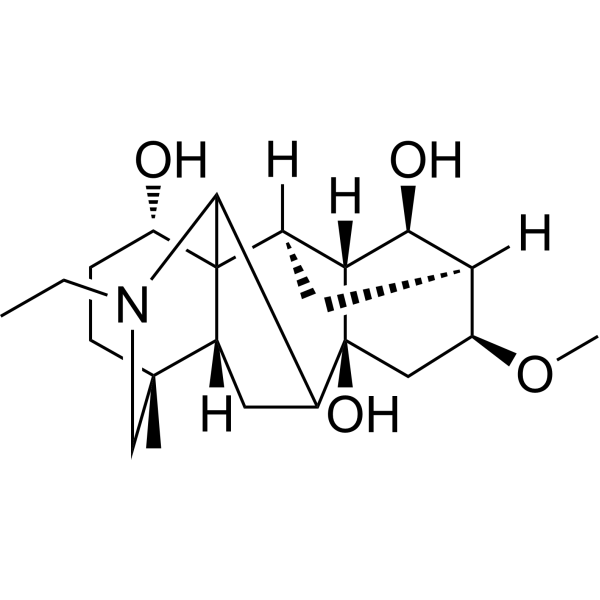
Physicochemical Properties
| Molecular Formula | C22H35NO4 |
| Molecular Weight | 377.5176 |
| Exact Mass | 377.256 |
| CAS # | 39089-30-0 |
| PubChem CID | 170157 |
| Appearance | White to off-white solid powder |
| Density | 1.3±0.1 g/cm3 |
| Boiling Point | 540.2±50.0 °C at 760 mmHg |
| Flash Point | 280.5±30.1 °C |
| Vapour Pressure | 0.0±3.3 mmHg at 25°C |
| Index of Refraction | 1.623 |
| LogP | -0.26 |
| Hydrogen Bond Donor Count | 3 |
| Hydrogen Bond Acceptor Count | 5 |
| Rotatable Bond Count | 2 |
| Heavy Atom Count | 27 |
| Complexity | 673 |
| Defined Atom Stereocenter Count | 0 |
| InChi Key | HKQZUYOVMYOFIT-UHFFFAOYSA-N |
| InChi Code | InChI=1S/C22H35NO4/c1-4-23-10-20(2)6-5-16(24)22-12-7-11-14(27-3)9-21(26,17(12)18(11)25)13(19(22)23)8-15(20)22/h11-19,24-26H,4-10H2,1-3H3 |
| Chemical Name | 11-ethyl-6-methoxy-13-methyl-11-azahexacyclo[7.7.2.12,5.01,10.03,8.013,17]nonadecane-4,8,16-triol |
| HS Tariff Code | 2934.99.9001 |
| Storage |
Powder-20°C 3 years 4°C 2 years In solvent -80°C 6 months -20°C 1 month Note: This product requires protection from light (avoid light exposure) during transportation and storage. |
| Shipping Condition | Room temperature (This product is stable at ambient temperature for a few days during ordinary shipping and time spent in Customs) |
Biological Activity
| Targets |
The action target of Karacoline is the nuclear factor-kappa B (NF-κB) signaling pathway, which regulates the activity of key proteins (p65 and IκBα) in this pathway. [2] |
| ln Vitro |
1. Regulation of extracellular matrix (ECM) degradation in nucleus pulposus (NP) cells: Human NP cells were divided into control group, lipopolysaccharide (LPS)-induced group (1 μg/mL LPS), and Karacoline treatment groups (10 μM, 20 μM, 40 μM Karacoline + 1 μg/mL LPS). After 24-hour treatment, RT-PCR and Western blot showed LPS increased mRNA/protein levels of MMP-3 and ADAMTS-5, and decreased those of COL2A1 and AGG. Karacoline reversed these changes concentration-dependently: 40 μM Karacoline reduced MMP-3/ADAMTS-5 protein by ~50%/45% and increased COL2A1/AGG protein by ~60%/55% [2] 2. Inhibition of NF-κB activation: NP cells were treated with 1 μg/mL LPS and 10-40 μM Karacoline for 12 hours. Western blot showed LPS increased p-p65 and p-IκBα levels; Karacoline inhibited this dose-dependently (40 μM reduced p-p65/p-IκBα by ~55%/60%). Immunofluorescence showed Karacoline reduced p65 nuclear translocation [2] |
| ln Vivo | Amelioration of rat intervertebral disc degeneration: Male Sprague-Dawley rats were used to establish a disc degeneration model by puncturing L4-L5/L5-L6 discs. Rats were divided into sham group, model group (puncture + saline), and Karacoline group (puncture + 20 μg Karacoline). Karacoline was injected into discs once every 7 days for 4 times. At 8 weeks, MRI showed Karacoline lowered Pfirrmann grade (2-3 vs. 4-5 in model group); histology showed improved disc structure, more NP cells, and increased ECM. Western blot showed Karacoline reduced MMP-3, ADAMTS-5, p-p65, p-IκBα, and increased COL2A1, AGG [2] |
| Cell Assay |
Human NP cell culture and treatment: Human NP cells (3rd-5th passage) were seeded in 6-well plates (5×10^5 cells/well) and divided into control, LPS (1 μg/mL), and Karacoline (10-40 μM + LPS) groups. After 24-hour incubation, cells were collected for RT-PCR (MMP-3, ADAMTS-5, COL2A1, AGG mRNA) and Western blot (related proteins). For p65 immunofluorescence, cells on coverslips were treated for 12 hours, fixed, permeabilized, incubated with p65 antibody/fluorescent secondary antibody, stained with DAPI, and observed under a fluorescence microscope [2] |
| Animal Protocol |
Rat disc degeneration model and treatment: Rats (200-250 g) were anesthetized, and L4-L5/L5-L6 discs were punctured with a 21-gauge needle (sham group only exposed discs). Karacoline was dissolved in saline (20 μg/10 μL). From day 7 after surgery, Karacoline group received 10 μL Karacoline (20 μg/rat) per disc injection, model group received saline, once every 7 days for 4 times. At 8 weeks, rats were sacrificed, and discs were collected for MRI, histology, and Western blot [2] |
| References |
[1]. Neurotransmitter receptor and transporter binding profile of antidepressants and their metabolites. J Pharmacol Exp Ther. 1997 Dec;283(3):1305-22. PMID: 9400006. [2]. Zhou X, Hong Y, Zhan Y. Karacoline, identified by network pharmacology, reduces degradation of the extracellular matrix in intervertebral disc degeneration via the NF-κB signaling pathway. J Pharm Anal. 2020;10(1):13-22. |
| Additional Infomation |
Karakoline has been reported in Aconitum japonicum, Delphinium pentagynum, and other organisms with data available. See also: Karakoline (annotation moved to). 1. Karacoline is a diterpenoid alkaloid from Aconitum genus (e.g., Aconitum karakolicum ) with anti-inflammatory and analgesic activities, identified as a potential agent for intervertebral disc degeneration via network pharmacology [2] 2. Karacoline alleviates disc degeneration by inhibiting NF-κB pathway: it reduces IκBα/p65 phosphorylation, prevents p65 nuclear translocation, downregulates MMP-3/ADAMTS-5, and upregulates COL2A1/AGG [2] 3. This study provides experimental evidence for Karacoline in treating intervertebral disc degeneration (a major cause of low back pain) [2] |
Solubility Data
| Solubility (In Vitro) | DMSO : ~25 mg/mL (~66.22 mM) |
| Solubility (In Vivo) |
Solubility in Formulation 1: ≥ 2.5 mg/mL (6.62 mM) (saturation unknown) in 10% DMSO + 40% PEG300 + 5% Tween80 + 45% Saline (add these co-solvents sequentially from left to right, and one by one), clear solution. For example, if 1 mL of working solution is to be prepared, you can add 100 μL of 25.0 mg/mL clear DMSO stock solution to 400 μL PEG300 and mix evenly; then add 50 μL Tween-80 to the above solution and mix evenly; then add 450 μL normal saline to adjust the volume to 1 mL. Preparation of saline: Dissolve 0.9 g of sodium chloride in 100 mL ddH₂ O to obtain a clear solution. Solubility in Formulation 2: ≥ 2.5 mg/mL (6.62 mM) (saturation unknown) in 10% DMSO + 90% (20% SBE-β-CD in Saline) (add these co-solvents sequentially from left to right, and one by one), clear solution. For example, if 1 mL of working solution is to be prepared, you can add 100 μL of 25.0 mg/mL clear DMSO stock solution to 900 μL of 20% SBE-β-CD physiological saline solution and mix evenly. Preparation of 20% SBE-β-CD in Saline (4°C,1 week): Dissolve 2 g SBE-β-CD in 10 mL saline to obtain a clear solution. Solubility in Formulation 3: ≥ 2.5 mg/mL (6.62 mM) (saturation unknown) in 10% DMSO + 90% Corn Oil (add these co-solvents sequentially from left to right, and one by one), clear solution. For example, if 1 mL of working solution is to be prepared, you can add 100 μL of 25.0 mg/mL clear DMSO stock solution to 900 μL of corn oil and mix evenly. (Please use freshly prepared in vivo formulations for optimal results.) |
| Preparing Stock Solutions | 1 mg | 5 mg | 10 mg | |
| 1 mM | 2.6489 mL | 13.2443 mL | 26.4887 mL | |
| 5 mM | 0.5298 mL | 2.6489 mL | 5.2977 mL | |
| 10 mM | 0.2649 mL | 1.3244 mL | 2.6489 mL |