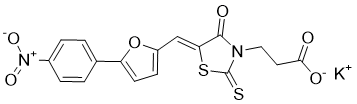
Physicochemical Properties
| Molecular Formula | C17H11KN2O6S2 |
| Molecular Weight | 442.5013 |
| Exact Mass | 441.969 |
| CAS # | 1956356-56-1 |
| Related CAS # | 851304-36-4 (free acid);1956356-56-1; |
| PubChem CID | 119057297 |
| Appearance | Yellow to orange solid powder |
| Hydrogen Bond Donor Count | 0 |
| Hydrogen Bond Acceptor Count | 8 |
| Rotatable Bond Count | 4 |
| Heavy Atom Count | 28 |
| Complexity | 663 |
| Defined Atom Stereocenter Count | 0 |
| SMILES | C1=CC(=CC=C1C2=CC=C(O2)/C=C\3/C(=O)N(C(=S)S3)CCC(=O)[O-])[N+](=O)[O-].[K+] |
| InChi Key | (5Z)-5-[[5-(4-Nitrophenyl)-2-furanyl]methylene]-4-oxo-2-thioxo-3-thiazolidinepropanoic acid potassium salt |
| InChi Code | PHUNRLYHXGMOLG-WQRRWHLMSA-M |
| Chemical Name | KYA1797K |
| HS Tariff Code | 2934.99.9001 |
| Storage |
Powder-20°C 3 years 4°C 2 years In solvent -80°C 6 months -20°C 1 month Note: Please store this product in a sealed and protected environment, avoid exposure to moisture. |
| Shipping Condition | Room temperature (This product is stable at ambient temperature for a few days during ordinary shipping and time spent in Customs) |
Biological Activity
| ln Vitro | By strengthening the β-catenin complex disruptor that activates GSK3β, KYA1797K directly attaches to the regulator of the G protein signaling domain of axin, starting the control of β-catenin and Ras. The growth of APC and KRAS CRC is successfully inhibited by KYA1797K. It also promotes the formation of the β-catenin destruction complex and activates GSK3β, which phosphorylates β-catenin and K-Ras at S33/S37/T41 and T144/T148. β-catenin and Ras are degraded by KYA1797K in SW480, LoVo, DLD1, and HCT15 cells in a dose-dependent manner. In DLD1 cells expressing WT β-catenin or WT K-Ras, KYA1797K destabilizes both Ras and β-catenin [1]. |
| ln Vivo | Both in the Apcmin/+/KrasG12DLA2 mouse model and in tagged APC and K-Ras mutant CRC cell xenograft mice, KYA1797K effectively decreases tumor size. Tumor weight and volume were 70% decreased by KYA1797K (25 mg/kg). Treatment causes a considerable decrease in Wnt/β-catenin and Ras signaling targets, as well as β-catenin and Ras protein levels [1]. |
| References |
[1]. Small-molecule binding of the axin RGS domain promotes β-catenin and Ras degradation. Nat Chem Biol. 2016 Aug;12(8):593-600. |
Solubility Data
| Solubility (In Vitro) |
DMSO : ~6 mg/mL (~13.56 mM) H2O : ~1 mg/mL (~2.26 mM) |
| Solubility (In Vivo) |
Solubility in Formulation 1: 1 mg/mL (2.26 mM) in 10% DMSO + 40% PEG300 + 5% Tween80 + 45% Saline (add these co-solvents sequentially from left to right, and one by one), suspension solution; with sonication. For example, if 1 mL of working solution is to be prepared, you can add 100 μL of 10.0 mg/mL clear DMSO stock solution to 400 μL of PEG300 and mix evenly; then add 50 μL of Tween-80 to the above solution and mix evenly; then add 450 μL of normal saline to adjust the volume to 1 mL. Preparation of saline: Dissolve 0.9 g of sodium chloride in 100 mL ddH₂ O to obtain a clear solution. Solubility in Formulation 2: 1 mg/mL (2.26 mM) in 10% DMSO + 90% (20% SBE-β-CD in Saline) (add these co-solvents sequentially from left to right, and one by one), suspension solution; with ultrasonication. For example, if 1 mL of working solution is to be prepared, you can add 100 μL of 10.0 mg/mL clear DMSO stock solution to 900 μL of 20% SBE-β-CD physiological saline solution and mix evenly. Preparation of 20% SBE-β-CD in Saline (4°C,1 week): Dissolve 2 g SBE-β-CD in 10 mL saline to obtain a clear solution. (Please use freshly prepared in vivo formulations for optimal results.) |
| Preparing Stock Solutions | 1 mg | 5 mg | 10 mg | |
| 1 mM | 2.2599 mL | 11.2994 mL | 22.5989 mL | |
| 5 mM | 0.4520 mL | 2.2599 mL | 4.5198 mL | |
| 10 mM | 0.2260 mL | 1.1299 mL | 2.2599 mL |