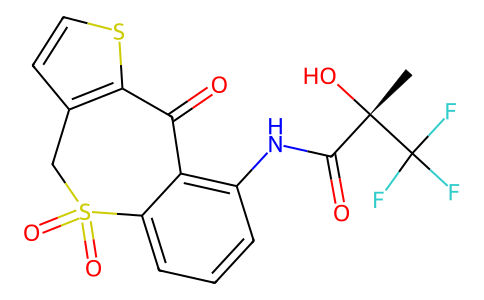
Physicochemical Properties
| Molecular Formula | C16H12F3NO5S2 |
| Molecular Weight | 419.38 |
| Exact Mass | 419.011 |
| CAS # | 214764-26-8 |
| PubChem CID | 9844981 |
| Appearance | Typically exists as solid at room temperature |
| LogP | 4.248 |
| Hydrogen Bond Donor Count | 2 |
| Hydrogen Bond Acceptor Count | 9 |
| Rotatable Bond Count | 2 |
| Heavy Atom Count | 27 |
| Complexity | 735 |
| Defined Atom Stereocenter Count | 1 |
| SMILES | S1(CC2C=CSC=2C(C2C(=CC=CC1=2)NC([C@@](C)(C(F)(F)F)O)=O)=O)(=O)=O |
| InChi Key | NAFSYPCVPLWHFY-HNNXBMFYSA-N |
| InChi Code | InChI=1S/C16H12F3NO5S2/c1-15(23,16(17,18)19)14(22)20-9-3-2-4-10-11(9)12(21)13-8(5-6-26-13)7-27(10,24)25/h2-6,23H,7H2,1H3,(H,20,22)/t15-/m0/s1 |
| Chemical Name | (2S)-3,3,3-trifluoro-2-hydroxy-2-methyl-N-(5,5,10-trioxo-4H-thieno[3,2-c][1]benzothiepin-9-yl)propanamide |
| Synonyms | KW 7158; KW7158; KW-7158 |
| HS Tariff Code | 2934.99.9001 |
| Storage |
Powder-20°C 3 years 4°C 2 years In solvent -80°C 6 months -20°C 1 month |
| Shipping Condition | Room temperature (This product is stable at ambient temperature for a few days during ordinary shipping and time spent in Customs) |
Biological Activity
| Additional Infomation |
KW-7158 is a tricyclic compound with a non-cholingergic mechanism of action for the treatment of "urinary urgency," "frequent urination" and "urinary incontinence" associated with bladder overactivity (involuntary abnormal contraction of the bladder). The therapeutic effects of KW-7158 in overactive bladder may be due to the activation of A-type K(+) channels which regulate afferent neuron excitability and firing properties in the dorsal root ganglion neurons. Drug Indication Investigated for use/treatment in urinary incontinence. Mechanism of Action The therapeutic effects of KW-7158 in overactive bladder may be due to the activation of A-type K(+) channels which regulate afferent neuron excitability and firing properties in the dorsal root ganglion neurons. It is proposed that KW-7158 acts uniquely on the peripheral sensory nerves to control bladder activities by shortenining the action potential duration in DRG neurons. Pharmacodynamics KW-7158 is a tricyclic compound with a non-cholingergic mechanism of action for the treatment of "urinary urgency," "frequent urination" and "urinary incontinence" associated with bladder overactivity (involuntary abnormal contraction of the bladder). As the aging of population progresses, an increasing number of people are likely to suffer from urinary incontinence. Bladder overactivity, the indication for this compound, is estimated to affect around 2.4 million people in Japan and around 20 million in the US and Europe combined. We consider that the market for this therapeutic domain, which is characterised by the predominance of untreated patients, tends to grow. The current mainstay of treatment for bladder overactivity is anti-cholinergic agents, which, however, are associated with high incidences of adverse reactions such as thirst and urination disorder. The development of a new type of drugs, particularly those causing fewer side effects, is thus anticipated. |
Solubility Data
| Solubility (In Vitro) | May dissolve in DMSO (in most cases), if not, try other solvents such as H2O, Ethanol, or DMF with a minute amount of products to avoid loss of samples |
| Solubility (In Vivo) |
Note: Listed below are some common formulations that may be used to formulate products with low water solubility (e.g. < 1 mg/mL), you may test these formulations using a minute amount of products to avoid loss of samples. Injection Formulations (e.g. IP/IV/IM/SC) Injection Formulation 1: DMSO : Tween 80: Saline = 10 : 5 : 85 (i.e. 100 μL DMSO stock solution → 50 μL Tween 80 → 850 μL Saline) *Preparation of saline: Dissolve 0.9 g of sodium chloride in 100 mL ddH ₂ O to obtain a clear solution. Injection Formulation 2: DMSO : PEG300 :Tween 80 : Saline = 10 : 40 : 5 : 45 (i.e. 100 μL DMSO → 400 μLPEG300 → 50 μL Tween 80 → 450 μL Saline) Injection Formulation 3: DMSO : Corn oil = 10 : 90 (i.e. 100 μL DMSO → 900 μL Corn oil) Example: Take the Injection Formulation 3 (DMSO : Corn oil = 10 : 90) as an example, if 1 mL of 2.5 mg/mL working solution is to be prepared, you can take 100 μL 25 mg/mL DMSO stock solution and add to 900 μL corn oil, mix well to obtain a clear or suspension solution (2.5 mg/mL, ready for use in animals). Injection Formulation 4: DMSO : 20% SBE-β-CD in saline = 10 : 90 [i.e. 100 μL DMSO → 900 μL (20% SBE-β-CD in saline)] *Preparation of 20% SBE-β-CD in Saline (4°C,1 week): Dissolve 2 g SBE-β-CD in 10 mL saline to obtain a clear solution. Injection Formulation 5: 2-Hydroxypropyl-β-cyclodextrin : Saline = 50 : 50 (i.e. 500 μL 2-Hydroxypropyl-β-cyclodextrin → 500 μL Saline) Injection Formulation 6: DMSO : PEG300 : castor oil : Saline = 5 : 10 : 20 : 65 (i.e. 50 μL DMSO → 100 μLPEG300 → 200 μL castor oil → 650 μL Saline) Injection Formulation 7: Ethanol : Cremophor : Saline = 10: 10 : 80 (i.e. 100 μL Ethanol → 100 μL Cremophor → 800 μL Saline) Injection Formulation 8: Dissolve in Cremophor/Ethanol (50 : 50), then diluted by Saline Injection Formulation 9: EtOH : Corn oil = 10 : 90 (i.e. 100 μL EtOH → 900 μL Corn oil) Injection Formulation 10: EtOH : PEG300:Tween 80 : Saline = 10 : 40 : 5 : 45 (i.e. 100 μL EtOH → 400 μLPEG300 → 50 μL Tween 80 → 450 μL Saline) Oral Formulations Oral Formulation 1: Suspend in 0.5% CMC Na (carboxymethylcellulose sodium) Oral Formulation 2: Suspend in 0.5% Carboxymethyl cellulose Example: Take the Oral Formulation 1 (Suspend in 0.5% CMC Na) as an example, if 100 mL of 2.5 mg/mL working solution is to be prepared, you can first prepare 0.5% CMC Na solution by measuring 0.5 g CMC Na and dissolve it in 100 mL ddH2O to obtain a clear solution; then add 250 mg of the product to 100 mL 0.5% CMC Na solution, to make the suspension solution (2.5 mg/mL, ready for use in animals). Oral Formulation 3: Dissolved in PEG400 Oral Formulation 4: Suspend in 0.2% Carboxymethyl cellulose Oral Formulation 5: Dissolve in 0.25% Tween 80 and 0.5% Carboxymethyl cellulose Oral Formulation 6: Mixing with food powders Note: Please be aware that the above formulations are for reference only. InvivoChem strongly recommends customers to read literature methods/protocols carefully before determining which formulation you should use for in vivo studies, as different compounds have different solubility properties and have to be formulated differently. (Please use freshly prepared in vivo formulations for optimal results.) |
| Preparing Stock Solutions | 1 mg | 5 mg | 10 mg | |
| 1 mM | 2.3845 mL | 11.9224 mL | 23.8447 mL | |
| 5 mM | 0.4769 mL | 2.3845 mL | 4.7689 mL | |
| 10 mM | 0.2384 mL | 1.1922 mL | 2.3845 mL |