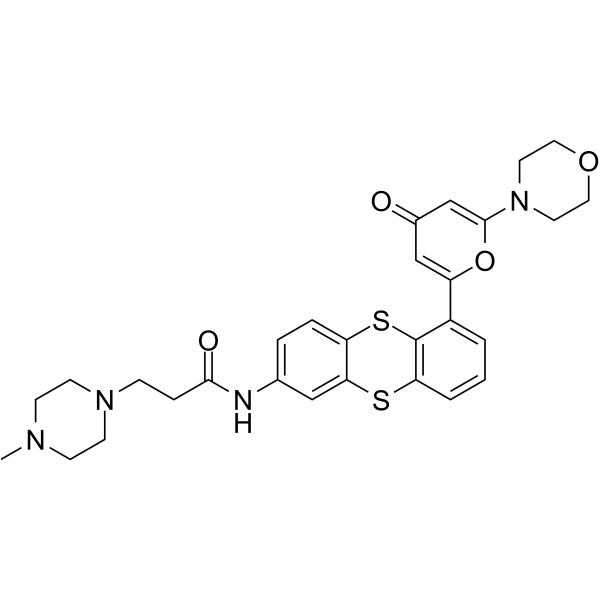
Physicochemical Properties
| Molecular Formula | C29H32N4O4S2 |
| Molecular Weight | 564.72 |
| Exact Mass | 564.186 |
| CAS # | 845932-30-1 |
| PubChem CID | 11433009 |
| Appearance | White to yellow solid powder |
| Density | 1.4±0.1 g/cm3 |
| Boiling Point | 814.3±65.0 °C at 760 mmHg |
| Flash Point | 446.3±34.3 °C |
| Vapour Pressure | 0.0±2.9 mmHg at 25°C |
| Index of Refraction | 1.683 |
| LogP | 4.48 |
| Hydrogen Bond Donor Count | 1 |
| Hydrogen Bond Acceptor Count | 9 |
| Rotatable Bond Count | 6 |
| Heavy Atom Count | 39 |
| Complexity | 963 |
| Defined Atom Stereocenter Count | 0 |
| InChi Key | IIBZKDYAYJSSGB-UHFFFAOYSA-N |
| InChi Code | InChI=1S/C29H32N4O4S2/c1-31-9-11-32(12-10-31)8-7-27(35)30-20-5-6-24-26(17-20)38-25-4-2-3-22(29(25)39-24)23-18-21(34)19-28(37-23)33-13-15-36-16-14-33/h2-6,17-19H,7-16H2,1H3,(H,30,35) |
| Chemical Name | 3-(4-methylpiperazin-1-yl)-N-[6-(6-morpholin-4-yl-4-oxopyran-2-yl)thianthren-2-yl]propanamide |
| Synonyms | KU 59403; KU-59403; KU59403 |
| HS Tariff Code | 2934.99.9001 |
| Storage |
Powder-20°C 3 years 4°C 2 years In solvent -80°C 6 months -20°C 1 month Note: Please store this product in a sealed and protected environment, avoid exposure to moisture. |
| Shipping Condition | Room temperature (This product is stable at ambient temperature for a few days during ordinary shipping and time spent in Customs) |
Biological Activity
| ln Vitro | KU 59403 (1 μM) exhibits a sensitization of 11.9 in p53 mutant SW620 cells and the human breast cancer cell line MDAMB-231, while also potentiating VP-16 (1 μM) cytotoxicity in HCT116 and HCT116-N7 cells to a comparable degree. ±4.7 and 3.8±1.8 times, in that order. In MDA-MB231 cells, which have lower ATM expression and activity, KU 59403 (1 μM) inhibited IR-induced ATM activity by roughly 50%, whereas in HCT116 cells, it was more than 50% [1]. |
| ln Vivo | At a single daily dosage of 12.5 mg/kg, KU59403 significantly sensitizes the body [1]. The KU59403 dose was increased to 25 mg/kg twice day, which produced maximal chemosensitivity and a three-fold increase in the tumor growth delay induced by BMY-40481 in SW620 and HCT116-N7 xenografts without causing considerable chemosensitivity. elevated toxicity [1]. |
| Cell Assay |
Cell viability assay[1] Cell Types: LoVo, HCT116 and SW620 (human colon cancer), U2OS (human osteosarcoma) and MDA-MB-231 (human breast cancer) cells. Tested Concentrations: 1μM. Incubation Duration: 16 hrs (hours). Experimental Results: ATM was at least 1000-fold more specific than other members of the PI3K family tested. Camptothecin cytotoxicity was enhanced in both cell lines, with a greater enhancement observed in LoVo cells compared with SW620 cells. Dramatically enhances the cytotoxicity of fixed concentrations of VP-16 (0.1 and 1 μM) or NSC 123127 (10 or 100 nM) in these cell lines, with VP-16 in SW620 cells and NSC 123127 in LoVo cells. The effect is greater. |
| Animal Protocol |
Animal/Disease Models: CD-1 nude mice were subcutaneously (sc) (sc) implanted with SW620 or HCT116-N7 human cancer cell lines, with 1×10⁷ cells per animal (n=5 per group) [1]. Doses: 6, 12.5 and 25 mg/kg. Dosing: 12.5 mg/kg IP twice (two times) daily (0 hrs (hrs (hours)) and 4 hrs (hrs (hours))), one time/day. Experimental Results: Treatment with BMY-40481 alone resulted in a modest delay in tumor growth of 4 days (time to RTV4 = 10.5 days). This delay extended to 8.5 days when KU 59403 was administered intraperitoneally (ip) (ip) at 12.5 mg/kg twice (two times) daily for 5 days and to 11.5 when KU 59403 was administered intraperitoneally (ip) (ip) at 25 mg/kg twice (two times) daily for 5 days. days (time to reach RTV4 = 18 days). |
| References |
[1]. Preclinical evaluation of a novel ATM inhibitor, KU59403, in vitro and in vivo in p53 functional and dysfunctional models of human cancer. Mol Cancer Ther. 2013 Jun;12(6):959-67. |
Solubility Data
| Solubility (In Vitro) | DMSO : ~10 mg/mL (~17.71 mM) |
| Solubility (In Vivo) |
Note: Listed below are some common formulations that may be used to formulate products with low water solubility (e.g. < 1 mg/mL), you may test these formulations using a minute amount of products to avoid loss of samples. Injection Formulations (e.g. IP/IV/IM/SC) Injection Formulation 1: DMSO : Tween 80: Saline = 10 : 5 : 85 (i.e. 100 μL DMSO stock solution → 50 μL Tween 80 → 850 μL Saline) *Preparation of saline: Dissolve 0.9 g of sodium chloride in 100 mL ddH ₂ O to obtain a clear solution. Injection Formulation 2: DMSO : PEG300 :Tween 80 : Saline = 10 : 40 : 5 : 45 (i.e. 100 μL DMSO → 400 μLPEG300 → 50 μL Tween 80 → 450 μL Saline) Injection Formulation 3: DMSO : Corn oil = 10 : 90 (i.e. 100 μL DMSO → 900 μL Corn oil) Example: Take the Injection Formulation 3 (DMSO : Corn oil = 10 : 90) as an example, if 1 mL of 2.5 mg/mL working solution is to be prepared, you can take 100 μL 25 mg/mL DMSO stock solution and add to 900 μL corn oil, mix well to obtain a clear or suspension solution (2.5 mg/mL, ready for use in animals). Injection Formulation 4: DMSO : 20% SBE-β-CD in saline = 10 : 90 [i.e. 100 μL DMSO → 900 μL (20% SBE-β-CD in saline)] *Preparation of 20% SBE-β-CD in Saline (4°C,1 week): Dissolve 2 g SBE-β-CD in 10 mL saline to obtain a clear solution. Injection Formulation 5: 2-Hydroxypropyl-β-cyclodextrin : Saline = 50 : 50 (i.e. 500 μL 2-Hydroxypropyl-β-cyclodextrin → 500 μL Saline) Injection Formulation 6: DMSO : PEG300 : castor oil : Saline = 5 : 10 : 20 : 65 (i.e. 50 μL DMSO → 100 μLPEG300 → 200 μL castor oil → 650 μL Saline) Injection Formulation 7: Ethanol : Cremophor : Saline = 10: 10 : 80 (i.e. 100 μL Ethanol → 100 μL Cremophor → 800 μL Saline) Injection Formulation 8: Dissolve in Cremophor/Ethanol (50 : 50), then diluted by Saline Injection Formulation 9: EtOH : Corn oil = 10 : 90 (i.e. 100 μL EtOH → 900 μL Corn oil) Injection Formulation 10: EtOH : PEG300:Tween 80 : Saline = 10 : 40 : 5 : 45 (i.e. 100 μL EtOH → 400 μLPEG300 → 50 μL Tween 80 → 450 μL Saline) Oral Formulations Oral Formulation 1: Suspend in 0.5% CMC Na (carboxymethylcellulose sodium) Oral Formulation 2: Suspend in 0.5% Carboxymethyl cellulose Example: Take the Oral Formulation 1 (Suspend in 0.5% CMC Na) as an example, if 100 mL of 2.5 mg/mL working solution is to be prepared, you can first prepare 0.5% CMC Na solution by measuring 0.5 g CMC Na and dissolve it in 100 mL ddH2O to obtain a clear solution; then add 250 mg of the product to 100 mL 0.5% CMC Na solution, to make the suspension solution (2.5 mg/mL, ready for use in animals). Oral Formulation 3: Dissolved in PEG400 Oral Formulation 4: Suspend in 0.2% Carboxymethyl cellulose Oral Formulation 5: Dissolve in 0.25% Tween 80 and 0.5% Carboxymethyl cellulose Oral Formulation 6: Mixing with food powders Note: Please be aware that the above formulations are for reference only. InvivoChem strongly recommends customers to read literature methods/protocols carefully before determining which formulation you should use for in vivo studies, as different compounds have different solubility properties and have to be formulated differently. (Please use freshly prepared in vivo formulations for optimal results.) |
| Preparing Stock Solutions | 1 mg | 5 mg | 10 mg | |
| 1 mM | 1.7708 mL | 8.8539 mL | 17.7079 mL | |
| 5 mM | 0.3542 mL | 1.7708 mL | 3.5416 mL | |
| 10 mM | 0.1771 mL | 0.8854 mL | 1.7708 mL |