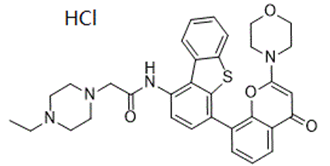
KU0060648 HCl is a novel, potent and dual inhibitor of DNA-dependent protein kinase (DNA-PK) and PI3Kα/β/δ (Phosphoinositide 3-kinases) with potential antitumor activity. It inhibits DNA-PK and PI3Kα/β/δ with an IC50 of 8.6 nM and 4 nM, 0.5 nM, 0.1 nM respectively. It exhibits 20-1000 fold higher selectivity for DNA-PK over other PIKKs and a panel of 60 other kinases.
Physicochemical Properties
| Molecular Formula | C₂₇H₂₉CL₂N₇O₂S |
| Molecular Weight | 586.54 |
| Related CAS # | 881375-00-4 |
| Appearance | Typically exists as solid at room temperature |
| SMILES | O=C(NCC1=CC=C(S(C2=CC(F)=CC(F)=C2)(=O)=O)C=C1)C3=CN4C(C=C3)=NC=C4.Cl |
| Synonyms | KU-0060648 HCl |
| HS Tariff Code | 2934.99.9001 |
| Storage |
Powder-20°C 3 years 4°C 2 years In solvent -80°C 6 months -20°C 1 month |
| Shipping Condition | Room temperature (This product is stable at ambient temperature for a few days during ordinary shipping and time spent in Customs) |
Biological Activity
| ln Vitro | In vitro activity : KU-0060648 exhibits differential effects on growth inhibition, but is not profoundly cytotoxic in a panel of human cancer cell lines. It inhibits DNA-PK and PI-3K with greater potency in MCF7 than SW620 cell using cell-based assays. Five-day exposure to 1 mM KU-0060648 inhibits cell proliferation by more than 95% in MCF7 cells but only by 55% in SW620 cells. In clonogenic survival assays, KU-0060648 increases the cytotoxicity of etoposide and doxorubicin across the panel of DNA-PKcs-proficient cells, but not in DNA-PKcs-deficient cells, confirming that enhanced cytotoxicity of the topoisomerase II poisons etoposide and doxorubicin is due to DNA-PK inhibition. |
| ln Vivo | In mice bearing SW620 and MCF7 xenografts, KU-0060648 concentrations that were sufficient for in vitro growth inhibition and chemosensitization were maintained within the tumor at nontoxic doses for at least 4 hours. KU-0060648 alone delayed the MCF7 xenografts growth and increased etoposide-induced tumor growth delay in both in MCF7 and SW620 xenografts by up to 4.5 folds, without causing etoposide toxicity to unacceptable levels |
| Animal Protocol | Mice bearing SW620 and MCF7 xenografts |
| References | Mol Cancer Ther.2012 Aug;11(8):1789-98. |
Solubility Data
| Solubility (In Vitro) |
DMSO: ~10 mM Water: N/A Ethanol: N/A |
| Solubility (In Vivo) | 30% propylene glycol, 5% Tween 80, 65% D5W: 20mg/mL (Please use freshly prepared in vivo formulations for optimal results.) |
| Preparing Stock Solutions | 1 mg | 5 mg | 10 mg | |
| 1 mM | 1.7049 mL | 8.5246 mL | 17.0491 mL | |
| 5 mM | 0.3410 mL | 1.7049 mL | 3.4098 mL | |
| 10 mM | 0.1705 mL | 0.8525 mL | 1.7049 mL |