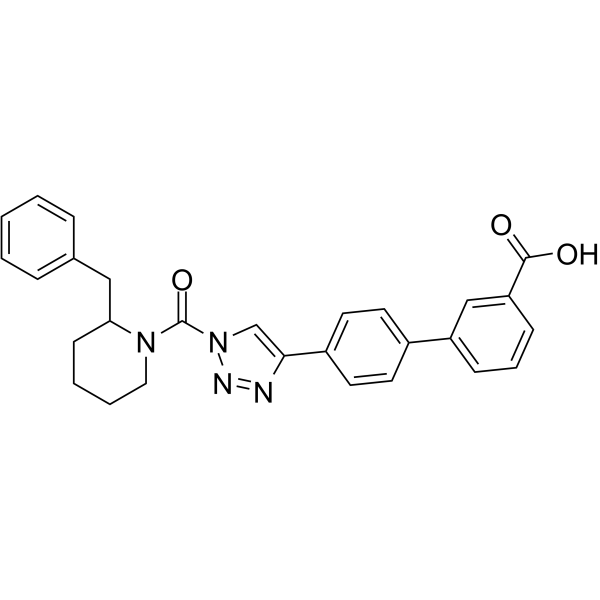
Physicochemical Properties
| Molecular Formula | C28H26N4O3 |
| Molecular Weight | 466.531046390533 |
| Exact Mass | 466.2 |
| CAS # | 1402612-64-9 |
| PubChem CID | 53364510 |
| Appearance | White to yellow solid powder |
| LogP | 5.3 |
| Hydrogen Bond Donor Count | 1 |
| Hydrogen Bond Acceptor Count | 5 |
| Rotatable Bond Count | 5 |
| Heavy Atom Count | 35 |
| Complexity | 719 |
| Defined Atom Stereocenter Count | 0 |
| SMILES | C1(C2=CC=C(C3=CN(C(N4CCCCC4CC4=CC=CC=C4)=O)N=N3)C=C2)=CC=CC(C(O)=O)=C1 |
| InChi Key | SSSCOJOXPDDHOO-UHFFFAOYSA-N |
| InChi Code | InChI=1S/C28H26N4O3/c33-27(34)24-10-6-9-23(18-24)21-12-14-22(15-13-21)26-19-32(30-29-26)28(35)31-16-5-4-11-25(31)17-20-7-2-1-3-8-20/h1-3,6-10,12-15,18-19,25H,4-5,11,16-17H2,(H,33,34) |
| Chemical Name | 3-[4-[1-(2-benzylpiperidine-1-carbonyl)triazol-4-yl]phenyl]benzoic acid |
| HS Tariff Code | 2934.99.9001 |
| Storage |
Powder-20°C 3 years 4°C 2 years In solvent -80°C 6 months -20°C 1 month |
| Shipping Condition | Room temperature (This product is stable at ambient temperature for a few days during ordinary shipping and time spent in Customs) |
Biological Activity
| Targets |
Alpha/beta-hydrolase domain containing 6 (ABHD6) (IC50 = 0.8 – 1.7 nM, gel-based ABPP; IC50 = 3.9 – 15.1 nM, 2-AG hydrolysis assay) Diacylglycerol lipase β (DAGLβ) (~50% inhibition at 1 µM). [1] |
| ln Vitro |
In gel-based competitive activity-based protein profiling (ABPP) assays using the tailored probe HT-01 on Neuro2A cell membrane proteomes, KT203 (compound 20) inhibited endogenous ABHD6 with high potency. [1] In 2-arachidonoylglycerol (2-AG) substrate hydrolysis assays using recombinant mouse ABHD6 overexpressed in HEK293T cell membranes, KT203 inhibited ABHD6 activity. [1] Gel-based competitive ABPP using the broad-spectrum serine hydrolase (SH) probe FP-rhodamine on mouse brain membrane proteomes showed that KT203 at 1 µM selectively inhibited ABHD6 without observable off-targets against other SHs, except for a modest (~50%) inhibition of DAGLβ. At 10 µM, off-target activity against FAAH and DAGLβ was observed. [1] Quantitative mass spectrometry-based ABPP-SILAC analysis in Neuro2A cells treated with 3 nM KT203 for 4 hours showed that it blocked >90% of ABHD6 activity with negligible cross-reactivity (<50% inhibition) against more than 50 other SHs detected in the proteome. [1] |
| ln Vivo |
Mice treated intraperitoneally (i.p.) with KT203 at 1 mg/kg for 4 hours showed near-complete blockade of ABHD6 activity in the liver, as measured by gel-based competitive ABPP using the HT-01 probe. At lower doses (0.5 and 0.1 mg/kg), KT203 maintained strong inhibition (~80%) of liver ABHD6. [1] In contrast to its effect in the liver, KT203 showed negligible inhibition of ABHD6 activity in the brain at all tested doses (0.1, 0.5, and 1 mg/kg, i.p.), indicating peripherally-restricted activity. [1] KT203 displayed good selectivity in vivo. In the liver, it showed little cross-reactivity against numerous carboxylesterase (CES) enzymes, which are common off-targets for serine hydrolase inhibitors. In the brain and liver, gel-based ABPP with the FP-rhodamine probe revealed minimal off-target activity. [1] |
| Enzyme Assay |
The activity of ABHD6 was determined using a 2-AG hydrolysis assay. Membrane lysates from HEK293T cells overexpressing recombinant mouse ABHD6 were diluted in assay buffer (PBS with 0.05% Triton X-100). The lysates were pre-treated with DMSO or compound for 30 minutes at 37°C. The reaction was initiated by adding 2-AG substrate (final concentration 100 µM) and incubated for 30 minutes at 37°C. The reaction was quenched by adding a chloroform:methanol mixture (2:1 v/v) containing an internal standard (pentadecanoic acid). After vortexing and centrifugation, the organic phase was analyzed by LC-MS to quantify the release of arachidonic acid, the hydrolysis product. [1] |
| Cell Assay |
For in situ potency measurement, Neuro2A cells were treated with varying concentrations of KT203 in serum-free media for 4 hours at 37°C. Cells were then lysed, and membrane proteomes were prepared. The proteomes were subjected to gel-based competitive ABPP analysis by labeling with the HT-01 probe (1 µM, 30 min, 37°C). After SDS-PAGE and in-gel fluorescence scanning, the percentage of remaining ABHD6 activity was quantified using image analysis software to determine the IC50 value. [1] For proteome-wide selectivity profiling in cells (ABPP-SILAC), Neuro2A cells were cultured in "light" or "heavy" SILAC media. "Heavy" cells were treated with 3 nM KT203 for 4 hours, while "light" cells were treated with DMSO. Cells were harvested, lysed, and membrane/soluble proteomes were isolated. Proteomes were labeled with FP-biotin (10 µM, 2 hours) to enrich serine hydrolases. Light and heavy proteomes were mixed 1:1, and biotinylated proteins were captured using avidin beads. Proteins were digested on-bead with trypsin, and the resulting peptides were analyzed by LC-MS/MS. The heavy/light ratio for peptides corresponding to individual serine hydrolases was calculated to determine the extent of inhibition. [1] |
| Animal Protocol |
For in vivo efficacy and selectivity studies, C57Bl/6 mice were injected intraperitoneally (i.p.) with KT203. The compound was formulated in an 18:1:1 (v/v/v) solution of saline/ethanol/PEG40 (ethoxylated castor oil) and administered at a volume of 10 µL per gram of body weight. Mice were treated with varying doses of KT203 (0.1, 0.5, or 1 mg/kg). After 4 hours, the mice were anesthetized and euthanized. Brain and liver tissues were collected, homogenized in PBS, and subjected to differential centrifugation to isolate membrane fractions. The membrane proteomes were then analyzed by gel-based competitive ABPP using the HT-01 and FP-rhodamine activity-based probes to assess ABHD6 inhibition and overall serine hydrolase selectivity. [1] |
| References |
[1]. Discovery and optimization of piperidyl-1,2,3-triazole ureas as potent, selective, and in vivo-active inhibitors of α/β-hydrolase domain containing 6 (ABHD6). J Med Chem. 2013 Nov 14;56(21):8270-9. |
| Additional Infomation |
KT203 (compound 20) is an optimized, irreversible inhibitor belonging to the (2-substituted)-piperidyl-1,2,3-triazole urea class, developed as a chemical probe for ABHD6. [1] It was developed through structure-activity relationship (SAR) studies focusing on adding polar substituents to the triazole-biphenyl group and modifying the piperidine substituent. KT203 features a 2-benzyl group on the piperidine and a carboxylic acid substituent at the 3-position of the distal phenyl ring of the triazole-biphenyl group. [1] KT203 acts as a potent and selective inactivator of ABHD6, predicted to irreversibly inhibit the enzyme by carbamoylating its active-site serine nucleophile. [1] A key characteristic of KT203 is its peripherally-restricted activity in vivo. While it potently inhibits ABHD6 in the liver, it shows negligible activity in the brain, likely due to reduced central nervous system (CNS) penetrance imparted by its carboxylic acid group. This property makes it a paired probe with the brain-penetrant inhibitor KT182 (compound 9) to distinguish between central and peripheral ABHD6 functions in animal models. [1] The development of KT203 addresses the need for optimized tools to study ABHD6 function. ABHD6 is a serine hydrolase that hydrolyzes the endocannabinoid 2-arachidonoylglycerol (2-AG) and may have roles in neuroinflammation and neuroprotection. [1] |
Solubility Data
| Solubility (In Vitro) | DMSO : ~100 mg/mL (~214.35 mM) |
| Solubility (In Vivo) |
Solubility in Formulation 1: ≥ 2.5 mg/mL (5.36 mM) (saturation unknown) in 10% DMSO + 40% PEG300 + 5% Tween80 + 45% Saline (add these co-solvents sequentially from left to right, and one by one), clear solution. For example, if 1 mL of working solution is to be prepared, you can add 100 μL of 25.0 mg/mL clear DMSO stock solution to 400 μL PEG300 and mix evenly; then add 50 μL Tween-80 to the above solution and mix evenly; then add 450 μL normal saline to adjust the volume to 1 mL. Preparation of saline: Dissolve 0.9 g of sodium chloride in 100 mL ddH₂ O to obtain a clear solution. Solubility in Formulation 2: ≥ 2.5 mg/mL (5.36 mM) (saturation unknown) in 10% DMSO + 90% Corn Oil (add these co-solvents sequentially from left to right, and one by one), clear solution. For example, if 1 mL of working solution is to be prepared, you can add 100 μL of 25.0 mg/mL clear DMSO stock solution to 900 μL of corn oil and mix evenly. (Please use freshly prepared in vivo formulations for optimal results.) |
| Preparing Stock Solutions | 1 mg | 5 mg | 10 mg | |
| 1 mM | 2.1435 mL | 10.7174 mL | 21.4348 mL | |
| 5 mM | 0.4287 mL | 2.1435 mL | 4.2870 mL | |
| 10 mM | 0.2143 mL | 1.0717 mL | 2.1435 mL |