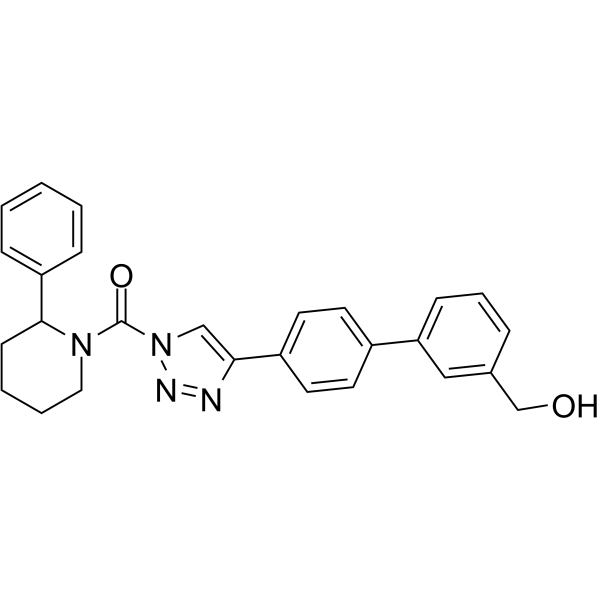
Physicochemical Properties
| Molecular Formula | C27H26N4O2 |
| Molecular Weight | 438.520946025848 |
| Exact Mass | 438.205 |
| CAS # | 1402612-62-7 |
| PubChem CID | 53364491 |
| Appearance | Off-white to light yellow solid powder |
| LogP | 4.4 |
| Hydrogen Bond Donor Count | 1 |
| Hydrogen Bond Acceptor Count | 4 |
| Rotatable Bond Count | 4 |
| Heavy Atom Count | 33 |
| Complexity | 632 |
| Defined Atom Stereocenter Count | 0 |
| SMILES | C(N1C=C(C2=CC=C(C3=CC=CC(CO)=C3)C=C2)N=N1)(N1CCCCC1C1=CC=CC=C1)=O |
| InChi Key | GICNKPZHUCVFNM-UHFFFAOYSA-N |
| InChi Code | InChI=1S/C27H26N4O2/c32-19-20-7-6-10-24(17-20)21-12-14-22(15-13-21)25-18-31(29-28-25)27(33)30-16-5-4-11-26(30)23-8-2-1-3-9-23/h1-3,6-10,12-15,17-18,26,32H,4-5,11,16,19H2 |
| Chemical Name | [4-[4-[3-(hydroxymethyl)phenyl]phenyl]triazol-1-yl]-(2-phenylpiperidin-1-yl)methanone |
| HS Tariff Code | 2934.99.9001 |
| Storage |
Powder-20°C 3 years 4°C 2 years In solvent -80°C 6 months -20°C 1 month |
| Shipping Condition | Room temperature (This product is stable at ambient temperature for a few days during ordinary shipping and time spent in Customs) |
Biological Activity
| Targets | Alpha/beta-hydrolase domain containing 6 (ABHD6) [1] |
| ln Vitro |
In mouse neuroblastoma Neuro2A cell membrane proteomes, KT182 potently inhibited ABHD6 activity as measured by gel-based competitive activity-based protein profiling (ABPP), with an IC50 value of 1.7 nM. [1] In a 2-arachidonoylglycerol (2-AG) hydrolysis assay using recombinant mouse ABHD6 overexpressed in HEK293T cells, KT182 inhibited ABHD6 with an IC50 value of 6.3 nM. [1] In situ treatment of Neuro2A cells with KT182 for 4 hours resulted in potent inhibition of ABHD6, with an IC50 value of 0.3 nM. [1] Quantitative ABPP-SILAC analysis in Neuro2A cells treated with 3 nM KT182 for 4 hours showed that it blocked >90% of ABHD6 activity and displayed negligible cross-reactivity (<50% inhibition) against more than 50 other serine hydrolases detected in the proteome. [1] |
| ln Vivo |
Intraperitoneal (i.p.) administration of KT182 (1 mg kg⁻¹) to mice for 4 hours produced near-complete blockade of ABHD6 activity in both the brain and liver, as measured by gel-based competitive ABPP. [1] At lower doses (0.5 and 0.1 mg kg⁻¹, i.p., 4 hr), KT182 maintained approximately 80% inhibition of ABHD6 in the liver. [1] KT182 exhibited systemic activity (affecting both brain and liver) and showed good selectivity in vivo, with carboxylesterase 1 (CES1) identified as a minor off-target at 1 mg kg⁻¹. [1] |
| Enzyme Assay |
The activity of ABHD6 was determined using a 2-AG hydrolysis assay. Membrane lysates from HEK293T cells overexpressing recombinant mouse ABHD6 were diluted and pre-treated with DMSO or compound for 30 minutes at 37°C. The reaction was initiated by adding 2-AG substrate and incubated for 30 minutes at 37°C. The reaction was quenched by adding a chloroform:methanol mixture. The organic phase was analyzed by LC-MS to quantify the release of arachidonic acid. [1] |
| Cell Assay |
For in situ potency measurements, Neuro2A cells were treated with varying concentrations of KT182 in serum-free media for 4 hours at 37°C with 5% CO₂. Cells were then washed, lysed by sonication, and centrifuged to generate membrane proteomes. The proteomes were subjected to gel-based competitive ABPP analysis to determine remaining ABHD6 activity. [1] For ABPP-SILAC selectivity profiling, Neuro2A cells grown in heavy isotopic medium were treated with KT182 (3 nM) for 4 hours, while light medium-grown cells were treated with DMSO. Cells were harvested, lysed, and membrane/soluble fractions were prepared. Proteomes were labeled with a fluorophosphonate-biotin activity-based probe. Heavy and light proteomes were mixed, biotinylated proteins were enriched with avidin beads, digested with trypsin, and analyzed by LC-MS/MS. [1] |
| Animal Protocol |
For in vivo efficacy and selectivity studies, C57Bl/6 mice were injected intraperitoneally (i.p.) with KT182 dissolved in an 18:1:1 (v/v/v) solution of saline/ethanol/PEG40 (ethoxylated castor oil) at a volume of 10 µL per gram of body weight. The compound was administered at doses of 0.1, 0.5, or 1 mg kg⁻¹. After 4 hours, mice were anesthetized, euthanized, and brain and liver tissues were collected. Tissues were homogenized, and membrane fractions were isolated by centrifugation for subsequent competitive ABPP analysis. [1] |
| References |
[1]. Discovery and optimization of piperidyl-1,2,3-triazole ureas as potent, selective, and in vivo-active inhibitors of α/β-hydrolase domain containing 6 (ABHD6). J Med Chem. 2013 Nov 14;56(21):8270-9. |
| Additional Infomation |
KT182 is an optimized, irreversible (2-phenyl)-piperidyl-1,2,3-triazole urea inhibitor of ABHD6. [1] It was developed from an initial lead compound through structure-activity relationship studies, where the addition of a polar hydroxymethyl substituent at the 3-position of the distal phenyl ring on the biphenyl-triazole group helped fine-tune selectivity. [1] It serves as a brain-penetrant chemical probe, allowing for the functional analysis of ABHD6 in the central nervous system in animal models. [1] In contrast, a related compound KT203 (20) with a carboxylic acid substituent showed peripherally-restricted activity. [1] |
Solubility Data
| Solubility (In Vitro) |
DMSO : ~100 mg/mL (~228.04 mM) Ethanol : ~11 mg/mL (~25.08 mM) |
| Solubility (In Vivo) |
Solubility in Formulation 1: ≥ 2.5 mg/mL (5.70 mM) (saturation unknown) in 10% DMSO + 40% PEG300 + 5% Tween80 + 45% Saline (add these co-solvents sequentially from left to right, and one by one), clear solution. For example, if 1 mL of working solution is to be prepared, you can add 100 μL of 25.0 mg/mL clear DMSO stock solution to 400 μL PEG300 and mix evenly; then add 50 μL Tween-80 to the above solution and mix evenly; then add 450 μL normal saline to adjust the volume to 1 mL. Preparation of saline: Dissolve 0.9 g of sodium chloride in 100 mL ddH₂ O to obtain a clear solution. Solubility in Formulation 2: ≥ 2.5 mg/mL (5.70 mM) (saturation unknown) in 10% DMSO + 90% (20% SBE-β-CD in Saline) (add these co-solvents sequentially from left to right, and one by one), clear solution. For example, if 1 mL of working solution is to be prepared, you can add 100 μL of 25.0 mg/mL clear DMSO stock solution to 900 μL of 20% SBE-β-CD physiological saline solution and mix evenly. Preparation of 20% SBE-β-CD in Saline (4°C,1 week): Dissolve 2 g SBE-β-CD in 10 mL saline to obtain a clear solution. Solubility in Formulation 3: ≥ 2.5 mg/mL (5.70 mM) (saturation unknown) in 10% DMSO + 90% Corn Oil (add these co-solvents sequentially from left to right, and one by one), clear solution. For example, if 1 mL of working solution is to be prepared, you can add 100 μL of 25.0 mg/mL clear DMSO stock solution to 900 μL of corn oil and mix evenly. (Please use freshly prepared in vivo formulations for optimal results.) |
| Preparing Stock Solutions | 1 mg | 5 mg | 10 mg | |
| 1 mM | 2.2804 mL | 11.4020 mL | 22.8040 mL | |
| 5 mM | 0.4561 mL | 2.2804 mL | 4.5608 mL | |
| 10 mM | 0.2280 mL | 1.1402 mL | 2.2804 mL |