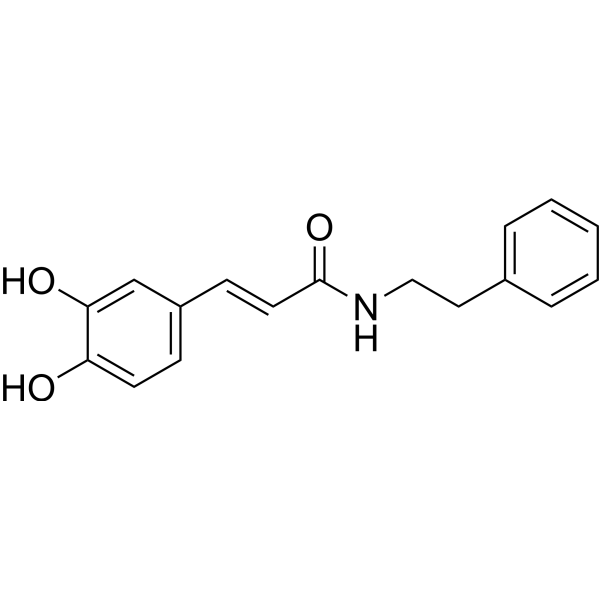
Physicochemical Properties
| Molecular Formula | C17H17NO3 |
| Molecular Weight | 283.32 |
| Exact Mass | 283.121 |
| Elemental Analysis | C, 72.07; H, 6.05; N, 4.94; O, 16.94 |
| CAS # | 105955-01-9 |
| PubChem CID | 11391937 |
| Appearance | Solid powder |
| LogP | 3.31 |
| Hydrogen Bond Donor Count | 3 |
| Hydrogen Bond Acceptor Count | 3 |
| Rotatable Bond Count | 5 |
| Heavy Atom Count | 21 |
| Complexity | 350 |
| Defined Atom Stereocenter Count | 0 |
| SMILES | O=C(/C=C/C1C=CC(=C(C=1)O)O)NCCC1C=CC=CC=1 |
| InChi Key | QOWABIXYAFJMQE-VQHVLOKHSA-N |
| InChi Code | InChI=1S/C17H17NO3/c19-15-8-6-14(12-16(15)20)7-9-17(21)18-11-10-13-4-2-1-3-5-13/h1-9,12,19-20H,10-11H2,(H,18,21)/b9-7+ |
| Chemical Name | (E)-3-(3,4-dihydroxyphenyl)-N-(2-phenylethyl)prop-2-enamide |
| Synonyms | KS 370 G; KS-370-G; KS370G |
| HS Tariff Code | 2934.99.9001 |
| Storage |
Powder-20°C 3 years 4°C 2 years In solvent -80°C 6 months -20°C 1 month |
| Shipping Condition | Room temperature (This product is stable at ambient temperature for a few days during ordinary shipping and time spent in Customs) |
Biological Activity
| ln Vivo | By lowering the phosphorylation of high-stress myocardial ERK, AKT, and GSK3β, KS370G (1 mg/kg; oral; once daily for 8 weeks) enhances left ventricular function and prevents cardiac hypertrophy [1]. By decreasing neuronal and oxidative stress, oral medication (once daily for 13 days) mitigates unilateral ureteral blockage-induced kidney fibrosis in mice [2]. |
| Animal Protocol |
Animal/Disease Models: Pressure overload ICR mouse model [1] Doses: 1 mg/kg Route of Administration: po (oral gavage), one time/day for 8 weeks. Experimental Results: Inhibited cardiac hypertrophy caused by pressure overload and improved cardiac function. Decreases plasma levels of atrial natriuretic peptide and lactate dehydrogenase. Dramatically diminished pressure overload-induced increases in α-SMA and ERK, AKT, and GSK3β phosphorylation. Collagen accumulation in the heart is diminished. Animal/Disease Models: Male ICR mouse, unilateral ureteral obstruction (UUO) model [2] Doses: 10 mg/kg Route of Administration: Orally, one time/day for 13 days Experimental Results: Dramatically attenuated collagen deposition in the obstructed kidney, and inhibited UUO-induced expression of renal fibrosis markers, including fibronectin, type I collagen, vimentin, and α-smooth muscle actin (α-SMA). Dramatically diminished renal expression of inflammatory chemokines/adhesion molecules and monocyte markers (MCP-1, VCAM-1, ICAM-1 and CD11b). diminished renal malondialdehyde l |
| References |
[1]. Chuang ST, et al. KS370G, a caffeamide derivative, attenuates unilateral ureteral obstruction-induced renal fibrosis by the reduction of inflammation and oxidative stress in mice. Eur J Pharmacol. 2015 Mar 5;750:1-7. [2]. Weng YC, et al. KS370G, a synthetic caffeamide derivative, improves left ventricular hypertrophy and function in pressure-overload mice heart. Eur J Pharmacol. 2012 Jun 5;684(1-3):108-15. [3]. Chuang ST, et al. KS370G, a caffeamide derivative, attenuates unilateral ureteral obstruction-induced renal fibrosis by the reduction of inflammation and oxidative stress in mice. Eur J Pharmacol. 2015 Mar 5;750:1-7. |
| Additional Infomation |
Caffeic Acid Phenethyl Amide has been reported in Annona cherimola with data available. See also: Ipomoea aquatica leaf (part of). |
Solubility Data
| Solubility (In Vitro) | DMSO : ~100 mg/mL (~352.96 mM) |
| Solubility (In Vivo) |
Solubility in Formulation 1: ≥ 2.5 mg/mL (8.82 mM) (saturation unknown) in 10% DMSO + 90% (20% SBE-β-CD in Saline) (add these co-solvents sequentially from left to right, and one by one), clear solution. For example, if 1 mL of working solution is to be prepared, you can add 100 μL of 25.0 mg/mL clear DMSO stock solution to 900 μL of 20% SBE-β-CD physiological saline solution and mix evenly. Preparation of 20% SBE-β-CD in Saline (4°C,1 week): Dissolve 2 g SBE-β-CD in 10 mL saline to obtain a clear solution. Solubility in Formulation 2: ≥ 2.5 mg/mL (8.82 mM) (saturation unknown) in 10% DMSO + 90% Corn Oil (add these co-solvents sequentially from left to right, and one by one), clear solution. For example, if 1 mL of working solution is to be prepared, you can add 100 μL of 25.0 mg/mL clear DMSO stock solution to 900 μL of corn oil and mix evenly. (Please use freshly prepared in vivo formulations for optimal results.) |
| Preparing Stock Solutions | 1 mg | 5 mg | 10 mg | |
| 1 mM | 3.5296 mL | 17.6479 mL | 35.2958 mL | |
| 5 mM | 0.7059 mL | 3.5296 mL | 7.0592 mL | |
| 10 mM | 0.3530 mL | 1.7648 mL | 3.5296 mL |