|
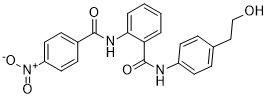
KS176 is a novel potent and highly selective/specific inhibitor of the breast cancer resistance protein (BCRP) multidrug transporter with IC50 values of 0.59 and 1.39 μM in Pheo A and Hoechst 33342 assays respectively. It displays no inhibitory activity against P-gp or MRP1. KS176 and its analogs share a noncompetitive-type interaction with pheophorbide A. Experiments with imatinib and pheophorbide A revealed a mixed-type interaction. This class of specific breast cancer resistance protein (BCRP) inhibitors showed no inhibition of the ATP binding cassette (ABC) transporters P-gp and MRP1. Some of these modulators inhibit BCRP with high potency; they are only slightly less potent than Ko143 and could serve as promising lead structures for the design of novel effective BCRP inhibitors. These inhibitors are structurally related to tariquidar (XR9576) and belong to a library of multidrug-resistance modulators
|
Physicochemical Properties
| Molecular Formula |
C22H19N3O5
|
| Molecular Weight |
405.4
|
| Exact Mass |
405.132
|
| Elemental Analysis |
C, 65.18; H, 4.72; N, 10.37; O, 19.73
|
| CAS # |
1253452-78-6
|
| Related CAS # |
|
| PubChem CID |
49779726
|
| Appearance |
White to off-white solid powder
|
| LogP |
4.303
|
| Hydrogen Bond Donor Count |
3
|
| Hydrogen Bond Acceptor Count |
5
|
| Rotatable Bond Count |
6
|
| Heavy Atom Count |
30
|
| Complexity |
592
|
| Defined Atom Stereocenter Count |
0
|
| InChi Key |
LTWQQWSXYYXVGA-UHFFFAOYSA-N
|
| InChi Code |
InChI=1S/C22H19N3O5/c26-14-13-15-5-9-17(10-6-15)23-22(28)19-3-1-2-4-20(19)24-21(27)16-7-11-18(12-8-16)25(29)30/h1-12,26H,13-14H2,(H,23,28)(H,24,27)
|
| Chemical Name |
N-[4-(2-Hydroxyethyl)phenyl]-2-[(4-nitrobenzoyl)amino]benzamide
|
| Synonyms |
|
| HS Tariff Code |
2934.99.9001
|
| Storage |
Powder-20°C 3 years
4°C 2 years
In solvent -80°C 6 months
-20°C 1 month
|
| Shipping Condition |
Room temperature (This product is stable at ambient temperature for a few days during ordinary shipping and time spent in Customs)
|
|
Biological Activity
| Targets |
BCRP (breast cancer resistance protein)
|
| ln Vitro |
In vitro activity: KS176 is a novel potent and highly selective/specific inhibitor of the breast cancer resistance protein (BCRP) multidrug transporter with IC50 values of 0.59 and 1.39 μM in Pheo A and Hoechst 33342 assays respectively. It displays no inhibitory activity against P-gp or MRP1. KS176 and its analogs share a noncompetitive-type interaction with pheophorbide A. Experiments with imatinib and pheophorbide A revealed a mixed-type interaction. This class of specific breast cancer resistance protein (BCRP) inhibitors showed no inhibition of the ATP binding cassette (ABC) transporters P-gp and MRP1. Some of these modulators inhibit BCRP with high potency; they are only slightly less potent than Ko143 and could serve as promising lead structures for the design of novel effective BCRP inhibitors. These inhibitors are structurally related to tariquidar (XR9576) and belong to a library of multidrug-resistance modulators
Kinase Assay: KS176 is a novel potent and highly selective/specific inhibitor of the breast cancer resistance protein (BCRP) multidrug transporter with IC50 values of 0.59 and 1.39 μM in Pheo A and Hoechst 33342 assays respectively.
Cell Assay: |
|
| Enzyme Assay |
A new class of specific breast cancer resistance protein (BCRP) inhibitors was identified, showing no inhibition of the ATP binding cassette (ABC) transporters P-gp and MRP1. Some of these modulators inhibit BCRP with high potency; they are only slightly less potent than Ko143 and could serve as promising lead structures for the design of novel effective BCRP inhibitors. These inhibitors are structurally related to tariquidar (XR9576) and belong to a library of multidrug-resistance modulators synthesized by our research group. The absence of the tetrahydroisoquinoline substructure appears to play a crucial role for specificity; we found that the presence of this substructure is not essential for interaction with BCRP. To determine the type of interaction between pheophorbide A and compounds with and without the tetrahydroisoquinoline substructure, various substrate pheophorbide A concentrations were used in enzyme kinetics assays. The resulting data show that these compounds share a noncompetitive-type interaction with pheophorbide A. Experiments with imatinib and pheophorbide A revealed a mixed-type interaction. The combination of imatinib and compounds with and without the tetrahydroisoquinoline substructure resulted in a positive cooperative effect, indicating that imatinib engages a binding site distinct from that of the new compounds on one side and distinct from that of pheophorbide A on the other side as well. The results of this study suggest that the category of BCRP-specific inhibitors, which includes only fumitremorgin C, Ko143 and analogues, and novobiocin needs to be extended by this new class of inhibitors, which possess three key characteristics: specificity, potency, and low toxicity[1].
|
| Animal Protocol |
|
| References |
ChemMedChem.2010 Sep 3;5(9):1498-505.
|
|
Solubility Data
| Solubility (In Vitro) |
| DMSO:≥ 35 mg/mL | | Water:<1 mg/mL | | Ethanol:<1 mg/mL |
|
| Solubility (In Vivo) |
| O=C(NC1=CC=C(CCO)C=C1)C2=CC=CC=C2NC(C3=CC=C([N+]([O-])=O)C=C3)=O |
(Please use freshly prepared in vivo formulations for optimal results.)
|
| Preparing Stock Solutions |
|
1 mg |
5 mg |
10 mg |
| 1 mM |
2.4667 mL |
12.3335 mL |
24.6670 mL |
| 5 mM |
0.4933 mL |
2.4667 mL |
4.9334 mL |
| 10 mM |
0.2467 mL |
1.2333 mL |
2.4667 mL |
*Note: Please select an appropriate solvent for the preparation of stock solution based on your experiment needs. For most products, DMSO can be used for preparing stock solutions (e.g. 5 mM, 10 mM, or 20 mM concentration); some products with high aqueous solubility may be dissolved in water directly. Solubility information is available at the above Solubility Data section. Once the stock solution is prepared, aliquot it to routine usage volumes and store at -20°C or -80°C. Avoid repeated freeze and thaw cycles. |