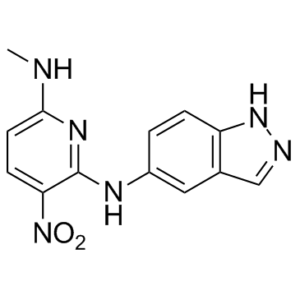
KRIBB11, a novel and potent inhibitor of Heat shock factor 1 (HSF1), abolishes the heat shock-induced luciferase activity with an IC50 of 1.2 μM. Heat shock protein 90 (Hsp90) is the master switch for heat shock protein (HSP) expression in eukaryotes and has an important role in many cancers. Biochemical inhibitors of Hsp90 are in advanced clinical development for the treatment of solid and hematological malignancies. As an inhibitor of the transcription factor Heat Shock Factor 1 (HSF1), KRIBB11 can inhibit cancer cell proliferation, arrests the cell cycle at G2/M phase and induces apoptosis. But it does not inhibit heat shock-induced recruitment of HSF1 to the hsp70 promoter or phosphorylation of HSF1 Ser-230. KRIBB11 inhibits heat shock-induced recruitment of pTEFb to the hsp70 promoter and p-TEFb-dependent Phosphorylation of polⅡ CTD Ser-2. Immunoblotting assays showed that the expression of HSP70 was lower in KRIBB11-treated tumor tissue than in control tissues. Because HSPs are expressed at high levels in a wide range of tumors, these results strengthen the rationale for targeting HSF1 in cancer therapy.
Physicochemical Properties
| Molecular Formula | C13H12N6O2 | |
| Molecular Weight | 284.27 | |
| Exact Mass | 284.102 | |
| CAS # | 342639-96-7 | |
| Related CAS # |
|
|
| PubChem CID | 69894253 | |
| Appearance | Yellow to orange solid powder | |
| Density | 1.5±0.1 g/cm3 | |
| Boiling Point | 535.0±50.0 °C at 760 mmHg | |
| Flash Point | 277.3±30.1 °C | |
| Vapour Pressure | 0.0±1.4 mmHg at 25°C | |
| Index of Refraction | 1.812 | |
| LogP | 4.3 | |
| Hydrogen Bond Donor Count | 3 | |
| Hydrogen Bond Acceptor Count | 6 | |
| Rotatable Bond Count | 3 | |
| Heavy Atom Count | 21 | |
| Complexity | 376 | |
| Defined Atom Stereocenter Count | 0 | |
| InChi Key | NDJJEQIMIJJCLL-UHFFFAOYSA-N | |
| InChi Code | InChI=1S/C13H12N6O2/c1-14-12-5-4-11(19(20)21)13(17-12)16-9-2-3-10-8(6-9)7-15-18-10/h2-7H,1H3,(H,15,18)(H2,14,16,17) | |
| Chemical Name | 2-N-(1H-indazol-5-yl)-6-N-methyl-3-nitropyridine-2,6-diamine | |
| Synonyms |
|
|
| HS Tariff Code | 2934.99.9001 | |
| Storage |
Powder-20°C 3 years 4°C 2 years In solvent -80°C 6 months -20°C 1 month |
|
| Shipping Condition | Room temperature (This product is stable at ambient temperature for a few days during ordinary shipping and time spent in Customs) |
Biological Activity
| ln Vitro | KRIBB11 prevents downstream target proteins of HSF1, including HSP27 and HSP70, from being induced. In HCT-116 cells, KRIBB11 causes apoptosis and growth arrest. KRIBB11 prevents p-TEFb (positive transcription elongation factor b) from being recruited to the hsp70 promoter in an HSF1-dependent manner [1]. After KRIBB11 treatment, PARP and caspase-3 cleavage increased in the cells. KRIBB11 incubation on RKO results in an IC50 of 20–30 μM and a toxicity threshold of about 10 μM [2]. | ||
| ln Vivo | In nude mice without weight loss, KRIBB11 (50 mg/kg, intraperitoneal injection) inhibited 47.4% of tumor growth [1]. | ||
| Animal Protocol |
|
||
| References |
[1]. KRIBB11 inhibits HSP70 synthesis through inhibition of heat shock factor 1 function by impairing the recruitment of positive transcription elongation factor b to the hsp70 promoter. J Biol Chem. 2011 Jan 21;286(3):1737-47. [2]. Heat shock factor 1 confers resistance to Hsp90 inhibitors through p62/SQSTM1 expression and promotion of autophagic flux. Biochem Pharmacol. 2014 Feb 1;87(3):445-55. |
||
| Additional Infomation | KRIBB11 is a member of the class of indazoles that is 1H-indazole substituted by a [6-(methylamino)-3-nitropyridin-2-yl]amino group at position 5. It is an inhibitor of heat shock factor 1 (IC50 = 1.2muM) and suppresses tumour growth in mouse xenograft models. It has a role as an apoptosis inducer, an antineoplastic agent and a heat shock factor 1 inhibitor. It is a member of indazoles, an aromatic amine, an aminopyridine and a C-nitro compound. |
Solubility Data
| Solubility (In Vitro) |
|
|||
| Solubility (In Vivo) |
Note: Listed below are some common formulations that may be used to formulate products with low water solubility (e.g. < 1 mg/mL), you may test these formulations using a minute amount of products to avoid loss of samples. Injection Formulations (e.g. IP/IV/IM/SC) Injection Formulation 1: DMSO : Tween 80: Saline = 10 : 5 : 85 (i.e. 100 μL DMSO stock solution → 50 μL Tween 80 → 850 μL Saline) *Preparation of saline: Dissolve 0.9 g of sodium chloride in 100 mL ddH ₂ O to obtain a clear solution. Injection Formulation 2: DMSO : PEG300 :Tween 80 : Saline = 10 : 40 : 5 : 45 (i.e. 100 μL DMSO → 400 μLPEG300 → 50 μL Tween 80 → 450 μL Saline) Injection Formulation 3: DMSO : Corn oil = 10 : 90 (i.e. 100 μL DMSO → 900 μL Corn oil) Example: Take the Injection Formulation 3 (DMSO : Corn oil = 10 : 90) as an example, if 1 mL of 2.5 mg/mL working solution is to be prepared, you can take 100 μL 25 mg/mL DMSO stock solution and add to 900 μL corn oil, mix well to obtain a clear or suspension solution (2.5 mg/mL, ready for use in animals). Injection Formulation 4: DMSO : 20% SBE-β-CD in saline = 10 : 90 [i.e. 100 μL DMSO → 900 μL (20% SBE-β-CD in saline)] *Preparation of 20% SBE-β-CD in Saline (4°C,1 week): Dissolve 2 g SBE-β-CD in 10 mL saline to obtain a clear solution. Injection Formulation 5: 2-Hydroxypropyl-β-cyclodextrin : Saline = 50 : 50 (i.e. 500 μL 2-Hydroxypropyl-β-cyclodextrin → 500 μL Saline) Injection Formulation 6: DMSO : PEG300 : castor oil : Saline = 5 : 10 : 20 : 65 (i.e. 50 μL DMSO → 100 μLPEG300 → 200 μL castor oil → 650 μL Saline) Injection Formulation 7: Ethanol : Cremophor : Saline = 10: 10 : 80 (i.e. 100 μL Ethanol → 100 μL Cremophor → 800 μL Saline) Injection Formulation 8: Dissolve in Cremophor/Ethanol (50 : 50), then diluted by Saline Injection Formulation 9: EtOH : Corn oil = 10 : 90 (i.e. 100 μL EtOH → 900 μL Corn oil) Injection Formulation 10: EtOH : PEG300:Tween 80 : Saline = 10 : 40 : 5 : 45 (i.e. 100 μL EtOH → 400 μLPEG300 → 50 μL Tween 80 → 450 μL Saline) Oral Formulations Oral Formulation 1: Suspend in 0.5% CMC Na (carboxymethylcellulose sodium) Oral Formulation 2: Suspend in 0.5% Carboxymethyl cellulose Example: Take the Oral Formulation 1 (Suspend in 0.5% CMC Na) as an example, if 100 mL of 2.5 mg/mL working solution is to be prepared, you can first prepare 0.5% CMC Na solution by measuring 0.5 g CMC Na and dissolve it in 100 mL ddH2O to obtain a clear solution; then add 250 mg of the product to 100 mL 0.5% CMC Na solution, to make the suspension solution (2.5 mg/mL, ready for use in animals). Oral Formulation 3: Dissolved in PEG400 Oral Formulation 4: Suspend in 0.2% Carboxymethyl cellulose Oral Formulation 5: Dissolve in 0.25% Tween 80 and 0.5% Carboxymethyl cellulose Oral Formulation 6: Mixing with food powders Note: Please be aware that the above formulations are for reference only. InvivoChem strongly recommends customers to read literature methods/protocols carefully before determining which formulation you should use for in vivo studies, as different compounds have different solubility properties and have to be formulated differently. (Please use freshly prepared in vivo formulations for optimal results.) |
| Preparing Stock Solutions | 1 mg | 5 mg | 10 mg | |
| 1 mM | 3.5178 mL | 17.5889 mL | 35.1778 mL | |
| 5 mM | 0.7036 mL | 3.5178 mL | 7.0356 mL | |
| 10 mM | 0.3518 mL | 1.7589 mL | 3.5178 mL |