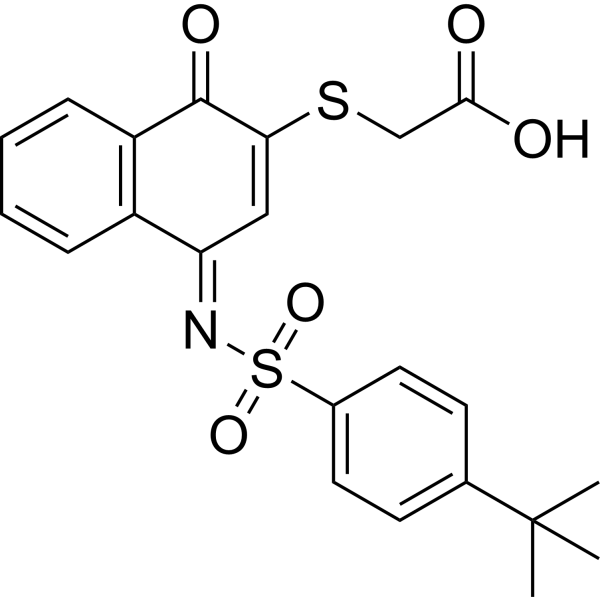
Physicochemical Properties
| Molecular Formula | C22H21NO5S2 |
| Molecular Weight | 443.535843610764 |
| Exact Mass | 443.086 |
| CAS # | 881487-77-0 |
| PubChem CID | 6022998 |
| Appearance | White to yellow solid powder |
| LogP | 4.8 |
| Hydrogen Bond Donor Count | 1 |
| Hydrogen Bond Acceptor Count | 7 |
| Rotatable Bond Count | 6 |
| Heavy Atom Count | 30 |
| Complexity | 840 |
| Defined Atom Stereocenter Count | 0 |
| SMILES | O=C(CSC1C(=O)C2C(=CC=CC=2)C(=NS(C2C=CC(C(C)(C)C)=CC=2)(=O)=O)C=1)O |
| InChi Key | BXWWOKYIKNEEHJ-PTGBLXJZSA-N |
| InChi Code | InChI=1S/C22H21NO5S2/c1-22(2,3)14-8-10-15(11-9-14)30(27,28)23-18-12-19(29-13-20(24)25)21(26)17-7-5-4-6-16(17)18/h4-12H,13H2,1-3H3,(H,24,25)/b23-18+ |
| Chemical Name | 2-[(4E)-4-(4-tert-butylphenyl)sulfonylimino-1-oxonaphthalen-2-yl]sulfanylacetic acid |
| Synonyms | KPT6566; KPT 6566; KPT-6566 |
| HS Tariff Code | 2934.99.9001 |
| Storage |
Powder-20°C 3 years 4°C 2 years In solvent -80°C 6 months -20°C 1 month Note: (1). This product requires protection from light (avoid light exposure) during transportation and storage.(2). Please store this product in a sealed and protected environment (e.g. under nitrogen), avoid exposure to moisture. |
| Shipping Condition | Room temperature (This product is stable at ambient temperature for a few days during ordinary shipping and time spent in Customs) |
Biological Activity
| ln Vitro | KPT-6566 (1–5 μM; 0–8 days) suppresses the proliferation of WT fibroblasts [1]. In a PIN1-dependent way, KPT-6566 (0-10 μM; 48 hours) reduces the viability of cancer cells and normal breast epithelial cells [1]. Cyclin D1, PIN1 concentrations, and hyperphosphorylated pRB levels are all impacted by KPT-6566 (0-10 μM; 48 hours) [1]. The mut-p53, NOTCH1, and NRF2 pathways are inhibited by KPT-6566 (2.5–5 μM; 48 hours) [1]. In a PIN1-dependent way, KPT-6566 (0-5 μM; 48 hours) causes damage to DNA [1]. |
| ln Vivo | Mice are not harmful to KPT-6566 (5 mg/kg; intraperitoneally administered once daily for 26 days) [1]. |
| Cell Assay |
Cell proliferation assay[1] Cell Types: WT and Pin1 KO mouse embryo-derived immortalized fibroblasts Tested Concentrations: 1 and 5 μM Incubation Duration: 0-8 days Experimental Results: Dose-dependent inhibition of proliferation of WT fibroblasts, whereas Pin1 KO had no effect on fibroblasts. Cell viability assay[1] Cell Types: MCF10A, HMEC, HeLa, LNCaP, SKOV-3, PANC-1, PC-3, MDA-MB-468 and MDA-MB-231 Cell Tested Concentrations: 0-10 μM Incubation Duration: 48 hour Experimental Results: Inhibited the viability of normal breast epithelial cells and cancer cells even at low concentrations, and increased the concentration of PIN1 in MDA-MB-468, SKOV-3, PC-3, LNCaP and PANC-1. Western Blot Analysis[1] Cell Types: Immortalized fibroblasts derived from WT and Pin1 KO mouse embryos and PIN1 KO MDA-MB-231 cells Tested Concentrations: 0-10 μM Incubation Duration: 48 hrs (hours) Experimental Results: Hyperphosphorylated pRB and Cyclin D1 levels, dose diminished - and promoted PIN1 degradation over time. Western Blot Analysis[1] Cell Types: MDA-MB-231, MCF10A, MDA-MB-468, and |
| Animal Protocol |
Animal/Disease Models: 6weeks old female mice, injected with 1 million MDA-MB-231Luc6 cells [1] Doses: 5 mg/kg Route of Administration: intraperitoneal (ip) injection; 5 mg/kg, one time/day; for 26 days Experimental Results:Passed Postmortem morphological analysis revealed no evidence of local or systemic and organ toxicity. |
| References |
[1]. A covalent PIN1 inhibitor selectively targets cancer cells by a dual mechanism of action. Nat Commun. 2017 Jun 9;8:15772. |
Solubility Data
| Solubility (In Vitro) | DMSO : ~19.23 mg/mL (~43.36 mM) |
| Solubility (In Vivo) |
Solubility in Formulation 1: 1.92 mg/mL (4.33 mM) in 10% DMSO + 40% PEG300 + 5% Tween80 + 45% Saline (add these co-solvents sequentially from left to right, and one by one), suspension solution; with sonication. For example, if 1 mL of working solution is to be prepared, you can add 100 μL of 19.2 mg/mL clear DMSO stock solution to 400 μL PEG300 and mix evenly; then add 50 μL Tween-80 to the above solution and mix evenly; then add 450 μL normal saline to adjust the volume to 1 mL. Preparation of saline: Dissolve 0.9 g of sodium chloride in 100 mL ddH₂ O to obtain a clear solution. Solubility in Formulation 2: ≥ 1 mg/mL (2.25 mM) (saturation unknown) in 10% DMSO + 90% (20% SBE-β-CD in Saline) (add these co-solvents sequentially from left to right, and one by one), clear solution. For example, if 1 mL of working solution is to be prepared, you can add 100 μL of 10.0 mg/mL clear DMSO stock solution to 900 μL of 20% SBE-β-CD physiological saline solution and mix evenly. Preparation of 20% SBE-β-CD in Saline (4°C,1 week): Dissolve 2 g SBE-β-CD in 10 mL saline to obtain a clear solution. (Please use freshly prepared in vivo formulations for optimal results.) |
| Preparing Stock Solutions | 1 mg | 5 mg | 10 mg | |
| 1 mM | 2.2546 mL | 11.2729 mL | 22.5459 mL | |
| 5 mM | 0.4509 mL | 2.2546 mL | 4.5092 mL | |
| 10 mM | 0.2255 mL | 1.1273 mL | 2.2546 mL |