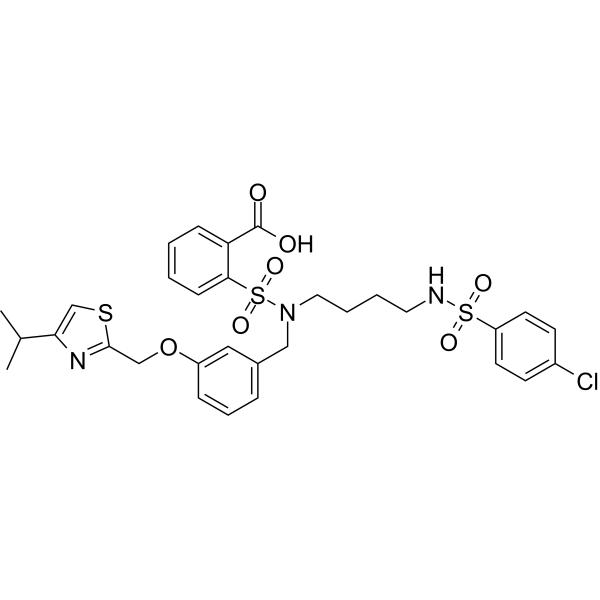
Physicochemical Properties
| Molecular Formula | C31H34CLN3O7S3 |
| Molecular Weight | 692.265563488007 |
| Exact Mass | 691.124 |
| CAS # | 217799-03-6 |
| PubChem CID | 11578433 |
| Appearance | White to off-white solid powder |
| LogP | 5.8 |
| Hydrogen Bond Donor Count | 2 |
| Hydrogen Bond Acceptor Count | 11 |
| Rotatable Bond Count | 16 |
| Heavy Atom Count | 45 |
| Complexity | 1140 |
| Defined Atom Stereocenter Count | 0 |
| SMILES | O=C(O)C1=CC=CC=C1S(=O)(N(CCCCNS(=O)(C2=CC=C(Cl)C=C2)=O)CC3=CC=CC(OCC4=NC(C(C)C)=CS4)=C3)=O |
| InChi Key | WMMCMKVGDPXYQS-UHFFFAOYSA-N |
| InChi Code | InChI=1S/C31H34ClN3O7S3/c1-22(2)28-21-43-30(34-28)20-42-25-9-7-8-23(18-25)19-35(45(40,41)29-11-4-3-10-27(29)31(36)37)17-6-5-16-33-44(38,39)26-14-12-24(32)13-15-26/h3-4,7-15,18,21-22,33H,5-6,16-17,19-20H2,1-2H3,(H,36,37) |
| Chemical Name | 2-[4-[(4-chlorophenyl)sulfonylamino]butyl-[[3-[(4-propan-2-yl-1,3-thiazol-2-yl)methoxy]phenyl]methyl]sulfamoyl]benzoic acid |
| HS Tariff Code | 2934.99.9001 |
| Storage |
Powder-20°C 3 years 4°C 2 years In solvent -80°C 6 months -20°C 1 month |
| Shipping Condition | Room temperature (This product is stable at ambient temperature for a few days during ordinary shipping and time spent in Customs) |
Biological Activity
| ln Vivo | Both acute (day 7) and chronic (day 21) lung inflammation were markedly reduced by KP496. KP496 decreased the amount of neutrophils, eosinophils, macrophages, and lymphocytes on days 7 and 21, as well as on day 7. Prednisolone and KP496 both strongly reduced the rise in the amount of hydroxy-L-proline in the lungs. KP496 and prednisolone decreased the increase in hydroxy-L-proline content by almost 74% and 63%, respectively, when compared to their respective vehicle control groups [1]. The KP496 (100 mg/head) and prednisolone (10 mg/kg) groups considerably reduced the amount of infiltrating lymphocytes, monocytes/macrophages, eosinophils, and total cells when compared to the control group. impact. All cell types except neutrophils had less infiltration in the KP496 (30 mg/head) group, though not to a statistically significant extent [2]. |
| References |
[1]. Effect of inhaled KP-496, a novel dual antagonist of the cysteinyl leukotriene and thromboxane A2 receptors, on a bleomycin-induced pulmonary fibrosis model in mice. Pulm Pharmacol Ther. 2010 Oct;23(5):425-31. [2]. Effects of KP-496, a novel dual antagonist for cysteinyl leukotriene receptor 1 and thromboxane A2 receptor, on Sephadex-induced airway inflammation in rats. Biol Pharm Bull. 2009 Jun;32(6):1057-61. |
Solubility Data
| Solubility (In Vitro) | DMSO : ~100 mg/mL (~144.45 mM) |
| Solubility (In Vivo) |
Solubility in Formulation 1: ≥ 2.5 mg/mL (3.61 mM) (saturation unknown) in 10% DMSO + 40% PEG300 + 5% Tween80 + 45% Saline (add these co-solvents sequentially from left to right, and one by one), clear solution. For example, if 1 mL of working solution is to be prepared, you can add 100 μL of 25.0 mg/mL clear DMSO stock solution to 400 μL PEG300 and mix evenly; then add 50 μL Tween-80 to the above solution and mix evenly; then add 450 μL normal saline to adjust the volume to 1 mL. Preparation of saline: Dissolve 0.9 g of sodium chloride in 100 mL ddH₂ O to obtain a clear solution. Solubility in Formulation 2: ≥ 2.5 mg/mL (3.61 mM) (saturation unknown) in 10% DMSO + 90% Corn Oil (add these co-solvents sequentially from left to right, and one by one), clear solution. For example, if 1 mL of working solution is to be prepared, you can add 100 μL of 25.0 mg/mL clear DMSO stock solution to 900 μL of corn oil and mix evenly. (Please use freshly prepared in vivo formulations for optimal results.) |
| Preparing Stock Solutions | 1 mg | 5 mg | 10 mg | |
| 1 mM | 1.4445 mL | 7.2226 mL | 14.4452 mL | |
| 5 mM | 0.2889 mL | 1.4445 mL | 2.8890 mL | |
| 10 mM | 0.1445 mL | 0.7223 mL | 1.4445 mL |