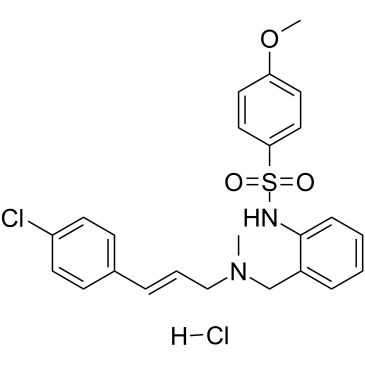
KN-92 Hydrochloride, the hydrochloride salt of KN-92, is an inactive derivative of KN-93. KN-92 is intended to be used as a negative control compound in studies designed to elucidate the antagonist activities of KN-93. KN-93 inhibits histamine-induced aminopyrine uptake in parietal cells (IC50 = 300 nM). KN-93 has been used to implicate roles for CaMKII in Ca2+-induced Ca2+ release in cardiac myocytes, constitutive phosphorylation of 5-lipoxygenase in 3T3 cells, and Ca2+-dependent activation of HIF-1α in colon cancer cell.
Physicochemical Properties
| Molecular Formula | C24H26CL2N2O3S | |
| Molecular Weight | 493.4458 | |
| Exact Mass | 492.104 | |
| Elemental Analysis | C, 58.42; H, 5.31; Cl, 14.37; N, 5.68; O, 9.73; S, 6.50 | |
| CAS # | 1431698-47-3 | |
| Related CAS # | KN-92 phosphate;1135280-28-2;KN-92;176708-42-2 | |
| PubChem CID | 71576672 | |
| Appearance | White to off-white solid powder | |
| Hydrogen Bond Donor Count | 2 | |
| Hydrogen Bond Acceptor Count | 5 | |
| Rotatable Bond Count | 9 | |
| Heavy Atom Count | 32 | |
| Complexity | 650 | |
| Defined Atom Stereocenter Count | 0 | |
| SMILES | CN(C/C=C/C1=CC=C(C=C1)Cl)CC2=CC=CC=C2NS(=O)(=O)C3=CC=C(C=C3)OC.Cl |
|
| InChi Key | SHDNWBMPAAXAHM-IPZCTEOASA-N | |
| InChi Code | InChI=1S/C24H25ClN2O3S.ClH/c1-27(17-5-6-19-9-11-21(25)12-10-19)18-20-7-3-4-8-24(20)26-31(28,29)23-15-13-22(30-2)14-16-23;/h3-16,26H,17-18H2,1-2H3;1H/b6-5+; | |
| Chemical Name |
|
|
| Synonyms |
|
|
| HS Tariff Code | 2934.99.9001 | |
| Storage |
Powder-20°C 3 years 4°C 2 years In solvent -80°C 6 months -20°C 1 month Note: Please store this product in a sealed and protected environment, avoid exposure to moisture. |
|
| Shipping Condition | Room temperature (This product is stable at ambient temperature for a few days during ordinary shipping and time spent in Customs) |
Biological Activity
| Targets | Inactive analog of KN-93; negative control | ||
| ln Vitro | LX-2 cell growth is inhibited by KN-93 (5-50μM; 24 hours), while KN-92 (5-50μM; 24 hours) is ineffective in blocking cell growth[2]. KN-93, not KN-92, decreased the expression of p53 and p21, according to an analysis of cell cycle regulator expression[2]. | ||
| ln Vivo |
|
||
| Cell Assay |
Cell Viability Assay[2] Cell Types: Human hepatic stellate cells (LX-2) Tested Concentrations: 5-50 μM Incubation Duration: 24 hrs (hours) Experimental Results: Ineffective in blocking cell growth. |
||
| Animal Protocol |
|
||
| References |
[1]. Inhibition of the inositol trisphosphate receptor of mouse eggs and A7r5 cells by KN-93 via a mechanism unrelated to Ca2+/calmodulin-dependent protein kinase II antagonism. J Biol Chem. 2002;277(38):35061-35070. [2]. KN-93, a specific inhibitor of CaMKII inhibits human hepatic stellate cell proliferation in vitro. World J Gastroenterol. 2007;13(9):1445-1448. |
||
| Additional Infomation |
KN-93, a Ca(2+)/calmodulin-dependent protein kinase II (CaMKII) inhibitor, concentration-dependently and reversibly inhibited inositol 1,4,5-trisphosphate receptor (IP(3)R)-mediated [Ca(2+)](i) signaling in mouse eggs and permeabilized A7r5 smooth muscle cells, two cell types predominantly expressing type-1 IP(3)R (IP(3)R-1). KN-92, an inactive analog, was ineffective. The inhibitory action of KN-93 on Ca(2+) signaling depended neither on effects on IP(3) metabolism nor on the filling grade of Ca(2+) stores, suggesting a direct action on the IP(3)R. Inhibition was independent of CaMKII, since in identical conditions other CaMKII inhibitors (KN-62, peptide 281-309, and autocamtide-related inhibitory peptide) were ineffective and since CaMKII activation was precluded in permeabilized cells. Moreover, KN-93 was most effective in the absence of Ca(2+). Analysis of Ca(2+) release in A7r5 cells at varying [IP(3)], of IP(3)R-1 degradation in eggs, and of [(3)H]IP(3) binding in Sf9 microsomes all indicated that KN-93 did not affect IP(3) binding. Comparison of the inhibition of Ca(2+) release and of [(3)H]IP(3) binding by KN-93 and calmodulin (CaM), either separately or combined, was compatible with a specific interaction of KN-93 with a CaM-binding site on IP(3)R-1. This was also consistent with the much smaller effect of KN-93 in permeabilized 16HBE14o(-) cells that predominantly express type 3 IP(3)R, which lacks the high affinity CaM-binding site. These findings indicate that KN-93 inhibits IP(3)R-1 directly and may therefore be a useful tool in the study of IP(3)R functional regulation. [1] Aim: To investigate the effects of KN-93, a CaMKII selective inhibitor on cell proliferation and the expression of p53 or p21 protein in human hepatic stellate cells. Methods: Human hepatic stellate cells (LX-2) were incubated with various concentrations (0-50 micromol/L) of KN-93 or its inactive derivative, KN-92. Cell proliferation was measured by CCK-8 assay, and the expression of two cell cycle regulators, p53 and p21, was determined by SDS-PAGE and Western blotting. Results: KN-93 (5-50 micromol/L) decreased the proliferation of human hepatic stellate cells in a dose-dependent manner from 81.76% (81.76% +/- 2.58% vs 96.63% +/- 2.69%, P < 0.05) to 27.15% (27.15% +/- 2.86% vs 96.59% +/- 2.44%, P < 0.01) after 24 h treatment. Incubation of 10 micromol/L KN-93 induced the cell growth reduction in a time-dependent manner from 78.27% at 8 h to 11.48% at 48 h. However, KN-92, an inactive derivative of KN-93, did not inhibit cell proliferation effectively. Moreover, analysis of cell cycle regulator expression revealed that KN-93 rather than KN-92 reduced the expression of p53 and p21. Conclusion: KN-93 has potent inhibitory effect on proliferation of LX-2 cells by modulating the expression of two special cell cycle regulators, p53 and p21. [2] |
Solubility Data
| Solubility (In Vitro) |
|
|||
| Solubility (In Vivo) |
Solubility in Formulation 1: ≥ 2.75 mg/mL (5.57 mM) (saturation unknown) in 10% DMSO + 40% PEG300 + 5% Tween80 + 45% Saline (add these co-solvents sequentially from left to right, and one by one), clear solution. For example, if 1 mL of working solution is to be prepared, you can add 100 μL of 27.5 mg/mL clear DMSO stock solution to 400 μL PEG300 and mix evenly; then add 50 μL Tween-80 to the above solution and mix evenly; then add 450 μL normal saline to adjust the volume to 1 mL. Preparation of saline: Dissolve 0.9 g of sodium chloride in 100 mL ddH₂ O to obtain a clear solution. Solubility in Formulation 2: ≥ 2.75 mg/mL (5.57 mM) (saturation unknown) in 10% DMSO + 90% (20% SBE-β-CD in Saline) (add these co-solvents sequentially from left to right, and one by one), clear solution. For example, if 1 mL of working solution is to be prepared, you can add 100 μL of 27.5 mg/mL clear DMSO stock solution to 900 μL of 20% SBE-β-CD physiological saline solution and mix evenly. Preparation of 20% SBE-β-CD in Saline (4°C,1 week): Dissolve 2 g SBE-β-CD in 10 mL saline to obtain a clear solution. Solubility in Formulation 3: ≥ 2.75 mg/mL (5.57 mM) (saturation unknown) in 10% DMSO + 90% Corn Oil (add these co-solvents sequentially from left to right, and one by one), clear solution. For example, if 1 mL of working solution is to be prepared, you can add 100 μL of 27.5 mg/mL clear DMSO stock solution to 900 μL of corn oil and mix evenly. (Please use freshly prepared in vivo formulations for optimal results.) |
| Preparing Stock Solutions | 1 mg | 5 mg | 10 mg | |
| 1 mM | 2.0265 mL | 10.1327 mL | 20.2655 mL | |
| 5 mM | 0.4053 mL | 2.0265 mL | 4.0531 mL | |
| 10 mM | 0.2027 mL | 1.0133 mL | 2.0265 mL |