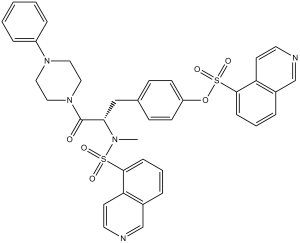
KN-62 (KN62; KN 62) is a potent, selective, cell-permeable and specific inhibitor of Ca2+/calmodulin-dependent protein kinase II (CaMKII) with potential anticancer activity. It inhibits CaMKII with a Ki of 0.9 μM. KN62 inhibits the invasiveness of cancer cells in vitro and in vivo KN62 causes retrograde amnesia in the rat. KN62 attenuates glutamate release by inhibiting voltage-dependent Ca2+-channels. The effect of KN62 on Ca2+-influx appears to be specific to slowly-or non-inactivating conductances, and therefore presents KN62 as a potentially useful tool.
Physicochemical Properties
| Molecular Formula | C38H35N5O6S2 | |
| Molecular Weight | 721.84 | |
| Exact Mass | 721.202 | |
| Elemental Analysis | C, 63.23; H, 4.89; N, 9.70; O, 13.30; S, 8.88 | |
| CAS # | 127191-97-3 | |
| Related CAS # |
|
|
| PubChem CID | 5312126 | |
| Appearance | Light yellow to yellow solid powder | |
| Density | 1.4±0.1 g/cm3 | |
| Boiling Point | 964.7±75.0 °C at 760 mmHg | |
| Melting Point | 92-94°C | |
| Flash Point | 537.3±37.1 °C | |
| Vapour Pressure | 0.0±0.3 mmHg at 25°C | |
| Index of Refraction | 1.686 | |
| LogP | 5.23 | |
| Hydrogen Bond Donor Count | 0 | |
| Hydrogen Bond Acceptor Count | 10 | |
| Rotatable Bond Count | 10 | |
| Heavy Atom Count | 51 | |
| Complexity | 1370 | |
| Defined Atom Stereocenter Count | 1 | |
| SMILES | S(C1=C([H])C([H])=C([H])C2C([H])=NC([H])=C([H])C1=2)(N(C([H])([H])[H])[C@@]([H])(C([H])([H])C1C([H])=C([H])C(=C([H])C=1[H])OS(C1=C([H])C([H])=C([H])C2C([H])=NC([H])=C([H])C1=2)(=O)=O)C(N1C([H])([H])C([H])([H])N(C2C([H])=C([H])C([H])=C([H])C=2[H])C([H])([H])C1([H])[H])=O)(=O)=O |
|
| InChi Key | RJVLFQBBRSMWHX-DHUJRADRSA-N | |
| InChi Code | InChI=1S/C38H35N5O6S2/c1-41(50(45,46)36-11-5-7-29-26-39-19-17-33(29)36)35(38(44)43-23-21-42(22-24-43)31-9-3-2-4-10-31)25-28-13-15-32(16-14-28)49-51(47,48)37-12-6-8-30-27-40-20-18-34(30)37/h2-20,26-27,35H,21-25H2,1H3/t35-/m0/s1 | |
| Chemical Name | (S)-4-(2-(N-methylisoquinoline-5-sulfonamido)-3-oxo-3-(4-phenylpiperazin-1-yl)propyl)phenyl isoquinoline-5-sulfonate | |
| Synonyms |
|
|
| HS Tariff Code | 2934.99.9001 | |
| Storage |
Powder-20°C 3 years 4°C 2 years In solvent -80°C 6 months -20°C 1 month |
|
| Shipping Condition | Room temperature (This product is stable at ambient temperature for a few days during ordinary shipping and time spent in Customs) |
Biological Activity
| Targets |
P2X7 Receptor; CaMK II (Ki = 0.9 μM) P2Z receptor (now designated as P2X7 receptor) (Ki = 0.7 μM for antagonism of ATP-induced responses in human lymphocytes) [1] - Calcium/calmodulin-dependent protein kinase II (CaMKII) (IC50 = 0.9 μM for inhibition of purified CaMKII) [2] |
| ln Vitro |
ATP-stimulated Ba2+ influx into human lymphocytes loaded with fura-2 is potently inhibited by KN-62, with an IC50 of 12.7 nM and total flux suppression at 500 nM[1]. KN-62 does not inhibit the activity of autophosphorylated Ca2+/CaM kinase II. KN-62 inhibits the Ca2+/calmodulin-dependent autophosphorylation of both alpha (50 kDa) and beta (60 kDa) subunits of Ca2+/CaM kinase II dose dependently in the presence or absence of exogenous substrate[2]. In human leukemic B lymphocytes, KN-62 reduces the rate of permeability increase to larger permeant cations, like ethidium, induced by Bz-ATP with an IC50 of 13.1 nM[4].
1. Extracellular adenosine 5'-triphosphate (ATP) is an agonist for a P2Z receptor on human lymphocytes which mediates opening of a cation-selective ion channel, activation of phospholipase D and shedding of the adhesion molecule, L-selectin, from the cell surface. The isoquinolinesulphonamides, KN-62, (1-[N, O-bis(5-isoquinolinesulphonyl)-N-methyl-L-tyrosyl]-4-phenylpiperaz ine), a selective antagonist of Ca2+/calmodulin-dependent protein kinase II (CaMKII), and KN-04, (N-[1-[N-methyl-p-(5 isoquinoline sulphonyl)benzyl]-2-(4 phenylpiperazine)ethyl]-5-isoquinolinesulphonamide) an inactive analogue, were used to investigate the possible role of CaMKII in these diverse effects of extracellular ATP. 2. KN-62 potently antagonized ATP-stimulated Ba2+ influx into fura-2 loaded human lymphocytes with an IC50 of 12.7 +/- 1.5 nM (n = 3) and complete inhibition of the flux at a concentration of 500 nM. Similarly, KN-62 inhibited ATP-stimulated ethidium+ uptake, measured by time resolved flow cytometry, with an IC50 of 13.1 +/- 2.6 nM (n = 4) and complete inhibition of the flux at 500 nM. 3. KN-04 antagonized ATP-stimulated Ba2+ influx with an IC50 of 17.3 +/- 2.7 nM (n = 3). Similarly, KN-04 inhibited ATP-stimulated ethidium+ uptake with an IC50 of 37.2 +/- 8.9 nM (n = 4). Both fluxes were completely inhibited at 500 nM KN-04. 4. ATP-stimulated phospholipase D activity, measured in [3H]-oleic acid-labelled lymphocytes by the transphosphatidylation reaction, was antagonized by KN-62 and KN-04, with 50% inhibition at 5.9 +/- 1.2 and 9.7 +/- 2.8 nM (n = 3), respectively. Both KN-62 and KN-04 inhibited ATP-stimulated shedding of L-selectin, measured by flow cytometric analysis of cell surface L-selectin, with IC50 values of 31.5 +/- 4.5 and 78.7 +/- 10.8 nM (n = 3), respectively. Neither of the isoquinolinesulphonamides (500 nM) inhibited phorbol ester- or ionomycin-stimulated phospholipase D activity or phorbol ester-induced shedding of L-selectin. 5. The inhibitory effect of KN-62 or KN-04 on P2Z-mediated responses was slow in onset (5 min) and only partially reversed by washing the cells. 6. Both KN-62 and KN-04 (at 500 nM) had no effect on uridine 5'-triphosphate (UTP)-stimulated Ca2+ transients in fura-2 loaded human neutrophils, a response which is mediated by the P2Y2 receptor. 7. Thus, KN-62 and KN-04 are potent antagonists of the P2Z receptor and at nanomolar concentrations inhibit all known responses mediated by the P2Z receptor of human lymphocytes. In contrast, KN-62 and KN-04 had no effect on responses mediated by the P2Y2 receptor of neutrophils. Moreover, since KN-62 and KN-04 are almost equipotent, the P2Z-mediated responses do not involve CaMKII, but indicate that the isoquinolinesulphonamides are potent and direct inhibitors of the P2Z-receptor [1]. P2Z receptor antagonism: KN-62 potently antagonized ATP-induced responses in human peripheral blood lymphocytes, including ATP-mediated 51Cr release (cell cytotoxicity), intracellular Ca2+ elevation, and membrane depolarization, with a Ki value of 0.7 μM. The antagonism was reversible and competitive with ATP [1] - CaMKII inhibition: KN-62 inhibited the activity of purified rabbit brain CaMKII in a dose-dependent manner, with an IC50 of 0.9 μM. It did not significantly inhibit other kinases (including PKA, PKC, MAPK) at concentrations up to 10 μM [2] - Selectivity for P2Z receptor: KN-62 showed no significant antagonism against other P2 purinergic receptors (P2X1, P2X2, P2Y1, P2Y2) in human cells at concentrations up to 10 μM [1] - Inhibition of ATP-induced interleukin-1β (IL-1β) release: Treatment of human monocytes with KN-62 (1-5 μM) dose-dependently inhibited ATP-induced IL-1β secretion, with maximum inhibition of 78% at 5 μM [1] |
| ln Vivo |
Five-week-old BALB/c athymic nude mice implanted with TAMR-MCF-7 cells showed a significant reduction in the liver metastatic tumor burden after receiving KN62 (5?mg/kg/day; ip; three times a week for six weeks)[3]. ?ZnCl2 (10 mg/kg, po) does not exhibit antidepressant-like behavior, and KN-62 (1 μg/site, icv) does not either[5].
As presented in Fig. 1C, the antidepressant-like behavior of ZnCl2 (10 mg/kg, p.o.) (p < 0.01) was prevented by CAMKII inhibitor KN-62 (1 μg/site, i.c.v.). The two-way ANOVA revealed a significantly main effect of KN-62 treatment [F (1,28) = 27.47, p < 0.01], no main effect of ZnCl2 treatment [F (1,28) = 0.84, p > 0.05] and a significant effect of KN-62 × ZnCl2 treatment interaction [F (1,28) = 22.57, p < 0.01] to immobility time. As revealed by the post-hoc analysis, the anti-immobility effect of ZnCl2 was completely prevented by treatment of animals with KN-62. No effect in locomotor activity in the open-field test was observed (Fig. 1D): (KN-62 treatment [F (1,24) = 1.97, p > 0.05], ZnCl2 treatment [F (1,24) = 3.99, p > 0.05] and KN-62 × ZnCl2 treatment interaction [F (1,24) = 0.61, p > 0.05]) [5]. P2Z receptor antagonism: KN-62 potently antagonized ATP-induced responses in human peripheral blood lymphocytes, including ATP-mediated 51Cr release (cell cytotoxicity), intracellular Ca2+ elevation, and membrane depolarization, with a Ki value of 0.7 μM. The antagonism was reversible and competitive with ATP [1] - CaMKII inhibition: KN-62 inhibited the activity of purified rabbit brain CaMKII in a dose-dependent manner, with an IC50 of 0.9 μM. It did not significantly inhibit other kinases (including PKA, PKC, MAPK) at concentrations up to 10 μM [2] - Selectivity for P2Z receptor: KN-62 showed no significant antagonism against other P2 purinergic receptors (P2X1, P2X2, P2Y1, P2Y2) in human cells at concentrations up to 10 μM [1] - Inhibition of ATP-induced interleukin-1β (IL-1β) release: Treatment of human monocytes with KN-62 (1-5 μM) dose-dependently inhibited ATP-induced IL-1β secretion, with maximum inhibition of 78% at 5 μM [1] |
| Enzyme Assay |
Phospholipase D assay [1] Lymphocytes (1x10~7/ml ) were cultured with [3 H]-oleic acid (2 ± 5 mCi ml71 , speci®c activity 10 Ci mmol71 ) for 20 ± 24 h in RPMI-1640 medium supplemented with gentamicin (40 mg ml71 ), 10% heat inactivated foetal calf serum (FCS) at 378C to label membrane phospholipids. Labelled cells were washed twice in HEPES buered saline followed by a ®nal wash in either HEPES buered saline or 150 mM KCl medium containing HEPES 10 mM, pH 7.4, bovine serum albumin (BSA) 1 g l71 and D-glucose 5 mM and CaCl2 1 mM. Three ml aliquots containing 1.16107 ml71 lymphocytes were warmed to 378C and incubated with or without KN-62 or KN-04 (1 nM ± 500 nM) for 5 min, then 900 ml aliquots were added to 100 ml butanol (®nal concentration 30 mM) for a further 5 min, and stimulated with 1 mM ATP for 15 min with gentle mixing in the continued presence of inhibitor or diluent. The phospholipase D reaction was terminated by addition of 1 ml of 20 mM MgCl2 followed by centrifugation and addition of 1 ml ice cold methanol. Membrane lipids were extracted into chloroform/HCl at 48C under N2 as described previously (Gargett et al., 1996), and separated by silica gel thin layer chromatography (t.l.c.) with the solvent system, ethyl acetate/ iso-octane/acetic acid/water (13:2:3:10, v/v) under saturating conditions. Sample spots were located by autoradiography and [ 3 H]-phosphatidylbutanol ([3 H]-PBut) spots identi®ed by an authentic standard. [3 H]-PBut and [3 H]-phospholipid spots were scraped into scintillant ¯uid (PPO in toluene, 4 g l71 ) and counted in a liquid scintillation counter. The quantity of [3 H]- PBut is presented as a percentage of total 3 H labelled-cellular 1484 C.E. Gargett & J.S. Wiley KN-62 is a potent P2Z receptor antagonist phospholipids. Phospholipase D assays were performed in triplicate and data are expressed as the mean+s.e.mean. CaMKII activity assay: Purified CaMKII was incubated with reaction buffer containing ATP, MgCl2, calmodulin, and a synthetic peptide substrate (derived from glycogen synthase kinase 3) in the presence of serial dilutions of KN-62. The reaction was conducted at 30°C for 20 minutes and terminated by adding stop solution. The phosphorylation of the peptide substrate was measured using a kinase assay detection system, and IC50 value was calculated from the dose-response curve [2] - Kinase selectivity assay: KN-62 was tested at concentrations up to 10 μM against purified recombinant kinases (PKA, PKC, MAPK, CDK1). Each kinase was incubated with its specific substrate, ATP, and KN-62 under optimal reaction conditions. Kinase activity was determined by measuring substrate phosphorylation, and inhibition rate was calculated relative to vehicle-treated controls [2] |
| Cell Assay |
Ethidium in¯ux measurement by fow cytometry [1] Lymphocytes (1x10~8/ml ) were diluted to 1x10~6/ml in 1 ml of 150 mM KCl medium containing HEPES 10 mM, pH 7.4, BSA 1 g l71 and D-glucose 5 mM. Cell suspensions were incubated with or without KN-62 or KN-04 (1 nM ± 1 mM) for 5 min at 378C, followed by ATP (500 mM) and incubated a further 2 min before the addition of ethidium (25 mM). Fluorescent signals were collected from stirred and temperature controlled (378C) samples 30 s before and up to 5 min after ethidium addition in the continued presence of inhibitor or diluent. Histograms (256 channels) of lymphocyte associated ¯uorescence signals were collected over consecutive 6 s intervals with a Coulter Elite ¯ow cytometer with an argon laser excitation at 488 nm. Fluorescent emission was collected with a 590 nm long-pass ®lter. The mean channel of ¯uorescence intensity was then calculated for each of the histograms collected for consecutive 6 s intervals and plotted against time. ATP-induced 51Cr release assay (lymphocyte cytotoxicity): Human peripheral blood lymphocytes were loaded with 51Cr for 90 minutes at 37°C, washed, and resuspended in culture medium. Serial dilutions of KN-62 were added, followed by addition of ATP (1 mM) as a P2Z receptor agonist. After incubation for 4 hours at 37°C, the supernatant was collected, and radioactivity was measured using a gamma counter. The percentage of 51Cr release (indicating cell cytotoxicity) was calculated, and Ki value was derived from the concentration-response curve [1] - Intracellular Ca2+ measurement: Human lymphocytes were loaded with a fluorescent Ca2+ indicator for 30 minutes at 37°C, washed, and incubated with KN-62 (0.1-10 μM) for 15 minutes. ATP (1 mM) was added, and changes in fluorescence intensity (reflecting intracellular Ca2+ elevation) were recorded using a fluorometer. The concentration of KN-62 inhibiting 50% of the ATP-induced fluorescence response was determined [1] - IL-1β release assay: Human monocytes were isolated from peripheral blood and cultured in 24-well plates. Cells were primed with lipopolysaccharide (LPS) for 24 hours, then treated with KN-62 (1-5 μM) for 30 minutes prior to addition of ATP (5 mM). After incubation for 2 hours, the supernatant was collected, and IL-1β concentration was measured using an immunoassay [1] |
| Animal Protocol |
Dissolved in 0.5 mM KN-62/50% DMSO; 2 pmol; intracerebroventricular (ICV) injection Sprague Dawley Rats Considering that intracellular signaling pathways that modulate brain BDNF are implicated in antidepressant responses, this study investigated whether signaling pathway inhibitors upstream to BDNF might influence the antidepressant-like effect of zinc, a metal that has been shown to display antidepressant properties. To this end, the influence of i.c.v. administration of H-89 (1μg/site, PKA inhibitor), KN-62 (1μg/site, CAMKII inhibitor), chelerythrine (1μg/site, PKC inhibitor), PD98059 (5μg/site, MEK1/2 inhibitor), U0126 (5μg/site, MEK1/2 inhibitor), LY294002 (10nmol/site, PI3K inhibitor) on the reduction of immobility time in the tail suspension test (TST) elicited by ZnCl2 (10mg/kg, p.o.) was investigated. Moreover, the effect of the combination of sub-effective doses of ZnCl2 (1mg/kg, p.o.) and AR-A014418 (0.001μg/site, GSK-3β inhibitor) was evaluated. The occurrence of changes in CREB phosphorylation and BDNF immunocontent in the hippocampus and prefrontal cortex of mice following ZnCl2 treatment was also investigated. The anti-immobility effect of ZnCl2 in the TST was prevented by treatment with PKA, PKC, CAMKII, MEK1/2 or PI3K inhibitors. Furthermore, ZnCl2 in combination with AR-A014418 caused a synergistic anti-immobility effect in the TST. None of the treatments altered locomotor activity of mice. ZnCl2 treatment caused no alteration in CREB phosphorylation and BDNF immunocontent. The results extend literature data regarding the mechanisms underlying the antidepressant-like action of zinc by indicating that its antidepressant-like effect may be dependent on the activation of PKA, CAMKII, PKC, ERK, and PI3K/GSK-3β pathways. However, zinc is not able to acutely increase BDNF in the hippocampus and prefrontal cortex.[5] Female Swiss mice (45–55 days old, weighing 30–45 g) were maintained at 20–22 °C with free access to water and food, under a 12:12 h light:dark cycle (lights on at 7:00 a.m.). The animals were caged in groups of 15 in a 41 × 34 × 16-cm cage. All behavioral tests were carried out between 9:00 a.m. and 04:00 p.m. Animals were acclimatized to the laboratory for at least 12 h before testing. [5] The following drugs were used: zinc chloride (ZnCl2) (1 or 10 mg/kg), N-[2-(p-bromocinnamylamino) ethyl]-5-isoquinolinesulfonamide — H-89 (1 μg/site, PKA inhibitor), 4-[2-[(5-isoquinolinyl-sulfonyl) methylamino]-3-oxo-3-(4-phenyl-1-piperazinyl) propyl] phenyl ester — KN-62(1 μg/site, CAMKII inhibitor), chelerythrine (1 μg/site, PKC inhibitor), PD98059 (5 μg/site, inhibitor of mitogen-activated protein kinase kinase (MAPKK/MEK 1/2)), U0126 (5 μg/site, inhibitor of MEK1/2), LY294002 (10 nmol/site, PI3K inhibitor), AR-A014418 (0.001 μg/site, selective GSK-3β inhibitor). ZnCl2 was dissolved in distilled water and administered orally (p.o.). H-89, KN-62, chelerythrine, PD98059, U0126, LY294002, AR-A014418 were dissolved in saline (0.9% NaCl) at a final concentration of 1% dimethyl sulfoxide (DMSO) and administered by intracerebroventricular (i.c.v.) route. The drugs were freshly prepared before treatment and administered in a volume of 10 ml/kg body weight (p.o. route) or 5 μl/site (i.c.v. route). Control animals received the appropriate vehicle.[5] To test the hypothesis that the antidepressant-like effect of zinc is dependent on the activation of intracellular signaling pathways, mice were pretreated with an effective dose of ZnCl2 (10 mg/kg, p.o.), and 30 min later they received sub-effective doses of either H-89, KN-62, PD98059, U0126, chelerythrine or LY294002. The animals were submitted to behavioral tests 30 min later (60 min after zinc administration). Moreover, to investigate a possible synergistic effect between zinc and GSK-3β inhibitor, animals received (p.o.) vehicle or a sub-effective dose of ZnCl2 (1 mg/kg). After 30 min, they received (i.c.v.) a sub-effective dose of AR-A014418 or vehicle. Thirty minutes after the end of the last treatment, the behavioral tests were performed.[5] The doses of ZnCl2 used were chosen based on experiment previously performed in our laboratory (Cunha et al., 2008). The doses of H-89, KN-62, chelerythrine, PD98059, U0126, LY294002, and AR-A014418 were chosen based on experiments previously performed in our laboratory or other groups (Almeida et al., 2006, Budni et al., 2011, Cunha et al., 2014, Moretti et al., 2014, Zeni et al., 2012). The number of animals used for behavioral tests was 7–8 per group. |
| References |
[1]. The isoquinoline derivative KN-62 a potent antagonist of the P2Z-receptor of human lymphocytes. Br J Pharmacol. 1997 Apr;120(8):1483-90. [2]. Pharmacology of protein kinase inhibitors. Annu Rev Pharmacol Toxicol. 1992;32:377-97. [3]. Involvement of the P2X7 receptor in the migration and metastasis of tamoxifen-resistant breast cancer: effects on small extracellular vesicles production. Sci Rep. 2019 Aug 12;9(1):11587. [4]. Potent P2X7 Receptor Antagonists: Tyrosyl Derivatives Synthesized Using a Sequential Parallel Synthetic Approach. Drug Dev Res. 2001 Oct;54(2):75-87. [5]. Antidepressant-like effect of zinc is dependent on signaling pathways implicated in BDNF modulation. Prog Neuropsychopharmacol Biol Psychiatry. 2015 Jun 3;59:59-67. |
| Additional Infomation |
5-isoquinolinesulfonic acid [4-[(2S)-2-[5-isoquinolinylsulfonyl(methyl)amino]-3-oxo-3-(4-phenyl-1-piperazinyl)propyl]phenyl] ester is a member of piperazines. 1. Extracellular adenosine 5'-triphosphate (ATP) is an agonist for a P2Z receptor on human lymphocytes which mediates opening of a cation-selective ion channel, activation of phospholipase D and shedding of the adhesion molecule, L-selectin, from the cell surface. The isoquinolinesulphonamides, KN-62, (1-[N, O-bis(5-isoquinolinesulphonyl)-N-methyl-L-tyrosyl]-4-phenylpiperaz ine), a selective antagonist of Ca2+/calmodulin-dependent protein kinase II (CaMKII), and KN-04, (N-[1-[N-methyl-p-(5 isoquinoline sulphonyl)benzyl]-2-(4 phenylpiperazine)ethyl]-5-isoquinolinesulphonamide) an inactive analogue, were used to investigate the possible role of CaMKII in these diverse effects of extracellular ATP. 2. KN-62 potently antagonized ATP-stimulated Ba2+ influx into fura-2 loaded human lymphocytes with an IC50 of 12.7 +/- 1.5 nM (n = 3) and complete inhibition of the flux at a concentration of 500 nM. Similarly, KN-62 inhibited ATP-stimulated ethidium+ uptake, measured by time resolved flow cytometry, with an IC50 of 13.1 +/- 2.6 nM (n = 4) and complete inhibition of the flux at 500 nM. 3. KN-04 antagonized ATP-stimulated Ba2+ influx with an IC50 of 17.3 +/- 2.7 nM (n = 3). Similarly, KN-04 inhibited ATP-stimulated ethidium+ uptake with an IC50 of 37.2 +/- 8.9 nM (n = 4). Both fluxes were completely inhibited at 500 nM KN-04. 4. ATP-stimulated phospholipase D activity, measured in [3H]-oleic acid-labelled lymphocytes by the transphosphatidylation reaction, was antagonized by KN-62 and KN-04, with 50% inhibition at 5.9 +/- 1.2 and 9.7 +/- 2.8 nM (n = 3), respectively. Both KN-62 and KN-04 inhibited ATP-stimulated shedding of L-selectin, measured by flow cytometric analysis of cell surface L-selectin, with IC50 values of 31.5 +/- 4.5 and 78.7 +/- 10.8 nM (n = 3), respectively. Neither of the isoquinolinesulphonamides (500 nM) inhibited phorbol ester- or ionomycin-stimulated phospholipase D activity or phorbol ester-induced shedding of L-selectin. 5. The inhibitory effect of KN-62 or KN-04 on P2Z-mediated responses was slow in onset (5 min) and only partially reversed by washing the cells. 6. Both KN-62 and KN-04 (at 500 nM) had no effect on uridine 5'-triphosphate (UTP)-stimulated Ca2+ transients in fura-2 loaded human neutrophils, a response which is mediated by the P2Y2 receptor. 7. Thus, KN-62 and KN-04 are potent antagonists of the P2Z receptor and at nanomolar concentrations inhibit all known responses mediated by the P2Z receptor of human lymphocytes. In contrast, KN-62 and KN-04 had no effect on responses mediated by the P2Y2 receptor of neutrophils. Moreover, since KN-62 and KN-04 are almost equipotent, the P2Z-mediated responses do not involve CaMKII, but indicate that the isoquinolinesulphonamides are potent and direct inhibitors of the P2Z-receptor.[1] Novel analogs of 1-(N,O-bis[5-isoquinolinesulfonyl]-N-methyl-L-tyrosyl)-4-phenylpiperazine (KN-62,1) were synthesized and found to be potent antagonists in a functional assay, inhibition of ATP-induced K+ efflux in HEK293 cells expressing recombinant human P2X7 receptors. Antagonism of murine P2X7 receptors was also observed. The analogs consisted of L-tyrosine derivatives, of the general structure R1-Tyr(OR2)-piperazinyl-R3, in which three positions were systematically varied in structure through facile acylation reactions. Each of the three positions was optimized in sequence through parallel synthesis alternating with biological evaluation, leading to the identification and optimization of potent P2X7 antagonists. The optimal groups at R1 were found to be large hydrophobic groups, linked to the α-amino position through carbamate, amide, or sulfonamide groups. The benzyloxycarbonyl (Cbz) group was preferred over most sulfonamides and other acyl groups examined, except for quinoline sulfonyl. At R2, an arylsulfonate ester was preferred, and the order of potency was p-tolyl, p-methoxyphenyl, phenyl > α-naphthyl, β-naphthyl. A benzoyl ester was of intermediate potency. Aliphatic esters and carbonate derivatives at the tyrosyl phenol were inactive, while a tyrosyl O-benzyl ether was relatively potent. The most potent P2X7 receptor antagonists identified in this study contained Cbz at the R1 position, an aryl sulfonate at the R2 position, and various acyl groups at the R3 position. At R3, t-butyloxycarbonyl- and benzoyl groups were preferred. The opening of the piperazinyl ring to an ethylene diamine moiety abolished antagonism. In concentration-response studies, a di-isoquinolinyl, Boc derivative, 4 (MRS2306), displayed an IC50 value of 40 nM as an antagonist of P2X7 receptor-mediated ion flux and was more potent than the reference compound 1. Nα-Cbz, Boc-piperazinyl derivatives, 11 (MRS2317), 22 (MRS2326), and 41 (MRS2409) were less potent than 1, with IC50 values of 200-300 nM.[4] Considering that intracellular signaling pathways that modulate brain BDNF are implicated in antidepressant responses, this study investigated whether signaling pathway inhibitors upstream to BDNF might influence the antidepressant-like effect of zinc, a metal that has been shown to display antidepressant properties. To this end, the influence of i.c.v. administration of H-89 (1μg/site, PKA inhibitor), KN-62 (1μg/site, CAMKII inhibitor), chelerythrine (1μg/site, PKC inhibitor), PD98059 (5μg/site, MEK1/2 inhibitor), U0126 (5μg/site, MEK1/2 inhibitor), LY294002 (10nmol/site, PI3K inhibitor) on the reduction of immobility time in the tail suspension test (TST) elicited by ZnCl2 (10mg/kg, p.o.) was investigated. Moreover, the effect of the combination of sub-effective doses of ZnCl2 (1mg/kg, p.o.) and AR-A014418 (0.001μg/site, GSK-3β inhibitor) was evaluated. The occurrence of changes in CREB phosphorylation and BDNF immunocontent in the hippocampus and prefrontal cortex of mice following ZnCl2 treatment was also investigated. The anti-immobility effect of ZnCl2 in the TST was prevented by treatment with PKA, PKC, CAMKII, MEK1/2 or PI3K inhibitors. Furthermore, ZnCl2 in combination with AR-A014418 caused a synergistic anti-immobility effect in the TST. None of the treatments altered locomotor activity of mice. ZnCl2 treatment caused no alteration in CREB phosphorylation and BDNF immunocontent. The results extend literature data regarding the mechanisms underlying the antidepressant-like action of zinc by indicating that its antidepressant-like effect may be dependent on the activation of PKA, CAMKII, PKC, ERK, and PI3K/GSK-3β pathways. However, zinc is not able to acutely increase BDNF in the hippocampus and prefrontal cortex.[5] KN-62 is an isoquinoline derivative initially identified as a selective antagonist of the P2Z receptor (later classified as the P2X7 receptor) [1] - It also acts as a selective inhibitor of CaMKII, with high selectivity over other serine/threonine kinases [2] - The P2Z receptor antagonism by KN-62 is mediated through competitive binding to the receptor’s ATP-binding site, preventing ATP-induced receptor activation and subsequent downstream signaling (e.g., Ca2+ influx, cytotoxicity, cytokine release) [1] - KN-62 has been widely used as a tool compound to study the physiological and pathological roles of P2X7 receptor and CaMKII in immune cells and other cell types [1][2] |
Solubility Data
| Solubility (In Vitro) |
|
|||
| Solubility (In Vivo) |
Solubility in Formulation 1: ≥ 2.5 mg/mL (3.46 mM) (saturation unknown) in 10% DMSO + 40% PEG300 + 5% Tween80 + 45% Saline (add these co-solvents sequentially from left to right, and one by one), clear solution. For example, if 1 mL of working solution is to be prepared, you can add 100 μL of 25.0 mg/mL clear DMSO stock solution to 400 μL PEG300 and mix evenly; then add 50 μL Tween-80 to the above solution and mix evenly; then add 450 μL normal saline to adjust the volume to 1 mL. Preparation of saline: Dissolve 0.9 g of sodium chloride in 100 mL ddH₂ O to obtain a clear solution. Solubility in Formulation 2: ≥ 2.5 mg/mL (3.46 mM) (saturation unknown) in 10% DMSO + 90% Corn Oil (add these co-solvents sequentially from left to right, and one by one), clear solution. For example, if 1 mL of working solution is to be prepared, you can add 100 μL of 25.0 mg/mL clear DMSO stock solution to 900 μL of corn oil and mix evenly. (Please use freshly prepared in vivo formulations for optimal results.) |
| Preparing Stock Solutions | 1 mg | 5 mg | 10 mg | |
| 1 mM | 1.3853 mL | 6.9267 mL | 13.8535 mL | |
| 5 mM | 0.2771 mL | 1.3853 mL | 2.7707 mL | |
| 10 mM | 0.1385 mL | 0.6927 mL | 1.3853 mL |