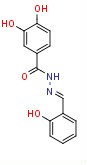
Physicochemical Properties
| Molecular Formula | C₁₄H₁₂N₂O₄ |
| Molecular Weight | 272.256083488464 |
| Exact Mass | 272.08 |
| CAS # | 304481-60-5 |
| PubChem CID | 135403138 |
| Appearance | White to off-white solid powder |
| LogP | 1.958 |
| Hydrogen Bond Donor Count | 4 |
| Hydrogen Bond Acceptor Count | 5 |
| Rotatable Bond Count | 3 |
| Heavy Atom Count | 20 |
| Complexity | 361 |
| Defined Atom Stereocenter Count | 0 |
| SMILES | C1=CC=C(C(=C1)/C=N/NC(=O)C2=CC(=C(C=C2)O)O)O |
| InChi Key | GWVYHPUGEQGQSF-OVCLIPMQSA-N |
| InChi Code | InChI=1S/C14H12N2O4/c17-11-4-2-1-3-10(11)8-15-16-14(20)9-5-6-12(18)13(19)7-9/h1-8,17-19H,(H,16,20)/b15-8+ |
| Chemical Name | 3,4-Dihydroxybenzoic Acid 2-[(2-Hydroxyphenyl)methylene]hydrazide |
| Synonyms | KM-91104KM 91104KM91104 |
| HS Tariff Code | 2934.99.9001 |
| Storage |
Powder-20°C 3 years 4°C 2 years In solvent -80°C 6 months -20°C 1 month |
| Shipping Condition | Room temperature (This product is stable at ambient temperature for a few days during ordinary shipping and time spent in Customs) |
Biological Activity
| Targets |
Adenosine Monophosphate-Activated Protein Kinase (AMPK) [1] |
| ln Vitro |
KM 91104 (1-10 μM) dose-dependently activated AMPK in human hepatic stellate cells (HSCs), as evidenced by increased phosphorylation of AMPKα (Thr172) and its downstream substrate ACC (Ser79) (western blot): 10 μM increased p-AMPKα by ~2.8-fold and p-ACC by ~3.2-fold compared to control [1] - It inhibited HSC proliferation: KM 91104 (5 μM, 72 h) reduced HSC viability by ~45% (CCK-8 assay) and blocked cell cycle progression at G0/G1 phase (flow cytometry): G0/G1 phase cells increased from 48% (control) to 72% [1] - Suppression of profibrogenic markers: KM 91104 (10 μM, 24 h) downregulated mRNA expression of α-SMA, collagen I, and fibronectin by ~65%, ~70%, and ~62% respectively (qPCR); corresponding protein levels were reduced by ~58%, ~63%, and ~55% (western blot) [1] - Regulation of vacuolar ATPase (v-ATPase) and intracellular pH: KM 91104 (5 μM) inhibited v-ATPase activity by ~40% (luciferase-based ATPase assay) and normalized intracellular pH (pHi) in activated HSCs (from 6.3 ± 0.1 to 7.1 ± 0.1, pH-sensitive dye detection) [1] - Inhibition of HSC migration: KM 91104 (10 μM) reduced HSC migration by ~52% compared to control (Boyden chamber assay) [1] |
| Enzyme Assay |
AMPK activation assay: Human HSCs were seeded in 6-well plates and cultured to subconfluence. Cells were treated with serial dilutions of KM 91104 (1-10 μM) for 24 h, then lysed in RIPA buffer. Proteins were separated by SDS-PAGE, transferred to PVDF membranes, and probed with antibodies against p-AMPKα (Thr172), total AMPKα, p-ACC (Ser79), and total ACC. Band intensity was quantified by densitometry to assess AMPK activation [1] - v-ATPase activity assay: Purified v-ATPase from HSCs was resuspended in assay buffer and mixed with KM 91104 (1-10 μM). The reaction mixture was supplemented with ATP and a luciferase-based ATP detection reagent. Luminescence intensity (reflecting remaining ATP) was measured at 0 and 60 minutes, and v-ATPase activity was calculated as the rate of ATP hydrolysis [1] |
| Cell Assay |
HSC proliferation assay: HSCs were seeded in 96-well plates (3×10³ cells/well) and cultured overnight. KM 91104 (1-10 μM) was added, and cells were incubated for 72 h. CCK-8 reagent was added, incubated for 2 h, and absorbance was measured at 450 nm to calculate cell viability [1] - Cell cycle analysis: HSCs were treated with KM 91104 (5 μM) for 72 h, fixed with ethanol, stained with propidium iodide, and analyzed by flow cytometry to determine cell cycle distribution [1] - Profibrogenic marker detection: HSCs were treated with KM 91104 (10 μM) for 24 h. Total RNA was extracted for qPCR analysis of α-SMA, collagen I, and fibronectin mRNA; cell lysates were used for western blot detection of corresponding proteins [1] - Intracellular pH measurement: HSCs were loaded with pH-sensitive fluorescent dye for 30 minutes, then treated with KM 91104 (5 μM) for 1 h. Fluorescence intensity was measured by flow cytometry, and pHi was calculated using a calibration curve [1] - HSC migration assay: HSCs were seeded in the upper chamber of Boyden chambers, and KM 91104 (10 μM) was added to both upper and lower chambers. After 24 h incubation, cells that migrated to the lower membrane were fixed, stained, and counted under a microscope [1] |
| References |
[1]. The adenosine monophosphate-activated protein kinase-vacuolar adenosine triphosphatase-pH axis: A key regulator of the profibrogenic phenotype of human hepatic stellate cells. Hepatology. 2018;68(3):1140-1153. [2]. Rescuing the negative impact of human endogenous retrovirus envelope protein on oligodendroglial differentiation and myelination. Glia. 2019;67(1):160-170. doi:10.1002/glia.23535. |
| Additional Infomation |
KM 91104 is a small-molecule activator of AMPK, specifically targeting the AMPK-vacuolar ATPase-pH axis in hepatic stellate cells [1] - Its anti-fibrotic mechanism involves activating AMPK to inhibit v-ATPase activity, normalize intracellular pH, and subsequently suppress HSC proliferation, migration, and profibrogenic gene/protein expression [1] - The compound is proposed as a potential therapeutic agent for liver fibrosis by targeting activated hepatic stellate cells, a key cell type in liver fibrogenesis [1] |
Solubility Data
| Solubility (In Vitro) | DMSO : ~100 mg/mL (~367.30 mM) |
| Solubility (In Vivo) |
Solubility in Formulation 1: ≥ 2.5 mg/mL (9.18 mM) (saturation unknown) in 10% DMSO + 40% PEG300 + 5% Tween80 + 45% Saline (add these co-solvents sequentially from left to right, and one by one), clear solution. For example, if 1 mL of working solution is to be prepared, you can add 100 μL of 25.0 mg/mL clear DMSO stock solution to 400 μL PEG300 and mix evenly; then add 50 μL Tween-80 to the above solution and mix evenly; then add 450 μL normal saline to adjust the volume to 1 mL. Preparation of saline: Dissolve 0.9 g of sodium chloride in 100 mL ddH₂ O to obtain a clear solution. Solubility in Formulation 2: ≥ 2.5 mg/mL (9.18 mM) (saturation unknown) in 10% DMSO + 90% (20% SBE-β-CD in Saline) (add these co-solvents sequentially from left to right, and one by one), clear solution. For example, if 1 mL of working solution is to be prepared, you can add 100 μL of 25.0 mg/mL clear DMSO stock solution to 900 μL of 20% SBE-β-CD physiological saline solution and mix evenly. Preparation of 20% SBE-β-CD in Saline (4°C,1 week): Dissolve 2 g SBE-β-CD in 10 mL saline to obtain a clear solution. Solubility in Formulation 3: ≥ 2.5 mg/mL (9.18 mM) (saturation unknown) in 10% DMSO + 90% Corn Oil (add these co-solvents sequentially from left to right, and one by one), clear solution. For example, if 1 mL of working solution is to be prepared, you can add 100 μL of 25.0 mg/mL clear DMSO stock solution to 900 μL of corn oil and mix evenly. (Please use freshly prepared in vivo formulations for optimal results.) |
| Preparing Stock Solutions | 1 mg | 5 mg | 10 mg | |
| 1 mM | 3.6730 mL | 18.3648 mL | 36.7296 mL | |
| 5 mM | 0.7346 mL | 3.6730 mL | 7.3459 mL | |
| 10 mM | 0.3673 mL | 1.8365 mL | 3.6730 mL |