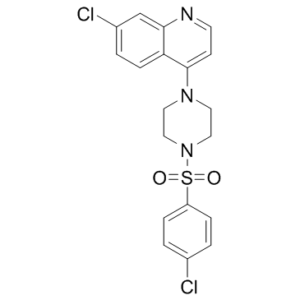
KM11060 is a novel mutated corrector of the F508del-CFTR (cystic fibrosis transmembrane conductance regulator) trafficking defect. It corrects F508del-CFTR trafficking, and increases the amount of functional CFTR at the plasma membrane (~75%) and inhibits PDE5 activity. Small-molecule correctors such as KM11060 may serve as useful pharmacological tools in studies of the F508del-CFTR processing defect and in the development of cystic fibrosis therapeutics. KM11060 partially corrects F508del-CFTR processing and increases surface expression to 75% of that observed in cells incubated at low temperature. Up to 50% of the F508del-CFTR in cells treated with KM11060 was complex-glycosylated, indicating passage through the Golgi. KM11060 as a promising compound for further development of CF therapeutics.
Physicochemical Properties
| Molecular Formula | C19H17CL2N3O2S | |
| Molecular Weight | 422.33 | |
| Exact Mass | 421.041 | |
| Elemental Analysis | C, 54.04; H, 4.06; Cl, 16.79; N, 9.95; O, 7.58; S, 7.59 | |
| CAS # | 774549-97-2 | |
| Related CAS # |
|
|
| PubChem CID | 1241327 | |
| Appearance | White to off-white solid powder | |
| Density | 1.5±0.1 g/cm3 | |
| Boiling Point | 607.3±65.0 °C at 760 mmHg | |
| Flash Point | 321.1±34.3 °C | |
| Vapour Pressure | 0.0±1.7 mmHg at 25°C | |
| Index of Refraction | 1.676 | |
| LogP | 4.19 | |
| Hydrogen Bond Donor Count | 0 | |
| Hydrogen Bond Acceptor Count | 5 | |
| Rotatable Bond Count | 3 | |
| Heavy Atom Count | 27 | |
| Complexity | 599 | |
| Defined Atom Stereocenter Count | 0 | |
| SMILES | ClC1C([H])=C([H])C2C(C=1[H])=NC([H])=C([H])C=2N1C([H])([H])C([H])([H])N(C([H])([H])C1([H])[H])S(C1C([H])=C([H])C(=C([H])C=1[H])Cl)(=O)=O |
|
| InChi Key | GIEHIZKCIZLXLF-UHFFFAOYSA-N | |
| InChi Code | InChI=1S/C19H17Cl2N3O2S/c20-14-1-4-16(5-2-14)27(25,26)24-11-9-23(10-12-24)19-7-8-22-18-13-15(21)3-6-17(18)19/h1-8,13H,9-12H2 | |
| Chemical Name | 7-chloro-4-(4-((4-chlorophenyl)sulfonyl)piperazin-1-yl)quinoline | |
| Synonyms |
|
|
| HS Tariff Code | 2934.99.9001 | |
| Storage |
Powder-20°C 3 years 4°C 2 years In solvent -80°C 6 months -20°C 1 month |
|
| Shipping Condition | Room temperature (This product is stable at ambient temperature for a few days during ordinary shipping and time spent in Customs) |
Biological Activity
| Targets |
CFTR/cystic fibrosis transmembrane conductance regulator
KM11060 targets F508del-cystic fibrosis transmembrane conductance regulator (F508del-CFTR) to correct its trafficking defect [1] KM11060 acts on F508del-CFTR to correct its trafficking defect [2] |
| ln Vitro |
Pharmacological tools like KM11060, which are small-molecule correctors, could be beneficial in researching the F508del-CFTR processing problem and developing treatments for cystic fibrosis. In both native epithelial tissues and cultured cells, KM11060 restores F508del-CFTR trafficking. F508del-CFTR processing is largely corrected by KM11060, which also raises surface expression to 75% of what is seen in cells cultured at low temperature. In cells treated with KM11060, up to 50% of the F508del-CFTR was complex-glycosylated, indicating Golgi transit. KM11060 is a potentially useful substance for the advancement of CF treatments. [1] KM11060 (10 nM for 24 h or 10 μM for 2 h) partially restored F508del-CFTR trafficking and significantly increased the maturation of F508del-CFTR in baby hamster kidney (BHK) cells; the correction effect was confirmed by the appearance of mature CFTR in Western blots, as well as halide flux and patch-clamp measurements in unpolarized BHK cells [1] |
| ln Vivo |
When LPS causes acute lung inflammation, plasma lipoxin A4 levels in F508del mice relative to wildtype mice can be markedly elevated by blocking PSGL-1 (P-selectin glycoprotein ligand-1) or P-selectin, blocking PAF by WEB2086, or correcting mutated CFTR trafficking by KM11060. [2] CFTR (cystic fibrosis transmembrane conductance regulator) is expressed by both neutrophils and platelets. Lack of functional CFTR could lead to severe lung infection and inflammation. Here, we found that mutation of CFTR (F508del) or inhibition of CFTR in mice led to more severe thrombocytopenia, alveolar neutrocytosis and bacteriosis, and lower lipoxin A4/MIP-2 (macrophage inhibitory protein-2) or lipoxin A4/neutrophil ratios in the BAL (bronchoalveolar lavage) during acute E. coli pneumonia. In vitro, inhibition of CFTR promotes MIP-2 production in LPS-stimulated neutrophils; however, lipoxin A4 could dose-dependently suppress this effect. In LPS-induced acute lung inflammation, blockade of PSGL-1 (P-selectin glycoprotein ligand-1) or P-selectin, antagonism of PAF by WEB2086, or correction of mutated CFTR trafficking by KM11060 could significantly increase plasma lipoxin A4 levels in F508del relevant to wildtype mice. Concurrently, F508del mice had higher plasma platelet activating factor (PAF) levels and PAF-AH activity compared to wildtype under LPS challenge. Inhibiting hydrolysis of PAF by a specific PAF-AH (PAF-acetylhydrolase) inhibitor, MAFP, could worsen LPS-induced lung inflammation in F508del mice compared to vehicle treated F508del group. Particularly, depletion of platelets in F508del mice could significantly decrease plasma lipoxin A4 and PAF-AH activity and deteriorate LPS-induced lung inflammation compared to control F508del mice. Taken together, lipoxin A4 and PAF are involved in E. coli or LPS-induced lung inflammation in CFTR-deficient mice, suggesting that lipoxin A4 and PAF might be therapeutic targets for ameliorating CFTR-deficiency deteriorated lung inflammation.[2] KM11060 corrected mutated F508del-CFTR trafficking and significantly increased plasma lipoxin A4 levels in F508del mice under LPS-induced acute lung inflammation (compared with wildtype mice and vehicle-treated F508del mice) [2] - KM11060 partially restored F508del-CFTR function in monolayers of human airway epithelial cells (CFBE41o⁻) and intestines isolated from F508del-CFTR mice (Cftr^{tm1Eur}) treated ex vivo, confirmed by short-circuit current measurements [1] |
| Enzyme Assay | KM11060 is a novel corrector of the F508del-CFTR (cystic fibrosis transmembrane conductance regulator) trafficking defect. It corrects F508del-CFTR trafficking, and increases the amount of functional CFTR at the plasma membrane (~75%) and inhibits PDE5 activity. |
| Cell Assay |
Small-molecule correctors such as KM11060 may serve as useful pharmacological tools in studies of the F508del-CFTR processing defect and in the development of cystic fibrosis therapeutics. KM11060 rescues F508del-CFTR trafficking in cultured cells and native epithelial tissues. KM11060 partially corrects F508del-CFTR processing and increases surface expression to 75% of that observed in cells incubated at low temperature. Up to 50% of the F508del-CFTR in cells treated with KM11060 was complex-glycosylated, indicating passage through the Golgi. KM11060 as a promising compound for further development of CF therapeutics. F508del-CFTR maturation assay in BHK cells: BHK cells expressing F508del-CFTR were treated with KM11060 at concentrations of 10 nM (24 h incubation) or 10 μM (2 h incubation); cell lysates were prepared and subjected to Western blotting to detect the presence of mature CFTR protein; halide flux and patch-clamp measurements were performed on unpolarized BHK cells to assess CFTR chloride channel function [1] - CFTR function assay in human airway epithelial cells: Monolayers of CFBE41o⁻ cells (expressing F508del-CFTR) were treated with KM11060, and short-circuit current measurements were conducted to evaluate the restoration of CFTR-mediated chloride transport [1] |
| Animal Protocol |
Administration of CFTR Inhibitors[2] Mice were intraperitoneally injected (ip) with MalH-2 (dissolved in PBS, 3 mg/kg) or CFTRinh-172 (dissolved in DMSO, 3 mg/kg) 15∼20 min before intratracheal challenge with E. coli or LPS to establish lung inflammation mouse models. E. coli Pneumonia and LPS-induced Acute Lung Inflammation Models[2] Eight to ten-week old CD1 wild-type and CF mice (targeted F508del gene replacement, obtained from Professor A. Verkman, University of California San Francisco) were used for these studies. Anesthesia was induced with an ip injection of a mixture of ketamine (90 mg/kg) and xylazine (10 mg/kg). [2] A previously developed direct visualization instillation (DVI) method was used to instill LPS into the airspaces of the lung. The LPS dosage (5 mg/kg) was selected aiming to induce a robust lung inflammation and injury at 24 h as previously reported and no mice died at this dosage. For establishing E. coli pneumonia, 107 cfu of E. coli were instilled into the airspaces of the lung as reported before. E. coli pneumonia and LPS-induced acute lung inflammation mouse models were followed for 4 and 24 respectively. Vital signs of each mouse were observed timely. At the end of experiment, mice were first anesthetized and then sacrificed by cervical dislocation. Ex vivo intestinal assay in F508del-CFTR mice: Intestines were isolated from F508del-CFTR mice (Cftr^{tm1Eur}), treated ex vivo with KM11060, and short-circuit current measurements were used to assess the correction of F508del-CFTR trafficking and function [1] - LPS-induced lung inflammation model in F508del mice: F508del mice were pretreated with KM11060 (administration route and dosage not specified) before intratracheal challenge with LPS (5 mg/kg); mice were euthanized at 24 h post-challenge, plasma was collected, and lipoxin A4 levels were measured to evaluate the effect of KM11060 on CFTR trafficking correction and inflammatory response [2] |
| References |
[1]. Structural analog of sildenafil identified as a novel corrector of the F508del-CFTR trafficking defect. Mol Pharmacol. 2008 Feb;73(2):478-89. [2]. Lipoxin A4 and platelet activating factor are involved in E. coli or LPS-induced lung inflammation in CFTR-deficient mice. PLoS One. 2014 Mar 26;9(3):e93003. |
| Additional Infomation |
The F508del mutation impairs trafficking of the cystic fibrosis transmembrane conductance regulator (CFTR) to the plasma membrane and results in a partially functional chloride channel that is retained in the endoplasmic reticulum and degraded. We recently used a novel high-throughput screening (HTS) assay to identify small-molecule correctors of F508del CFTR trafficking and found several classes of hits in a screen of 2000 compounds (Carlile et al., 2007). In the present study, we have extended the screen to 42,000 compounds and confirmed sildenafil as a corrector using this assay. We evaluated structural analogs of sildenafil and found that one such molecule called KM11060 (7-chloro-4-{4-[(4-chlorophenyl) sulfonyl] piperazino}quinoline) was surprisingly potent. It partially restored F508del trafficking and increased maturation significantly when baby hamster kidney (BHK) cells were treated with 10 nM for 24 h or 10 muM for 2 h. Partial correction was confirmed by the appearance of mature CFTR in Western blots and by using halide flux, patch-clamp, and short-circuit current measurements in unpolarized BHK cells, monolayers of human airway epithelial cells (CFBE41o(-)), and intestines isolated from F508del-CFTR mice (Cftr(tm1Eur)) treated ex vivo. Small-molecule correctors such as KM11060 may serve as useful pharmacological tools in studies of the F508del-CFTR processing defect and in the development of cystic fibrosis therapeutics.[1] KM11060 (7-chloro-4-{4-[(4-chlorophenyl) sulfonyl] piperazino}quinoline) is a structural analog of sildenafil identified via high-throughput screening (HTS) as a novel corrector of F508del-CFTR trafficking defect; the F508del mutation impairs CFTR trafficking to the plasma membrane, leading to retention in the endoplasmic reticulum and degradation [1] - KM11060 may serve as a useful pharmacological tool for studying F508del-CFTR processing defects and for the development of cystic fibrosis therapeutics [1] - Correction of mutated F508del-CFTR trafficking by KM11060 modulates the inflammatory response in CFTR-deficient mice with LPS-induced lung inflammation by increasing plasma lipoxin A4 levels, which is associated with amelioration of lung inflammation [2] |
Solubility Data
| Solubility (In Vitro) |
DMSO: ~84 mg/mL ( 198.89 mM) Water: Insoluble Ethanol: <2 mg/mL |
| Solubility (In Vivo) |
Solubility in Formulation 1: ≥ 5 mg/mL (11.84 mM) (saturation unknown) in 10% DMSO + 90% Corn Oil (add these co-solvents sequentially from left to right, and one by one), clear solution. For example, if 1 mL of working solution is to be prepared, you can add 100 μL of 50.0 mg/mL clear DMSO stock solution to 900 μL of corn oil and mix evenly. Solubility in Formulation 2: 10%DMSO+90%corn oil:≥ 5 mg/mL (11.84 mM); Clear solution (Please use freshly prepared in vivo formulations for optimal results.) |
| Preparing Stock Solutions | 1 mg | 5 mg | 10 mg | |
| 1 mM | 2.3678 mL | 11.8391 mL | 23.6782 mL | |
| 5 mM | 0.4736 mL | 2.3678 mL | 4.7356 mL | |
| 10 mM | 0.2368 mL | 1.1839 mL | 2.3678 mL |