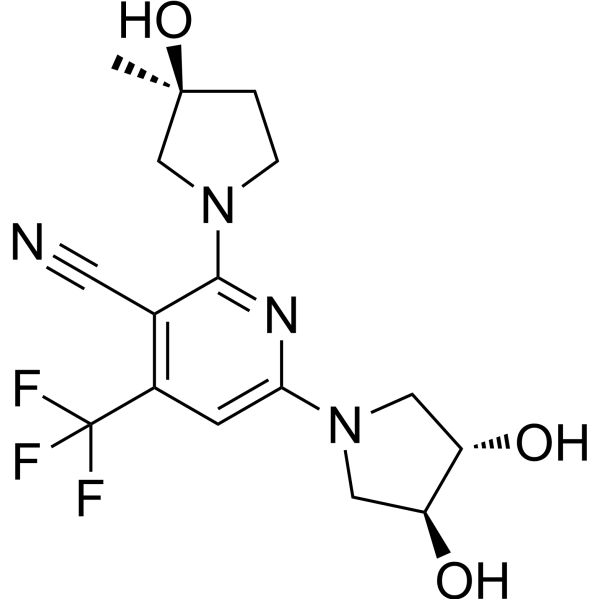
Physicochemical Properties
| Molecular Formula | C16H18F3N4O3 |
| Molecular Weight | 371.334333896637 |
| Exact Mass | 372.14 |
| CAS # | 2135304-43-5 |
| PubChem CID | 129900198 |
| Appearance | Light yellow to yellow solid powder |
| LogP | 0.6 |
| Hydrogen Bond Donor Count | 3 |
| Hydrogen Bond Acceptor Count | 10 |
| Rotatable Bond Count | 2 |
| Heavy Atom Count | 26 |
| Complexity | 573 |
| Defined Atom Stereocenter Count | 3 |
| SMILES | FC(C1C=C(N=C(C=1C#N)N1CC[C@@](C)(C1)O)N1C[C]([C@H](C1)O)O)(F)F |^1:19| |
| InChi Key | FAXXYODRCHXHTQ-HUBLWGQQSA-N |
| InChi Code | InChI=1S/C16H19F3N4O3/c1-15(26)2-3-22(8-15)14-9(5-20)10(16(17,18)19)4-13(21-14)23-6-11(24)12(25)7-23/h4,11-12,24-26H,2-3,6-8H2,1H3/t11-,12-,15-/m0/s1 |
| Chemical Name | 6-[(3S,4S)-3,4-dihydroxypyrrolidin-1-yl]-2-[(3S)-3-hydroxy-3-methylpyrrolidin-1-yl]-4-(trifluoromethyl)pyridine-3-carbonitrile |
| HS Tariff Code | 2934.99.9001 |
| Storage |
Powder-20°C 3 years 4°C 2 years In solvent -80°C 6 months -20°C 1 month |
| Shipping Condition | Room temperature (This product is stable at ambient temperature for a few days during ordinary shipping and time spent in Customs) |
Biological Activity
| Targets |
- Ketohexokinase (KHK): KHK-IN-2 is a selective inhibitor of KHK, with IC₅₀ values of 1.6 nM (human KHK-C), 2.1 nM (mouse KHK-C), and 120 nM (human KHK-A); it binds to KHK with a Ki of 0.9 nM (human KHK-C) [1] |
| ln Vitro |
1. KHK enzyme inhibition: KHK-IN-2 dose-dependently inhibited recombinant human KHK-C, mouse KHK-C, and human KHK-A with IC₅₀ values of 1.6 nM, 2.1 nM, and 120 nM, respectively. The inhibition was competitive with respect to the substrate fructose, as indicated by Lineweaver-Burk plot analysis [1] 2. Cellular fructose metabolism inhibition: HepG2 cells treated with KHK-IN-2 (10 nM) and fructose (10 mM) showed a 92% reduction in intracellular fructose-1-phosphate (F1P) accumulation compared to vehicle control. No significant effect on glucose metabolism (glucose-6-phosphate levels) was observed [1] 3. Selectivity: KHK-IN-2 (10 μM) showed no significant inhibition of other hexokinases (HK1, HK2, HK3) or metabolic enzymes (e.g., glucokinase, phosphofructokinase) in vitro [1] 4. Metabolic stability: Incubation with human liver microsomes showed a half-life (t₁/₂) of 120 minutes, and with mouse liver microsomes a t₁/₂ of 150 minutes [1] |
| ln Vivo |
1. F1P reduction in mice: C57BL/6 mice were administered KHK-IN-2 (3, 10, 30 mg/kg oral gavage) 1 hour before fructose challenge (2 g/kg oral). Plasma F1P levels were reduced by 45% (3 mg/kg), 78% (10 mg/kg), and 91% (30 mg/kg) compared to vehicle control [1] 2. Uric acid lowering in hyperuricemic mice: Mice fed a high-fructose diet (HFD) for 2 weeks were treated with KHK-IN-2 (10 mg/kg PO QD) for 7 days. Plasma uric acid levels decreased from 12.8 ± 1.2 mg/dL (vehicle) to 6.3 ± 0.8 mg/dL (treatment), a 51% reduction [1] 3. Liver F1P reduction: HFD-fed mice treated with KHK-IN-2 (10 mg/kg PO QD) for 7 days showed a 85% reduction in hepatic F1P levels compared to vehicle, with no significant change in liver glycogen content [1] |
| Enzyme Assay |
1. KHK activity inhibition assay: Recombinant human/mouse KHK-C or human KHK-A was incubated with serial concentrations of KHK-IN-2 (0.001–100 nM) and fructose (5 mM) in reaction buffer containing ATP and Mg²⁺. The formation of F1P was detected by a coupled enzymatic assay measuring NADPH production. IC₅₀ values were calculated from dose-response curves, and inhibition mode was determined by Lineweaver-Burk plots with varying fructose concentrations [1] 2. Hexokinase selectivity assay: Recombinant HK1, HK2, HK3, and glucokinase were incubated with KHK-IN-2 (10 μM) and their respective substrates. Enzyme activity was measured via NAD(P)H-coupled assays, and inhibition percentage was calculated relative to vehicle control [1] |
| Cell Assay |
1. Intracellular F1P measurement assay: HepG2 cells were seeded in 96-well plates and serum-starved for 16 hours. Cells were pre-incubated with KHK-IN-2 (0.01–100 nM) for 1 hour, then treated with fructose (10 mM) for 2 hours. Cells were lysed, and F1P levels were quantified using a specific F1P detection kit. Glucose-6-phosphate levels were measured in parallel to assess glucose metabolism specificity [1] |
| Animal Protocol |
1. Acute fructose challenge model: C57BL/6 mice were randomly divided into vehicle and KHK-IN-2 groups (n=6/group). KHK-IN-2 was administered via oral gavage at 3, 10, 30 mg/kg, and vehicle (10% DMSO/40% PEG400/50% saline) was given to the control group. One hour post-dosing, all mice received fructose (2 g/kg oral). Blood samples were collected 30 minutes after fructose administration to measure plasma F1P levels [1] 2. High-fructose diet (HFD) hyperuricemic model: C57BL/6 mice were fed a HFD (60% fructose) for 2 weeks to induce hyperuricemia. Mice were then treated with KHK-IN-2 (10 mg/kg PO QD) or vehicle for 7 days. Blood samples were collected before and after treatment to measure plasma uric acid. Mice were sacrificed at the end of treatment, and liver tissues were collected to quantify hepatic F1P and glycogen levels [1] 3. Pharmacokinetic study: Male SD rats were administered KHK-IN-2 via oral gavage (30 mg/kg) or intravenous injection (10 mg/kg). Blood samples were collected at 0.25, 0.5, 1, 2, 4, 6, 8, 24 hours post-dosing. Plasma drug concentrations were quantified by LC-MS/MS to calculate pharmacokinetic parameters [1] |
| ADME/Pharmacokinetics |
1. Oral bioavailability: KHK-IN-2 had an oral bioavailability (F) of 58% in SD rats after oral administration of 30 mg/kg [1] 2. Plasma pharmacokinetics: Intravenous administration (10 mg/kg, rats) resulted in t₁/₂ = 5.8 ± 0.6 hours, Cₘₐₓ = 1850 ± 210 ng/mL, AUC₀₋∞ = 8920 ± 950 ng·h/mL. Oral administration (30 mg/kg, rats) resulted in t₁/₂ = 6.2 ± 0.7 hours, Cₘₐₓ = 1050 ± 130 ng/mL, AUC₀₋∞ = 10200 ± 1100 ng·h/mL [1] 3. Tissue distribution: Rats orally administered KHK-IN-2 (30 mg/kg) showed highest concentrations in liver (15.6 ± 1.8 μg/g), kidney (10.2 ± 1.1 μg/g), and small intestine (8.9 ± 0.9 μg/g) at 2 hours post-dosing; brain penetration was low (0.4 ± 0.1 μg/g) [1] 4. Metabolic stability: In vitro liver microsome incubation showed t₁/₂ = 120 ± 12 minutes (human) and 150 ± 15 minutes (mouse) [1] 5. Plasma protein binding: KHK-IN-2 had a plasma protein binding rate of 94 ± 2% (human plasma) and 92 ± 3% (rat plasma) [1] |
| Toxicity/Toxicokinetics |
1. Acute toxicity: SD rats administered KHK-IN-2 via oral gavage at doses up to 200 mg/kg showed no mortality or behavioral abnormalities within 14 days. Body weight change was ≤4% vs. control [1] 2. Subchronic toxicity: HFD-fed mice treated with KHK-IN-2 (30 mg/kg PO QD for 14 days) showed no significant changes in liver function (ALT, AST) or kidney function (BUN, creatinine) compared to vehicle. Histopathological analysis of liver, kidney, and gastrointestinal tract revealed no obvious tissue damage [1] 3. Hematological parameters: No significant abnormalities in white blood cell count, red blood cell count, or platelet count were observed in mice treated with KHK-IN-2 (30 mg/kg PO QD for 14 days) [1] |
| References |
[1]. Discovery of Fragment-Derived Small Molecules for in Vivo Inhibition of Ketohexokinase (KHK). J Med Chem. 2017 Sep 28;60(18):7835-7849. |
| Additional Infomation |
1. KHK-IN-2 is a fragment-derived small-molecule inhibitor of KHK, with a chemical structure featuring a pyridine core scaffold [1] 2. It acts as a competitive inhibitor of KHK with respect to fructose, blocking the first step of fructose metabolism (conversion of fructose to F1P) [1] 3. The compound shows high selectivity for KHK-C (the major isoform involved in fructose metabolism in liver and kidney) over KHK-A and other hexokinases [1] 4. KHK-IN-2 has potential therapeutic applications in fructose-induced metabolic disorders, such as non-alcoholic fatty liver disease (NAFLD), hyperuricemia, and type 2 diabetes [1] |
Solubility Data
| Solubility (In Vitro) | DMSO : ~250 mg/mL (~671.43 mM) |
| Solubility (In Vivo) |
Solubility in Formulation 1: ≥ 2.08 mg/mL (5.59 mM) (saturation unknown) in 10% DMSO + 40% PEG300 + 5% Tween80 + 45% Saline (add these co-solvents sequentially from left to right, and one by one), clear solution. For example, if 1 mL of working solution is to be prepared, you can add 100 μL of 20.8 mg/mL clear DMSO stock solution to 400 μL PEG300 and mix evenly; then add 50 μL Tween-80 to the above solution and mix evenly; then add 450 μL normal saline to adjust the volume to 1 mL. Preparation of saline: Dissolve 0.9 g of sodium chloride in 100 mL ddH₂ O to obtain a clear solution. Solubility in Formulation 2: ≥ 2.08 mg/mL (5.59 mM) (saturation unknown) in 10% DMSO + 90% (20% SBE-β-CD in Saline) (add these co-solvents sequentially from left to right, and one by one), clear solution. For example, if 1 mL of working solution is to be prepared, you can add 100 μL of 20.8 mg/mL clear DMSO stock solution to 900 μL of 20% SBE-β-CD physiological saline solution and mix evenly. Preparation of 20% SBE-β-CD in Saline (4°C,1 week): Dissolve 2 g SBE-β-CD in 10 mL saline to obtain a clear solution. Solubility in Formulation 3: ≥ 2.08 mg/mL (5.59 mM) (saturation unknown) in 10% DMSO + 90% Corn Oil (add these co-solvents sequentially from left to right, and one by one), clear solution. For example, if 1 mL of working solution is to be prepared, you can add 100 μL of 20.8 mg/mL clear DMSO stock solution to 900 μL of corn oil and mix evenly. (Please use freshly prepared in vivo formulations for optimal results.) |
| Preparing Stock Solutions | 1 mg | 5 mg | 10 mg | |
| 1 mM | 2.6930 mL | 13.4651 mL | 26.9302 mL | |
| 5 mM | 0.5386 mL | 2.6930 mL | 5.3860 mL | |
| 10 mM | 0.2693 mL | 1.3465 mL | 2.6930 mL |