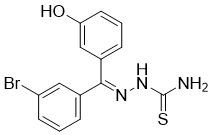
KGP94 is a novel, potent, reversible, time-dependent and competitive inhibitor of human cysteine protease Cathepsin L inhibitor(CTSL). It inhibits the activity of cathepsin L toward human type I collagen. KGP94 significantly impedes both migration and invasion of MDA-MB-231 human breast cancer cells. Molecular modeling places the thiocarbonyl of KGP94 in proximity to the active site Cys25. Significant growth retardation of C3H mouse mammary carcinomas is achieved with KGP94 treatment [1,2]. KGP94 treatment led to marked attenuation of tumor cell invasion and migration under both normal and aberrant microenvironmental conditions suggesting that it may have significant utility as an anti-metastatic agent. [3]
Physicochemical Properties
| Molecular Formula | C14H12BRN3OS |
| Molecular Weight | 350.233580589294 |
| Exact Mass | 348.988 |
| CAS # | 1131456-28-4 |
| Related CAS # | 1131456-28-4 |
| PubChem CID | 52944285 |
| Appearance | White to off-white solid powder |
| LogP | 3.4 |
| Hydrogen Bond Donor Count | 3 |
| Hydrogen Bond Acceptor Count | 3 |
| Rotatable Bond Count | 3 |
| Heavy Atom Count | 20 |
| Complexity | 377 |
| Defined Atom Stereocenter Count | 0 |
| SMILES | BrC1=CC=CC(=C1)/C(/C1C=CC=C(C=1)O)=N\NC(N)=S |
| InChi Key | ZDBKSZKTCPOBFR-GHRIWEEISA-N |
| InChi Code | InChI=1S/C14H12BrN3OS/c15-11-5-1-3-9(7-11)13(17-18-14(16)20)10-4-2-6-12(19)8-10/h1-8,19H,(H3,16,18,20)/b17-13+ |
| Chemical Name | [(Z)-[(3-bromophenyl)-(3-hydroxyphenyl)methylidene]amino]thiourea |
| HS Tariff Code | 2934.99.9001 |
| Storage |
Powder-20°C 3 years 4°C 2 years In solvent -80°C 6 months -20°C 1 month |
| Shipping Condition | Room temperature (This product is stable at ambient temperature for a few days during ordinary shipping and time spent in Customs) |
Biological Activity
| ln Vitro | KGP94 (10 or 20 μM, 24 hours) decreases cell invasion of primary bone marrow-derived macrophages or Raw264.7 as well as the expression of M2 (macrophage) markers (Arginase-1 and CD206)[3]. Prostate cancer cells' and breast cancer cells' ability to invade is reduced by 53% and 88%, respectively, by KGP94 (25 μM, 24 hours) [4]. In PC-3ML and MDA-MB-231, KGP94 (25 μM, 24 hours) reduced secreted CTSL activity by 94% and 92%, respectively [4]. Assay for cell invasion[4] |
| ln Vivo | In a prostate cancer bone metastasis model, KGP94 (ip; 20 mg/kg; once daily for three days) demonstrates anti-metastatic and anti-bone resorbtive effects [5]. |
| Cell Assay |
Cell invasion assay[4] Cell Types: PC-3ML, MDA-MB-231 Tested Concentrations: 10 μM, 25 μM Incubation Duration: 24 hrs (hours) Experimental Results: Attenuated migration and invasion of prostate and breast cancer cells. |
| Animal Protocol |
Animal/Disease Models: NCR nu/nu male mice [5] Doses: 20 mg/kg Route of Administration: intraperitoneal (ip) injection; one time/day for 3 days Experimental Results: Metastatic tumor load was diminished by 65%, tumor angiogenesis was diminished by 58%, and increased Survival rate of mice with bone metastasis. |
| References |
[1]. Synthesis and biological evaluation of a water-soluble phosphate prodrug salt and structural analogues of KGP94, a lead inhibitor of cathepsin L. Bioorg Med Chem Lett. 2017 Mar 1. 27(5):1304-1310. [2]. An efficient and concise synthesis of a selective small molecule non-peptide inhibitor of cathepsin L: KGP94. Bioorg Chem. 2021 Nov. 116:105317. [3]. Cathepsin L secretion by host and neoplastic cells potentiates invasion. Oncotarget. 2019 Sep 17. 10(53):5560-5568. [4]. Cathepsin L inhibition by the small molecule KGP94 suppresses tumor microenvironment enhanced metastasis associated cell functions of prostate and breast cancer cells. Clin Exp Metastasis. 2013 Oct. 30(7):891-902. [5]. Cathepsin L inactivation leads to multimodal inhibition of prostate cancer cell dissemination in a preclinical bone metastasis model. Int J Cancer. 2016 Jun 1;138(11):2665-77. |
Solubility Data
| Solubility (In Vitro) | DMSO : ≥ 100 mg/mL (~285.53 mM) |
| Solubility (In Vivo) |
Solubility in Formulation 1: ≥ 2.5 mg/mL (7.14 mM) (saturation unknown) in 10% DMSO + 40% PEG300 + 5% Tween80 + 45% Saline (add these co-solvents sequentially from left to right, and one by one), clear solution. For example, if 1 mL of working solution is to be prepared, you can add 100 μL of 25.0 mg/mL clear DMSO stock solution to 400 μL PEG300 and mix evenly; then add 50 μL Tween-80 to the above solution and mix evenly; then add 450 μL normal saline to adjust the volume to 1 mL. Preparation of saline: Dissolve 0.9 g of sodium chloride in 100 mL ddH₂ O to obtain a clear solution. Solubility in Formulation 2: ≥ 2.5 mg/mL (7.14 mM) (saturation unknown) in 10% DMSO + 90% Corn Oil (add these co-solvents sequentially from left to right, and one by one), clear solution. For example, if 1 mL of working solution is to be prepared, you can add 100 μL of 25.0 mg/mL clear DMSO stock solution to 900 μL of corn oil and mix evenly. (Please use freshly prepared in vivo formulations for optimal results.) |
| Preparing Stock Solutions | 1 mg | 5 mg | 10 mg | |
| 1 mM | 2.8553 mL | 14.2763 mL | 28.5527 mL | |
| 5 mM | 0.5711 mL | 2.8553 mL | 5.7105 mL | |
| 10 mM | 0.2855 mL | 1.4276 mL | 2.8553 mL |