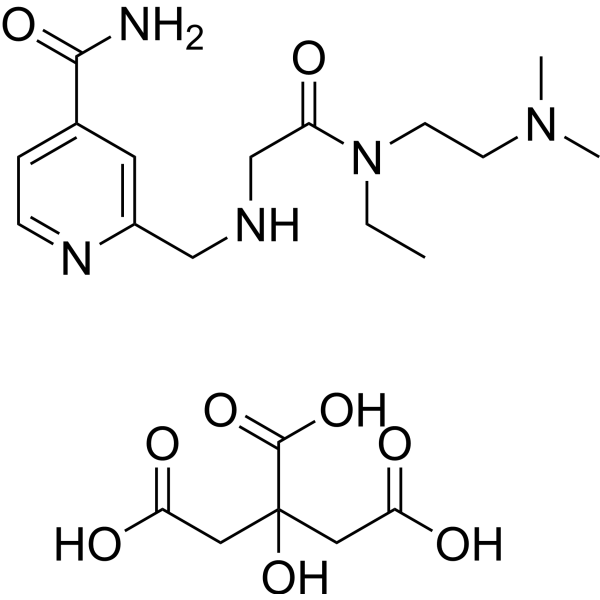
Physicochemical Properties
| Molecular Formula | C21H33N5O9 |
| Molecular Weight | 499.514825582504 |
| Exact Mass | 499.227 |
| CAS # | 2448475-08-7 |
| Related CAS # | KDOAM-25;2230731-99-2;KDOAM-25 trihydrochloride |
| PubChem CID | 139290992 |
| Appearance | Light yellow to yellow solid powder |
| Hydrogen Bond Donor Count | 6 |
| Hydrogen Bond Acceptor Count | 12 |
| Rotatable Bond Count | 14 |
| Heavy Atom Count | 35 |
| Complexity | 589 |
| Defined Atom Stereocenter Count | 0 |
| SMILES | OC(C(=O)O)(CC(=O)O)CC(=O)O.O=C(CNCC1C=C(C(N)=O)C=CN=1)N(CC)CCN(C)C |
| InChi Key | LOVVSPOOXGDJRT-UHFFFAOYSA-N |
| InChi Code | InChI=1S/C15H25N5O2.C6H8O7/c1-4-20(8-7-19(2)3)14(21)11-17-10-13-9-12(15(16)22)5-6-18-13;7-3(8)1-6(13,5(11)12)2-4(9)10/h5-6,9,17H,4,7-8,10-11H2,1-3H3,(H2,16,22);13H,1-2H2,(H,7,8)(H,9,10)(H,11,12) |
| Chemical Name | 2-[[[2-[2-(dimethylamino)ethyl-ethylamino]-2-oxoethyl]amino]methyl]pyridine-4-carboxamide;2-hydroxypropane-1,2,3-tricarboxylic acid |
| HS Tariff Code | 2934.99.9001 |
| Storage |
Powder-20°C 3 years 4°C 2 years In solvent -80°C 6 months -20°C 1 month Note: Please store this product in a sealed and protected environment (e.g. under nitrogen), avoid exposure to moisture. |
| Shipping Condition | Room temperature (This product is stable at ambient temperature for a few days during ordinary shipping and time spent in Customs) |
Biological Activity
| Targets | KDM5 |
| ln Vitro | At doses exceeding 100 μM, KDOAM-25 citrate most effectively inhibits other members of the KDM5 family, but not KDM5B, which has an IC50 of roughly 50 μM. Among the JmjC family members studied, KDOAM-25 citrate had no cellular action [1]. After a 5- to 7-day delay, KDOAM-25 citrate (IC50 of approximately 30 μM) can decrease the viability of MM1S cells [1]. The G1 cell cycle is arrested by KDOAM-25 citrate treatment, and the percentage of MM1S in the G1 phase rises while the percentage of G2 phase cells falls. However, the percentage of apoptotic sub-G1 phase cells does not rise [1]. When KDOAM-25 citrate (50 μM) is added to multiple myeloma cells, H3K4me3 is about doubled[1]. |
| References |
[1]. Potent and Selective KDM5 Inhibitor Stops Cellular Demethylation of H3K4me3 at Transcription Start Sites and Proliferation of MM1S Myeloma Cells. Cell Chem Biol. 2017 Mar 16;24(3):371-380. |
Solubility Data
| Solubility (In Vitro) |
DMSO : 200 mg/mL (400.39 mM) H2O : 100 mg/mL (200.20 mM) |
| Solubility (In Vivo) |
Solubility in Formulation 1: ≥ 5 mg/mL (10.01 mM) (saturation unknown) in 10% DMSO + 40% PEG300 + 5% Tween80 + 45% Saline (add these co-solvents sequentially from left to right, and one by one), clear solution. For example, if 1 mL of working solution is to be prepared, you can add 100 μL of 50.0 mg/mL clear DMSO stock solution to 400 μL PEG300 and mix evenly; then add 50 μL Tween-80 to the above solution and mix evenly; then add 450 μL normal saline to adjust the volume to 1 mL. Preparation of saline: Dissolve 0.9 g of sodium chloride in 100 mL ddH₂ O to obtain a clear solution. Solubility in Formulation 2: ≥ 5 mg/mL (10.01 mM) (saturation unknown) in 10% DMSO + 90% (20% SBE-β-CD in Saline) (add these co-solvents sequentially from left to right, and one by one), clear solution. For example, if 1 mL of working solution is to be prepared, you can add 100 μL of 50.0 mg/mL clear DMSO stock solution to 900 μL of 20% SBE-β-CD physiological saline solution and mix evenly. Preparation of 20% SBE-β-CD in Saline (4°C,1 week): Dissolve 2 g SBE-β-CD in 10 mL saline to obtain a clear solution. Solubility in Formulation 3: ≥ 5 mg/mL (10.01 mM) (saturation unknown) in 10% DMSO + 90% Corn Oil (add these co-solvents sequentially from left to right, and one by one), clear solution. For example, if 1 mL of working solution is to be prepared, you can add 100 μL of 50.0 mg/mL clear DMSO stock solution to 900 μL of corn oil and mix evenly. (Please use freshly prepared in vivo formulations for optimal results.) |
| Preparing Stock Solutions | 1 mg | 5 mg | 10 mg | |
| 1 mM | 2.0020 mL | 10.0098 mL | 20.0196 mL | |
| 5 mM | 0.4004 mL | 2.0020 mL | 4.0039 mL | |
| 10 mM | 0.2002 mL | 1.0010 mL | 2.0020 mL |