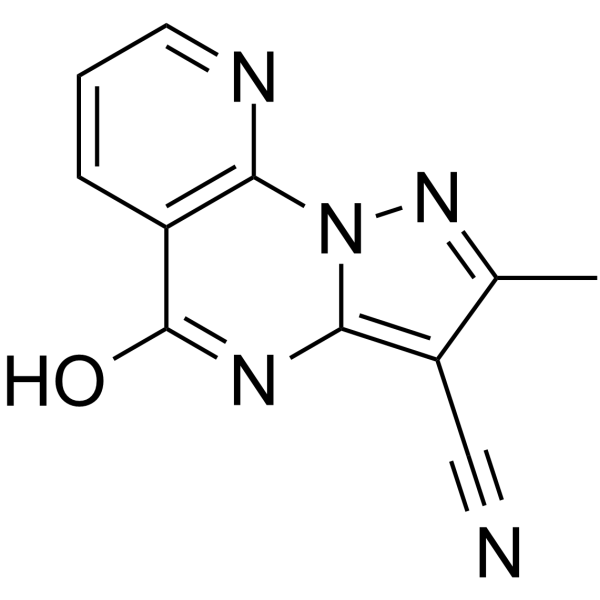
Physicochemical Properties
| Molecular Formula | C11H7N5O |
| Molecular Weight | 225.206180810928 |
| Exact Mass | 225.065 |
| CAS # | 2098902-68-0 |
| PubChem CID | 137174251 |
| Appearance | Light yellow to khaki solid powder |
| LogP | 0.5 |
| Hydrogen Bond Donor Count | 1 |
| Hydrogen Bond Acceptor Count | 4 |
| Rotatable Bond Count | 0 |
| Heavy Atom Count | 17 |
| Complexity | 389 |
| Defined Atom Stereocenter Count | 0 |
| SMILES | O=C1C2C=CC=NC=2N2C(=C(C#N)C(C)=N2)N1 |
| InChi Key | FIRSAIIBSBCBTF-UHFFFAOYSA-N |
| InChi Code | InChI=1S/C11H7N5O/c1-6-8(5-12)10-14-11(17)7-3-2-4-13-9(7)16(10)15-6/h2-4H,1H3,(H,14,17) |
| Chemical Name | 4-methyl-8-oxo-2,3,7,13-tetrazatricyclo[7.4.0.02,6]trideca-1(9),3,5,10,12-pentaene-5-carbonitrile |
| HS Tariff Code | 2934.99.9001 |
| Storage |
Powder-20°C 3 years 4°C 2 years In solvent -80°C 6 months -20°C 1 month |
| Shipping Condition | Room temperature (This product is stable at ambient temperature for a few days during ordinary shipping and time spent in Customs) |
Biological Activity
| Targets |
Histone lysine demethylase 4D (KDM4D) (IC50 = 0.32 μM); KDM4C (IC50 = 5.2 μM); KDM4A, KDM4B (IC50 > 10 μM); KDM6A, KDM6B [1] |
| ln Vitro |
The most potent one is KDM4D-IN-1 (Compound 10r), which has an IC50 value of 0.41±0.03 μM against KDM4D. KDM4D-IN-1 demonstrates good wiring of KDM4D against other selected KDMs, as evidenced by its low activity against KDM2B, KDM3B, and KDM5A (IC50>10 μM) [1]. Treatment of HeLa cells with KDM4D-IN-1 (10 μM) for 24 hours significantly increased H3K9me3 levels, as determined by Western blot. No notable changes were observed in H3K9me2, H3K9me1, or total histone H3 levels [1] |
| Enzyme Assay |
The inhibitory activity of KDM4D-IN-1 against KDM4D was measured using a FRET-based assay. Recombinant KDM4D enzyme was incubated with a fluorescently labeled histone peptide substrate, along with α-ketoglutarate, Fe²⁺, and ascorbate. Various concentrations of the compound were added to the reaction system, which was then incubated at 37°C for 1 hour. Fluorescence signals were detected to assess enzyme activity, and the IC50 value was calculated from the dose-response inhibition curve [1] |
| Cell Assay |
HeLa cells were seeded in 6-well plates and cultured overnight. KDM4D-IN-1 was dissolved in DMSO and added to the cell culture medium at a final concentration of 10 μM (DMSO content ≤ 0.1%). Cells were incubated at 37°C in a 5% CO₂ environment for 24 hours. After incubation, cells were collected and total proteins were extracted. Western blot analysis was conducted using specific antibodies against H3K9me3, H3K9me2, H3K9me1, and total H3 to detect alterations in histone methylation levels [1] |
| References |
[1]. Discovery of pyrazolo[1,5-a]pyrimidine-3-carbonitrile derivatives as a new class of histone lysine demethylase 4D (KDM4D) inhibitors. Bioorg Med Chem Lett. 2017 Jul 15;27(14):3201-3204. |
| Additional Infomation |
KDM4D-IN-1 is a member of the pyrazolo[1,5-a]pyrimidine-3-carbonitrile derivative family, a newly developed class of KDM4D inhibitors. It exhibits selective inhibition of KDM4D compared to other KDM isoforms, with minimal activity against KDM4A, KDM4B, KDM6A, and KDM6B. The compound serves as a potential tool for investigating the biological functions of KDM4D and its role in chromatin regulation [1] |
Solubility Data
| Solubility (In Vitro) | DMSO : ~7.14 mg/mL (~31.70 mM) |
| Solubility (In Vivo) |
Solubility in Formulation 1: ≥ 0.71 mg/mL (3.15 mM) (saturation unknown) in 10% DMSO + 40% PEG300 + 5% Tween80 + 45% Saline (add these co-solvents sequentially from left to right, and one by one), clear solution. For example, if 1 mL of working solution is to be prepared, you can add 100 μL of 7.1 mg/mL clear DMSO stock solution to 400 μL PEG300 and mix evenly; then add 50 μL Tween-80 to the above solution and mix evenly; then add 450 μL normal saline to adjust the volume to 1 mL. Preparation of saline: Dissolve 0.9 g of sodium chloride in 100 mL ddH₂ O to obtain a clear solution. Solubility in Formulation 2: ≥ 0.71 mg/mL (3.15 mM) (saturation unknown) in 10% DMSO + 90% (20% SBE-β-CD in Saline) (add these co-solvents sequentially from left to right, and one by one), clear solution. For example, if 1 mL of working solution is to be prepared, you can add 100 μL of 7.1 mg/mL clear DMSO stock solution to 900 μL of 20% SBE-β-CD physiological saline solution and mix evenly. Preparation of 20% SBE-β-CD in Saline (4°C,1 week): Dissolve 2 g SBE-β-CD in 10 mL saline to obtain a clear solution. (Please use freshly prepared in vivo formulations for optimal results.) |
| Preparing Stock Solutions | 1 mg | 5 mg | 10 mg | |
| 1 mM | 4.4403 mL | 22.2015 mL | 44.4030 mL | |
| 5 mM | 0.8881 mL | 4.4403 mL | 8.8806 mL | |
| 10 mM | 0.4440 mL | 2.2202 mL | 4.4403 mL |