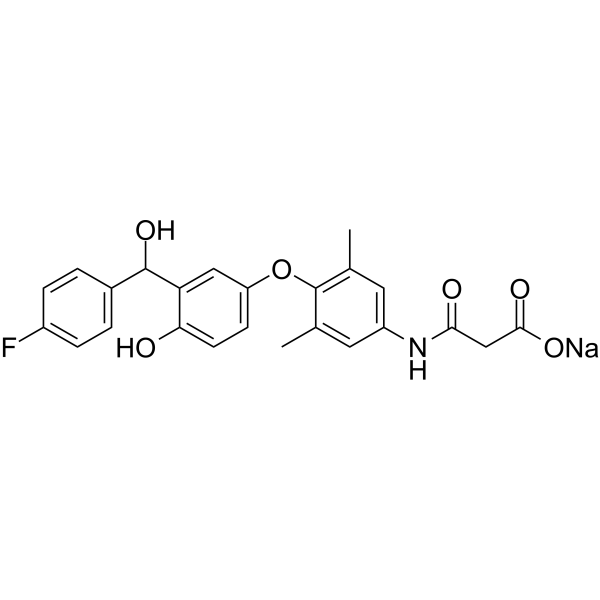
Physicochemical Properties
| Molecular Formula | C24H21FNNAO6 |
| Molecular Weight | 461.4148 |
| Exact Mass | 461.125 |
| CAS # | 373641-87-3 |
| PubChem CID | 25070693 |
| Appearance | Typically exists as solid at room temperature |
| Hydrogen Bond Donor Count | 3 |
| Hydrogen Bond Acceptor Count | 7 |
| Rotatable Bond Count | 7 |
| Heavy Atom Count | 33 |
| Complexity | 634 |
| Defined Atom Stereocenter Count | 0 |
| InChi Key | WIAUUVBWUTVDDD-UHFFFAOYSA-M |
| InChi Code | InChI=1S/C24H22FNO6.Na/c1-13-9-17(26-21(28)12-22(29)30)10-14(2)24(13)32-18-7-8-20(27)19(11-18)23(31)15-3-5-16(25)6-4-15;/h3-11,23,27,31H,12H2,1-2H3,(H,26,28)(H,29,30);/q;+1/p-1 |
| Chemical Name | sodium;3-[4-[3-[(4-fluorophenyl)-hydroxymethyl]-4-hydroxyphenoxy]-3,5-dimethylanilino]-3-oxopropanoate |
| Synonyms | T0681; T-0681; T 0681 |
| HS Tariff Code | 2934.99.9001 |
| Storage |
Powder-20°C 3 years 4°C 2 years In solvent -80°C 6 months -20°C 1 month |
| Shipping Condition | Room temperature (This product is stable at ambient temperature for a few days during ordinary shipping and time spent in Customs) |
Biological Activity
| ln Vitro | The impact of KAT681 (T-0681), a liver-selective thyroid mimic, on lipoprotein metabolism was investigated. Without altering the function of cholesteryl ester transfer protein, prolonged administration of KAT681 boosts the expression of class B scavenger receptor type I and low-density lipoprotein (LDL) receptors in the liver. Western blot demonstrating the expression of human SR-BI (CLA-1) in both AcLDL-loaded HepG2 cells and HepG2 cells that were then cultured with either vehicle or KAT681. Following incubation with 50 μg/mL AcLDL, there was a substantial down-regulation of SR-BI protein expression. This impact is not reversed by adding KAT681[1]. |
| ln Vivo | Plasma cholesterol was found to significantly decrease at a dose of 36 nmole/kg/day of KAT681 (T-0681) in a preliminary dose titration study; doses higher than this did not demonstrate any additional reduction in plasma cholesterol. lipid effect. Subsequently, in a 4-week study, 36 nmole/kg/day of KAT681 or a corresponding placebo control were given to New Zealand white rabbits (NZW) who were fed a 0.2% cholesterol diet. 60% less plasma cholesterol and 70% less plasma triglycerides can be achieved with KAT681 treatment [1]. A noteworthy rise in hepatic SR-BI expression was noted at 36 nmol/kg/d KAT681 (T-0681) in a preliminary dose titration study conducted in wild-type (WT) mice. This was accompanied by a noted 50% decrease in plasma cholesterol. The lipid-lowering effect was not observed at doses greater than 36 nmol/kg/d. Plasma cholesterol was significantly reduced in SR-BI KO mice, but liver LDLr was significantly increased by KAT681 (2-fold that of control, P<0.01) [2]. |
| References |
[1]. The thyromimetic T-0681 protects from atherosclerosis. J Lipid Res. 2009 May;50(5):938-44. [2]. The liver-selective thyromimetic T-0681 influences reverse cholesterol transport and atherosclerosis development in mice. PLoS One. 2010 Jan 15;5(1):e8722. |
Solubility Data
| Solubility (In Vitro) | May dissolve in DMSO (in most cases), if not, try other solvents such as H2O, Ethanol, or DMF with a minute amount of products to avoid loss of samples |
| Solubility (In Vivo) |
Note: Listed below are some common formulations that may be used to formulate products with low water solubility (e.g. < 1 mg/mL), you may test these formulations using a minute amount of products to avoid loss of samples. Injection Formulations (e.g. IP/IV/IM/SC) Injection Formulation 1: DMSO : Tween 80: Saline = 10 : 5 : 85 (i.e. 100 μL DMSO stock solution → 50 μL Tween 80 → 850 μL Saline) *Preparation of saline: Dissolve 0.9 g of sodium chloride in 100 mL ddH ₂ O to obtain a clear solution. Injection Formulation 2: DMSO : PEG300 :Tween 80 : Saline = 10 : 40 : 5 : 45 (i.e. 100 μL DMSO → 400 μLPEG300 → 50 μL Tween 80 → 450 μL Saline) Injection Formulation 3: DMSO : Corn oil = 10 : 90 (i.e. 100 μL DMSO → 900 μL Corn oil) Example: Take the Injection Formulation 3 (DMSO : Corn oil = 10 : 90) as an example, if 1 mL of 2.5 mg/mL working solution is to be prepared, you can take 100 μL 25 mg/mL DMSO stock solution and add to 900 μL corn oil, mix well to obtain a clear or suspension solution (2.5 mg/mL, ready for use in animals). Injection Formulation 4: DMSO : 20% SBE-β-CD in saline = 10 : 90 [i.e. 100 μL DMSO → 900 μL (20% SBE-β-CD in saline)] *Preparation of 20% SBE-β-CD in Saline (4°C,1 week): Dissolve 2 g SBE-β-CD in 10 mL saline to obtain a clear solution. Injection Formulation 5: 2-Hydroxypropyl-β-cyclodextrin : Saline = 50 : 50 (i.e. 500 μL 2-Hydroxypropyl-β-cyclodextrin → 500 μL Saline) Injection Formulation 6: DMSO : PEG300 : castor oil : Saline = 5 : 10 : 20 : 65 (i.e. 50 μL DMSO → 100 μLPEG300 → 200 μL castor oil → 650 μL Saline) Injection Formulation 7: Ethanol : Cremophor : Saline = 10: 10 : 80 (i.e. 100 μL Ethanol → 100 μL Cremophor → 800 μL Saline) Injection Formulation 8: Dissolve in Cremophor/Ethanol (50 : 50), then diluted by Saline Injection Formulation 9: EtOH : Corn oil = 10 : 90 (i.e. 100 μL EtOH → 900 μL Corn oil) Injection Formulation 10: EtOH : PEG300:Tween 80 : Saline = 10 : 40 : 5 : 45 (i.e. 100 μL EtOH → 400 μLPEG300 → 50 μL Tween 80 → 450 μL Saline) Oral Formulations Oral Formulation 1: Suspend in 0.5% CMC Na (carboxymethylcellulose sodium) Oral Formulation 2: Suspend in 0.5% Carboxymethyl cellulose Example: Take the Oral Formulation 1 (Suspend in 0.5% CMC Na) as an example, if 100 mL of 2.5 mg/mL working solution is to be prepared, you can first prepare 0.5% CMC Na solution by measuring 0.5 g CMC Na and dissolve it in 100 mL ddH2O to obtain a clear solution; then add 250 mg of the product to 100 mL 0.5% CMC Na solution, to make the suspension solution (2.5 mg/mL, ready for use in animals). Oral Formulation 3: Dissolved in PEG400 Oral Formulation 4: Suspend in 0.2% Carboxymethyl cellulose Oral Formulation 5: Dissolve in 0.25% Tween 80 and 0.5% Carboxymethyl cellulose Oral Formulation 6: Mixing with food powders Note: Please be aware that the above formulations are for reference only. InvivoChem strongly recommends customers to read literature methods/protocols carefully before determining which formulation you should use for in vivo studies, as different compounds have different solubility properties and have to be formulated differently. (Please use freshly prepared in vivo formulations for optimal results.) |
| Preparing Stock Solutions | 1 mg | 5 mg | 10 mg | |
| 1 mM | 2.1673 mL | 10.8363 mL | 21.6727 mL | |
| 5 mM | 0.4335 mL | 2.1673 mL | 4.3345 mL | |
| 10 mM | 0.2167 mL | 1.0836 mL | 2.1673 mL |