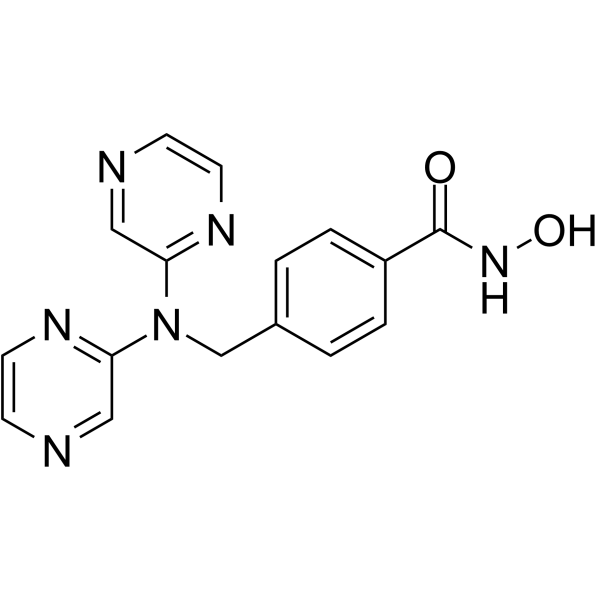
Physicochemical Properties
| Molecular Formula | C16H14N6O2 |
| Molecular Weight | 322.321362018585 |
| Exact Mass | 322.117 |
| CAS # | 1636894-46-6 |
| Related CAS # | KA2507 monohydrochloride;2972712-63-1 |
| PubChem CID | 117703516 |
| Appearance | White to light brown solid powder |
| LogP | 0.3 |
| Hydrogen Bond Donor Count | 2 |
| Hydrogen Bond Acceptor Count | 7 |
| Rotatable Bond Count | 5 |
| Heavy Atom Count | 24 |
| Complexity | 384 |
| Defined Atom Stereocenter Count | 0 |
| SMILES | O=C(C1C=CC(=CC=1)CN(C1C=NC=CN=1)C1C=NC=CN=1)NO |
| InChi Key | LXHMTDHBMRZSHJ-UHFFFAOYSA-N |
| InChi Code | InChI=1S/C16H14N6O2/c23-16(21-24)13-3-1-12(2-4-13)11-22(14-9-17-5-7-19-14)15-10-18-6-8-20-15/h1-10,24H,11H2,(H,21,23) |
| Chemical Name | 4-[[di(pyrazin-2-yl)amino]methyl]-N-hydroxybenzamide |
| HS Tariff Code | 2934.99.9001 |
| Storage |
Powder-20°C 3 years 4°C 2 years In solvent -80°C 6 months -20°C 1 month Note: This product requires protection from light (avoid light exposure) during transportation and storage. |
| Shipping Condition | Room temperature (This product is stable at ambient temperature for a few days during ordinary shipping and time spent in Customs) |
Biological Activity
| ln Vitro | In vitro growth of human or mouse cancer cells is not inhibited by KA2507 at dosages that specifically block HDAC6 [1]. |
| ln Vivo | KA2507 (100-200 mg/kg; oral; daily; for 20 days) suppresses tumor growth in the syngeneic B16-F10 mouse melanoma model [1]. KA2507 has shown anti-tumor activity in CT26 and MC38 colorectal cancer models [1]. Analysis of tumor samples also demonstrated modulation of anti-tumor immune biomarkers at effective doses, with KA2507 administration leading to reduced activation of STAT3 (measured by phosphorylated STAT3, an important suppressor of anti-tumor immune responses), reduced PD-L1 expression, decreased PD- L1 expression increases MHC class I expression [1]. KA2507 has poor oral bioavailability (15% in mice) and Cmax (300 ng/mL in mice) after oral treatment (200 mg/kg in mice) [1]. |
| Animal Protocol |
Animal/Disease Models: Male C57BL/6 mouse, B16-F10 melanoma model [1] Doses: 100 mg/kg, 200 mg/kg, 200 mg/kg Route of Administration: po (oral gavage), daily, for 20 days Experimental Results: Shows anti-tumor efficacy. Animal/Disease Models: Male C57BL/6 mice [1] Doses: 200 mg/kg (pharmacokinetic/PK/PK analysis) Route of Administration: Oral Experimental Results: Oral bioavailability (15%), Cmax (300 ng/mL). |
| References |
[1]. Preclinical Development and First-in-Human Study of KA2507, a Selective and Potent Inhibitor of Histone Deacetylase 6, for Patients with Refractory Solid Tumors. Clin Cancer Res. 2021 May 4. |
| Additional Infomation | HDAC6 Inhibitor KA2507 is an orally bioavailable inhibitor of histone deacetylase (HDAC) type 6 (HDAC6; HDAC-6), with potential antineoplastic activity. Upon administration, KA2507 targets, binds to and inhibits the activity of HDAC6. This results in an accumulation of highly acetylated chromatin histones, the induction of chromatin remodeling and an altered pattern of gene expression. Specifically, inhibition of HDAC6 prevents STAT3 activity, which leads to a reduction in programmed death-1 (PD-1) expression. Eventually, this results in a selective transcription of tumor suppressor genes, tumor suppressor protein-mediated inhibition of tumor cell division and an induction of apoptosis in tumor cells that overexpress HDAC6. HDAC6, which is upregulated in many tumor cell types, deacetylates chromatin histone proteins. |
Solubility Data
| Solubility (In Vitro) | DMSO : ~66.67 mg/mL (~206.84 mM) |
| Solubility (In Vivo) |
Solubility in Formulation 1: ≥ 2.08 mg/mL (6.45 mM) (saturation unknown) in 10% DMSO + 40% PEG300 + 5% Tween80 + 45% Saline (add these co-solvents sequentially from left to right, and one by one), clear solution. For example, if 1 mL of working solution is to be prepared, you can add 100 μL of 20.8 mg/mL clear DMSO stock solution to 400 μL PEG300 and mix evenly; then add 50 μL Tween-80 to the above solution and mix evenly; then add 450 μL normal saline to adjust the volume to 1 mL. Preparation of saline: Dissolve 0.9 g of sodium chloride in 100 mL ddH₂ O to obtain a clear solution. Solubility in Formulation 2: ≥ 2.08 mg/mL (6.45 mM) (saturation unknown) in 10% DMSO + 90% (20% SBE-β-CD in Saline) (add these co-solvents sequentially from left to right, and one by one), clear solution. For example, if 1 mL of working solution is to be prepared, you can add 100 μL of 20.8 mg/mL clear DMSO stock solution to 900 μL of 20% SBE-β-CD physiological saline solution and mix evenly. Preparation of 20% SBE-β-CD in Saline (4°C,1 week): Dissolve 2 g SBE-β-CD in 10 mL saline to obtain a clear solution. Solubility in Formulation 3: ≥ 2.08 mg/mL (6.45 mM) (saturation unknown) in 10% DMSO + 90% Corn Oil (add these co-solvents sequentially from left to right, and one by one), clear solution. For example, if 1 mL of working solution is to be prepared, you can add 100 μL of 20.8 mg/mL clear DMSO stock solution to 900 μL of corn oil and mix evenly. (Please use freshly prepared in vivo formulations for optimal results.) |
| Preparing Stock Solutions | 1 mg | 5 mg | 10 mg | |
| 1 mM | 3.1025 mL | 15.5125 mL | 31.0251 mL | |
| 5 mM | 0.6205 mL | 3.1025 mL | 6.2050 mL | |
| 10 mM | 0.3103 mL | 1.5513 mL | 3.1025 mL |