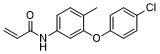
K-975 (K975) is the first covalent TEAD inhibitor that disrupt YAP/TAZ-TEAD protein-protein interaction, thus showing anticancer activity. K-975 acts by covalently binding to an internal cysteine residue located in the palmitate-binding pocket of TEAD.
Physicochemical Properties
| Molecular Formula | C16H14CLNO2 |
| Molecular Weight | 287.7409 |
| Exact Mass | 287.071 |
| CAS # | 2563855-03-6 |
| PubChem CID | 155353714 |
| Appearance | White to off-white solid powder |
| LogP | 4.2 |
| Hydrogen Bond Donor Count | 1 |
| Hydrogen Bond Acceptor Count | 2 |
| Rotatable Bond Count | 4 |
| Heavy Atom Count | 20 |
| Complexity | 339 |
| Defined Atom Stereocenter Count | 0 |
| SMILES | ClC1C([H])=C([H])C(=C([H])C=1[H])OC1C([H])=C(C([H])=C([H])C=1C([H])([H])[H])N([H])C(C([H])=C([H])[H])=O |
| InChi Key | KPXAHQSIROUBPH-UHFFFAOYSA-N |
| InChi Code | InChI=1S/C16H14ClNO2/c1-3-16(19)18-13-7-4-11(2)15(10-13)20-14-8-5-12(17)6-9-14/h3-10H,1H2,2H3,(H,18,19) |
| Chemical Name | N-[3-(4-chlorophenoxy)-4-methylphenyl]prop-2-enamide |
| HS Tariff Code | 2934.99.9001 |
| Storage |
Powder-20°C 3 years 4°C 2 years In solvent -80°C 6 months -20°C 1 month |
| Shipping Condition | Room temperature (This product is stable at ambient temperature for a few days during ordinary shipping and time spent in Customs) |
Biological Activity
| ln Vitro | Cell proliferation in malignant pleural mesothelioma (MPM) cell lines lacking NF2 is inhibited by K-975 (0.1–10,000 nM; 144 h) [1]. In NCI-H226 cells, the protein-protein interaction (PPI) between Halo-YAP and endogenous TEAD1/4 as well as Halo-TAZ and TEAD1/4 is inhibited by K-975 (10–10,000 nM; 24 hours) [1]. K-975 (0.1-10000 nM; 24 h) does not reduce reporter gene activity in NCI-H661/NRF2-Luc cells, but it significantly suppresses reporter gene activity in NCI-H661/CTGF-Luc cells, with a maximum inhibition of around 70%. [1]. In NCI-H226 cells, K-975 (1–10,000 nM; 24 hours) decreases the expression of NPPB, CTGF, and IGFBP3 mRNA and enhances the expression of FBXO32 mRNA [1]. |
| ln Vivo | K-975 (10-300 mg/kg; given orally twice daily for 14 days) reduces tumor growth by decreasing YAP1/TAZ-TEAD signaling in an MPM xenograft mice model [1]. |
| Cell Assay |
Cell proliferation experiment [1] Cell Types: MPM that does not express NF2 and malignant MPM that expresses NF2 Cell Tested Concentrations: 0.1, 1, 10, 100, 1000, 10000 nM Incubation Duration: 144 hrs (hours) Experimental Results: Strong inhibitory effect on NF2-non Expressing cell lines are higher than those expressing NF2. Inhibits the proliferation of MSTO-211H cells, an NF2-expressing cell line. Western Blot Analysis[1] Cell Types: NCI-H226 Cell Tested Concentrations: 10, 100, 1000, 10000 nM Incubation Duration: 24 hrs (hours) Experimental Results: TEAD1-YAP1 PPI and TEAD4-YAP1 PPI were inhibited. Inhibits TEAD1-TAZ PPI and TEAD4-TAZ PPI. |
| Animal Protocol |
Animal/Disease Models: Male SCID (severe combined immunodeficient) mouse (5 weeks) injected with NCI-H226 or MSTO-211H cells [1] Doses: 10, 30, 100, 300 mg/kg Route of Administration: Orally twice (two times) daily for 14 days Experimental Results: Performance Tumor effects in potent anti-MPM sc xenograft mouse models. diminished expression of CTGF, IGFBP3, and NPPB, and increased expression of FBXO32 in the NCI-H226 xenograft model. |
| References |
[1]. The novel potent TEAD inhibitor, K-975, inhibits YAP1/TAZ-TEAD protein-protein interactions and exerts an anti-tumor effect on malignant pleural mesothelioma. Am J Cancer Res. 2020 Dec 1;10(12):4399-4415. |
Solubility Data
| Solubility (In Vitro) | DMSO : ~220 mg/mL (~764.58 mM) |
| Solubility (In Vivo) |
Solubility in Formulation 1: 5.5 mg/mL (19.11 mM) in 10% DMSO + 40% PEG300 + 5% Tween80 + 45% Saline (add these co-solvents sequentially from left to right, and one by one), suspension solution; with sonication. For example, if 1 mL of working solution is to be prepared, you can add 100 μL of 55.0 mg/mL clear DMSO stock solution to 400 μL PEG300 and mix evenly; then add 50 μL Tween-80 to the above solution and mix evenly; then add 450 μL normal saline to adjust the volume to 1 mL. Preparation of saline: Dissolve 0.9 g of sodium chloride in 100 mL ddH₂ O to obtain a clear solution. Solubility in Formulation 2: ≥ 5.5 mg/mL (19.11 mM) (saturation unknown) in 10% DMSO + 90% (20% SBE-β-CD in Saline) (add these co-solvents sequentially from left to right, and one by one), clear solution. For example, if 1 mL of working solution is to be prepared, you can add 100 μL of 55.0 mg/mL clear DMSO stock solution to 900 μL of 20% SBE-β-CD physiological saline solution and mix evenly. Preparation of 20% SBE-β-CD in Saline (4°C,1 week): Dissolve 2 g SBE-β-CD in 10 mL saline to obtain a clear solution. Solubility in Formulation 3: ≥ 5.5 mg/mL (19.11 mM) (saturation unknown) in 10% DMSO + 90% Corn Oil (add these co-solvents sequentially from left to right, and one by one), clear solution. For example, if 1 mL of working solution is to be prepared, you can add 100 μL of 55.0 mg/mL clear DMSO stock solution to 900 μL of corn oil and mix evenly. (Please use freshly prepared in vivo formulations for optimal results.) |
| Preparing Stock Solutions | 1 mg | 5 mg | 10 mg | |
| 1 mM | 3.4754 mL | 17.3768 mL | 34.7536 mL | |
| 5 mM | 0.6951 mL | 3.4754 mL | 6.9507 mL | |
| 10 mM | 0.3475 mL | 1.7377 mL | 3.4754 mL |