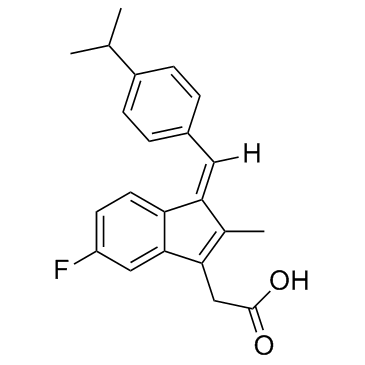
Physicochemical Properties
| Molecular Formula | C22H21FO2 |
| Molecular Weight | 336.399349927902 |
| Exact Mass | 336.152 |
| Elemental Analysis | C, 78.55; H, 6.29; F, 5.65; O, 9.51 |
| CAS # | 1292821-90-9 |
| Related CAS # | 1292821-90-9 |
| PubChem CID | 46224594 |
| Appearance | Light yellow to yellow solid powder |
| Density | 1.2±0.1 g/cm3 |
| Boiling Point | 491.6±40.0 °C at 760 mmHg |
| Flash Point | 251.1±27.3 °C |
| Vapour Pressure | 0.0±1.3 mmHg at 25°C |
| Index of Refraction | 1.615 |
| LogP | 6.6 |
| Hydrogen Bond Donor Count | 1 |
| Hydrogen Bond Acceptor Count | 3 |
| Rotatable Bond Count | 4 |
| Heavy Atom Count | 25 |
| Complexity | 567 |
| Defined Atom Stereocenter Count | 0 |
| SMILES | C1(=C/C2=CC=C(C(C)C)C=C2)/C2=C(C=C(F)C=C2)C(CC(O)=O)=C/1C |
| InChi Key | QCXBVGNDRYQVJO-GRSHGNNSSA-N |
| InChi Code | InChI=1S/C22H21FO2/c1-13(2)16-6-4-15(5-7-16)10-19-14(3)20(12-22(24)25)21-11-17(23)8-9-18(19)21/h4-11,13H,12H2,1-3H3,(H,24,25)/b19-10- |
| Chemical Name | 1H-Indene-3-acetic acid, 5-fluoro-2-methyl-1-((4-(1-methylethyl)phenyl)methylene)-, (1Z)- |
| Synonyms | K 80003; K-80003; K80003 |
| HS Tariff Code | 2934.99.9001 |
| Storage |
Powder-20°C 3 years 4°C 2 years In solvent -80°C 6 months -20°C 1 month |
| Shipping Condition | Room temperature (This product is stable at ambient temperature for a few days during ordinary shipping and time spent in Customs) |
Biological Activity
| Targets | Akt |
| ln Vitro | K-80003 inhibits TNF-induced colocalization of tRXRα with p85α in the cytoplasm, leading to tRXRα nuclear localization, in MCF-7 cells. Western blotting demonstrates that the tRXRα monomer is distributed in both the nuclear and cytoplasmic fractions while the K-80003-stabilized tetrameric form of tRXRα is only found in the nuclear fraction[2]. |
| ln Vivo | K-80003 is a potent inhibitor of AKT activation by all-trans-retinoic acid. Inhibiting tRXRα-dependent AKT activation and tRXRα tumor growth in animals with K-80003 shows improved efficacy. Despite lacking COX inhibitory activity, K-80003 has a high affinity for RXRα[1]. |
| Cell Assay | K-80003 (5 μM) is pretreated with or without for 3 hours before TNF (10 ng/mL) is applied to MCF-7 cells that have been cotransfected with Myc-RXRα, Myc-tRXRα, tRXRα/L433D and p85α. Anti-Myc and anti-p85α antibodies are used to stain the cells, and confocal microscopy is used to determine where in the cell they are located. K-80003 (5 μM) is administered to or left untreated for 6 hours to HEK293T cells that have been cotransfected with Myc-tRXRα . By using an anti-Myc antibody and western blotting to analyze the nuclear (N) and cytoplasmic (C) fractions after BS3 crosslinking. Examining the expression of cytoplasmic -tubulin and nuclear PARP in non-crosslinked fractions allows one to determine the purity of the fractions. The first of three related experiments is displayed[2]. |
| Animal Protocol | Mice[1]: Subcutaneous injection of 100 L of cells (2106) is performed on naked mice (BALB/c, 4-5 weeks old). Mice (n=6) are given intraperitoneal injections of K-80003, Sulindac, or corn oil once every other day (total of six injections) for a period of seven days following transplantation. Every 4 days, measurements are made of the body weight and tumor sizes. |
| References |
[1]. NSAID sulindac and its analog bind RXRalpha and inhibit RXRalpha-dependent AKT signaling. Cancer Cell. 2010 Jun 15;17(6):560-73. [2]. Modulation of nongenomic activation of PI3K signalling by tetramerization of N-terminally-cleaved RXRα. Nat Commun. 2017 Jul 17;8:16066. |
| Additional Infomation | [5-fluoro-1-(4-isopropylbenzylidene)-2-methylinden-3-yl]acetic acid is a sulindac-based non-steroidal anti-inflammatory drug. It has a role as a non-steroidal anti-inflammatory drug. It is functionally related to an acetic acid. |
Solubility Data
| Solubility (In Vitro) | DMSO: ~30 mg/mL (89.2 mM) |
| Solubility (In Vivo) |
Solubility in Formulation 1: ≥ 3 mg/mL (8.92 mM) (saturation unknown) in 10% DMSO + 40% PEG300 +5% Tween-80 + 45% Saline (add these co-solvents sequentially from left to right, and one by one), clear solution. For example, if 1 mL of working solution is to be prepared, you can add 100 μL of 30.0 mg/mL clear DMSO stock solution to 400 μL PEG300 and mix evenly; then add 50 μL Tween-80 + to the above solution and mix evenly; then add 450 μL normal saline to adjust the volume to 1 mL. Preparation of saline: Dissolve 0.9 g of sodium chloride in 100 mL ddH₂ O to obtain a clear solution. (Please use freshly prepared in vivo formulations for optimal results.) |
| Preparing Stock Solutions | 1 mg | 5 mg | 10 mg | |
| 1 mM | 2.9727 mL | 14.8633 mL | 29.7265 mL | |
| 5 mM | 0.5945 mL | 2.9727 mL | 5.9453 mL | |
| 10 mM | 0.2973 mL | 1.4863 mL | 2.9727 mL |