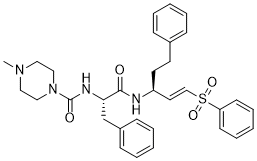
K-11777 (APC-3316; K-777) is a novel, orally bioactive and irreversible cysteine protease inhibitor as well as a selective CCR4 antagonist with anticancer and antiviral activity. K777 irreversibly inhibits Cruzain which is the major cysteine protease of Trypansoma cruzi, and cathepsins B and L. Thus, K777 has a broad-spectrum antiviral activity by targeting cathepsin-mediated cell entry. K777 also inhibits SARS-CoV and EBOV pseudovirus entry with IC50 values of 0.68 nM and 0.87 nM, respectively.
Physicochemical Properties
| Molecular Formula | C32H38N4O4S |
| Molecular Weight | 574.73352 |
| Exact Mass | 574.261 |
| CAS # | 233277-99-1 |
| Related CAS # | 502960-90-9; |
| PubChem CID | 9851116 |
| Appearance | White to off-white solid powder |
| LogP | 4.1 |
| Hydrogen Bond Donor Count | 2 |
| Hydrogen Bond Acceptor Count | 5 |
| Rotatable Bond Count | 11 |
| Heavy Atom Count | 41 |
| Complexity | 939 |
| Defined Atom Stereocenter Count | 2 |
| SMILES | CN1CCN(CC1)C(=O)NC(CC2=CC=CC=C2)C(=O)NC(CCC3=CC=CC=C3)C=CS(=O)(=O)C4=CC=CC=C4 |
| InChi Key | RHJLQMVZXQKJKB-FPHSVDBKSA-N |
| InChi Code | InChI=1S/C32H38N4O4S/c1-35-20-22-36(23-21-35)32(38)34-30(25-27-13-7-3-8-14-27)31(37)33-28(18-17-26-11-5-2-6-12-26)19-24-41(39,40)29-15-9-4-10-16-29/h2-16,19,24,28,30H,17-18,20-23,25H2,1H3,(H,33,37)(H,34,38)/b24-19+/t28-,30-/m0/s1 |
| Chemical Name | N-[(2S)-1-[[(E,3S)-1-(benzenesulfonyl)-5-phenylpent-1-en-3-yl]amino]-1-oxo-3-phenylpropan-2-yl]-4-methylpiperazine-1-carboxamide |
| Synonyms | APC 3316 K-11777 K-777APC3316 K11777 K777APC-3316 |
| HS Tariff Code | 2934.99.9001 |
| Storage |
Powder-20°C 3 years 4°C 2 years In solvent -80°C 6 months -20°C 1 month |
| Shipping Condition | Room temperature (This product is stable at ambient temperature for a few days during ordinary shipping and time spent in Customs) |
Biological Activity
| ln Vitro | K777 (K11777) can block entry caused by various viral envelope proteins, such as filoviruses (Glycoproteins of EBOV, SUDV, TAFV, RESTV), BEBOV, and MARV, or HIV-based pseudotyped viruses with coronavirus spikes (SARS-CoV, HCoV-229E, NL63, and MERS-CoV). K777, with IC50 values of 0.68 nM, 1.48 nM, 6.78 nM, 46.12 nM, and so on, blocks the entry of SARS-CoV, HCoV-229E, NL63, MERS-CoV, EBOV, SUDV, TAFV, RESTV, BEBOV, MARV, and Nipah pseudovirus. 1,14, 2.26, 3.37, 5.91, 1.9, 0.42, 1.87, and 2.26 nM. On the other hand, alphavirus (CHIKV), rhabdovirus (VSV), flavivirus (HCV), retroviruses MLV-A and XMRV, and two arenaviruses, Lassa virus and Junin virus, were not inhibited by 100 nM K777. glycoprotein-mediated membrane infection [1]. K777 by itself demonstrated a 70% reduction in 229E-mediated transduction. When K777 and camostat were used together, the inhibition rate rose to almost 90%. The human intestinal epithelial cell line Caco-2, which expresses endogenous TMPRSS2 and cathepsins, was used to generate a comparable pattern of inhibition [1]. In Hut78 cells, K777 reduces both CCL17-induced chemotaxis and CCL17 binding (IC50 57 nM and 8.9 nM, respectively). K777-mediated chemotaxis inhibition was still effective even when CCL17 concentrations were ten times greater. K777 decreases cell surface CCR4 by around 50% and causes CCR4 internalization. K777 does not inherently trigger Ca2+ mobilization, nor does it block CXCR4-induced chemotaxis or internalization [3]. |
| ln Vivo | K777 (K11777; 35-105 mg/kg; oral dose; twice daily; for 10 days; C57BL/6 IFN-γR-KO mice) therapy protected mice from otherwise deadly infections [4]. |
| Animal Protocol |
Animal/Disease Models: C57BL/6 IFN-γR-KO mice (6-8 weeks of age) injected with Cryptosporidium parvum[4] Doses: 35 mg/kg, 70 mg/kg, and 105 mg/kg Route of Administration: Oral administration; twice a day; for 10 days Experimental Results: Rescued mice from otherwise lethal infections. |
| ADME/Pharmacokinetics |
Metabolism / Metabolites K-11777 has known human metabolites that include N-desmethyl k-11777, N-oxide k-11777, and b-hydroxy-homoPhe K11777. |
| References |
[1]. Protease inhibitors targeting coronavirus and filovirus entry. Antiviral Res. 2015 Apr;116:76-84. [2]. In vitro evaluation of the disposition of A novel cysteine protease inhibitor. Drug Metab Dispos. 2000 Nov;28(11):1343-51. [3]. Internalization of CCR4 and inhibition of chemotaxis by K777, a potent and selective CCR4 antagonist. Pharmacology. 2013;91(5-6):305-13. [4]. A cysteine protease inhibitor rescues mice from a lethal Cryptosporidium parvum infection. Antimicrob Agents Chemother. 2013 Dec;57(12):6063-73. |
Solubility Data
| Solubility (In Vitro) | DMSO : ~100 mg/mL (~173.99 mM) |
| Solubility (In Vivo) |
Solubility in Formulation 1: ≥ 2.5 mg/mL (4.35 mM) (saturation unknown) in 10% DMSO + 40% PEG300 + 5% Tween80 + 45% Saline (add these co-solvents sequentially from left to right, and one by one), clear solution. For example, if 1 mL of working solution is to be prepared, you can add 100 μL of 25.0 mg/mL clear DMSO stock solution to 400 μL PEG300 and mix evenly; then add 50 μL Tween-80 to the above solution and mix evenly; then add 450 μL normal saline to adjust the volume to 1 mL. Preparation of saline: Dissolve 0.9 g of sodium chloride in 100 mL ddH₂ O to obtain a clear solution. Solubility in Formulation 2: ≥ 2.5 mg/mL (4.35 mM) (saturation unknown) in 10% DMSO + 90% (20% SBE-β-CD in Saline) (add these co-solvents sequentially from left to right, and one by one), clear solution. For example, if 1 mL of working solution is to be prepared, you can add 100 μL of 25.0 mg/mL clear DMSO stock solution to 900 μL of 20% SBE-β-CD physiological saline solution and mix evenly. Preparation of 20% SBE-β-CD in Saline (4°C,1 week): Dissolve 2 g SBE-β-CD in 10 mL saline to obtain a clear solution. Solubility in Formulation 3: ≥ 2.5 mg/mL (4.35 mM) (saturation unknown) in 10% DMSO + 90% Corn Oil (add these co-solvents sequentially from left to right, and one by one), clear solution. For example, if 1 mL of working solution is to be prepared, you can add 100 μL of 25.0 mg/mL clear DMSO stock solution to 900 μL of corn oil and mix evenly. (Please use freshly prepared in vivo formulations for optimal results.) |
| Preparing Stock Solutions | 1 mg | 5 mg | 10 mg | |
| 1 mM | 1.7399 mL | 8.6997 mL | 17.3995 mL | |
| 5 mM | 0.3480 mL | 1.7399 mL | 3.4799 mL | |
| 10 mM | 0.1740 mL | 0.8700 mL | 1.7399 mL |